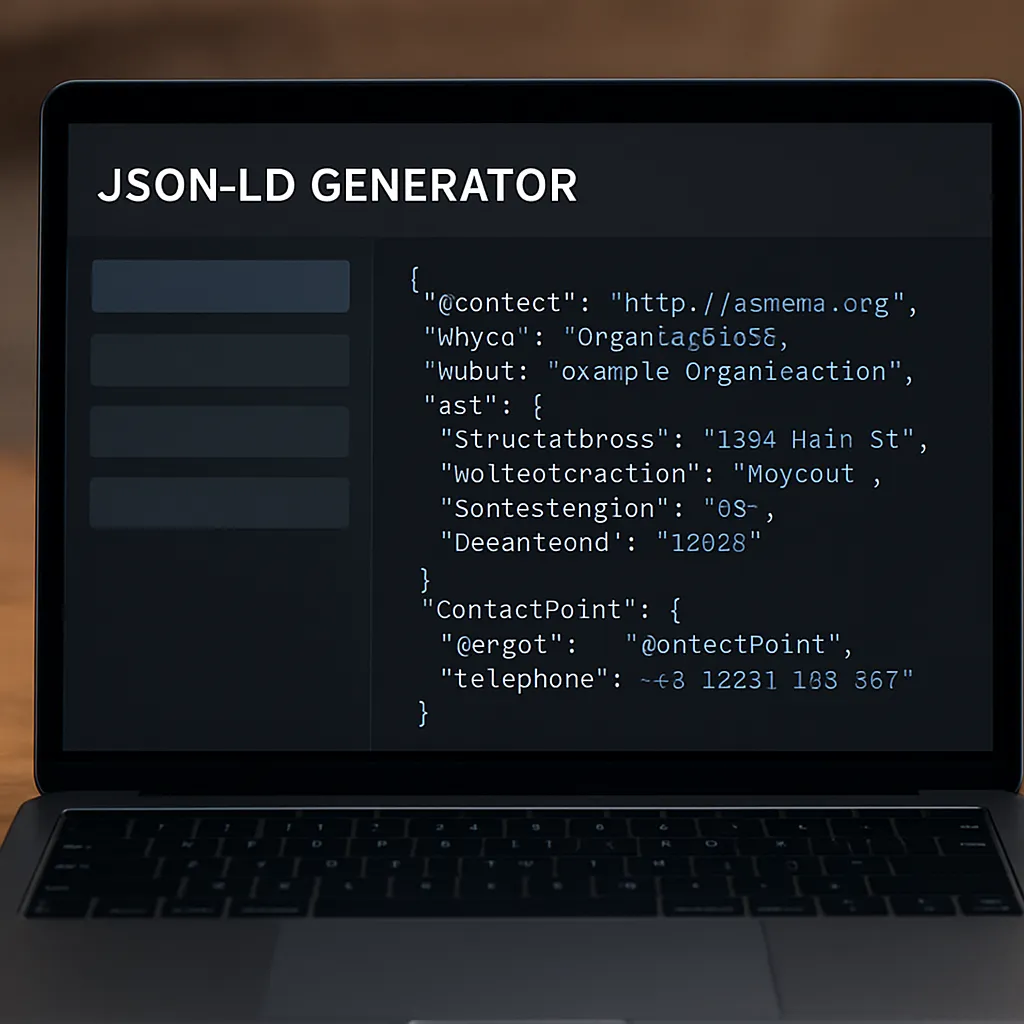
JSON-LD Generator
A JSON-LD Generator is a practical shortcut for anyone who wants to add precise, machine-readable meaning to web pages without hand-coding every property. For marketers and developers alike, it turns complex Schema.org vocabularies into copy‑and‑paste snippets that search engines can understand. Used well, it improves the way content is interpreted, elevates eligibility for enhanced search features, and streamlines technical tasks that otherwise eat time. In the context of SEO, the draw is obvious: faster implementation, fewer errors, and clearer entity relationships. In the context of content operations, it provides guardrails and repeatability. Whether you’re running a blog, a local directory, a product catalog, or a news site, a robust JSON-LD Generator helps you ship high-quality schema markup at scale.
What a JSON-LD Generator Actually Is
A JSON-LD Generator is a tool—often a web app, CMS plugin, or API—that collects content details in a guided form and outputs a ready-to-embed script of Schema.org markup. JSON-LD (JavaScript Object Notation for Linked Data) is a format that lets you express entities—organizations, people, products, articles, events—and their relationships using keys, values, and links. The “generator” piece does three jobs: it abstracts technical syntax, normalizes data into the correct properties, and provides optional checks to ensure the result conforms to search engine guidelines.
There are several flavors of generators:
- Form-based generators where you select a type (e.g., Product, Organization, Article) and fill out labeled fields that map to Schema.org properties.
- CMS plugins (for WordPress, Shopify, headless CMSs) that build templates and auto-fill properties from your content database.
- Programmatic generators (libraries and APIs) that accept raw data and return JSON-LD objects, often used in pipelines or CI/CD.
- Hybrid tools that pair UI templates with bulk import/export, enabling large-scale updates across thousands of pages.
The best generators reduce friction across teams: content editors can add details without memorizing vocabularies, while developers retain control through templates, governance, and versioning. In short, a generator translates your content model into consistent JSON-LD across the site.
Why JSON-LD Matters for SEO and How a Generator Helps
Search engines reward clarity. When your page tells them exactly what an entity is, which attributes it has, and how it relates to other entities, they can serve the right search features to the right audience. JSON-LD is the recommended way to provide that clarity. A generator strengthens the process by making it fast, consistent, and auditable.
Benefits tied to discoverability and performance
- Enhanced eligibility for search features. With proper markup, pages may show as carousels, FAQs, how-to steps, breadcrumbs, products with price and availability, event dates, and more. These are often referred to as rich results.
- Disambiguation and entity linkage. Markup helps search engines understand people, places, organizations, and products—even when names are ambiguous—by anchoring them with identifiers and relationships. This improves alignment with the Knowledge Graph.
- Improved content quality signals. While structured data is not a direct ranking factor, it can contribute to better click-through rates, clearer indexing, and a more robust footprint in search features. This indirectly supports measurable SEO goals.
- Consistency at scale. A generator imposes standards so that product A and product B expose the same properties, in the same formats, across thousands of pages.
Note that JSON-LD does not guarantee a search feature; it establishes eligibility and helps engines interpret your page. Real-world impact often shows up as improved CTR, more real estate in results, and better alignment of query intent to your content.
How JSON-LD Generators Work Under the Hood
Although each tool has its UI quirks, most share a similar flow:
- You select a Schema.org type (Article, BlogPosting, Product, Organization, LocalBusiness, Event, FAQPage, VideoObject, JobPosting, HowTo, etc.).
- The generator presents required and recommended fields (e.g., name, description, url, image) and advanced options (e.g., offers, aggregateRating, review, author).
- It guides formats for dates (ISO 8601), prices and currencies (ISO 4217), availability, GTINs, SKUs, contact points, and language codes.
- It safeguards against common mistakes: missing required fields, illegal types for a property, or values that violate guidelines.
- It outputs a single or multi-object script, sometimes wrapped in an @graph so multiple entities (WebPage, Article, Organization, BreadcrumbList) can be declared together.
High-end generators add templating, bulk operations, and validation pipelines so you automatically stamp every page in a section with a consistent model. They can also connect to your content repository and build markup on the fly as you publish, which supports continuous delivery of compliant structured data.
Core Use Cases: What to Generate and When
Not every page needs every type of markup. Instead, align types to content intent and user needs.
Foundational types for most sites
- Organization: Identity, logo, legal name, contact points, social profiles (via sameAs), and identifiers for disambiguation.
- WebSite + SearchAction: Helps expose a sitelinks search box for branded queries.
- WebPage: Useful for signaling page-level details, including primary image, inLanguage, and references to the main entity.
- BreadcrumbList: Communicates site hierarchy and may produce navigational breadcrumbs on result pages.
Content-specific types
- Article/NewsArticle/BlogPosting: For editorial content; include headline, datePublished, dateModified, author, image, and mainEntityOfPage.
- FAQPage: For frequently asked questions; ensure each Q/A pair is visible on the page and matches the markup exactly.
- HowTo: For step-by-step instructions; include steps, tools, supplies, time and cost if relevant.
- VideoObject: For video content; include duration, uploadDate, description, and a static preview image.
Commerce and local presence
- Product + Offer + AggregateRating + Review: For product detail pages; include price, priceCurrency, availability, condition, and merchant-specific identifiers. Ensure reviews markup is tied to first-party reviews if applicable.
- LocalBusiness subtypes (Restaurant, MedicalClinic, Store, etc.): Include address, geo, openingHoursSpecification, telephone, and menu/reservation links if relevant.
- Event: For performances, webinars, and meetups; include startDate, endDate, location, offers, and eventStatus.
Recruiting and careers
- JobPosting: Include title, hiringOrganization, jobLocation, datePosted, validThrough, employmentType, and application instructions.
A generator makes these types approachable by surfacing the correct fields and encoding rules for each use case, reducing the likelihood of invalid markup or guideline violations.
Implementation Patterns and Best Practices
Good JSON-LD is accurate, consistent with visible content, and easy to maintain. The following practices help you get there:
- Embed markup in a script tag with type application/ld+json, ideally server-rendered so it’s available on first load.
- Keep visible content and markup synchronized; do not claim properties that the user cannot verify on the page.
- Use canonical URLs for url and @id to avoid duplication and ambiguity.
- Link entities via sameAs to authoritative profiles (e.g., Wikipedia, Wikidata, official social channels) when appropriate.
- Use @graph to bundle related entities (WebPage, Article, Organization, BreadcrumbList) in a single script for clarity and performance.
- Normalize data formats: ISO 8601 for dates, ISO 4217 for currencies, hyphenated language codes (e.g., en-US).
- Keep images high quality and accessible at stable URLs; some search features require minimum dimensions.
- Version your templates; treat structured data like code with reviews, staging, and rollbacks.
Generators excel at enforcing these conventions, especially when integrated with CMS templates or build steps that prevent regressions before they ship.
Common Mistakes and How a Generator Reduces Risk
Structured data breaks for surprisingly small reasons. A generator can catch many of them before they reach production:
- Required properties omitted: e.g., priceCurrency missing alongside price for an Offer.
- Type mismatches: numbers provided as strings, arrays where single values are expected, or vice versa.
- Inconsistent identities: multiple versions of Organization with different names/logos across templates.
- Conflicting reviews: pulled from third parties without permission, or applied to non-eligible pages.
- Event dates in the wrong format or missing time zones.
- FAQ markup on pages where Q/A content is not actually visible to users.
- Over-markup: adding types or properties that do not match page intent, which can lead to manual actions.
With presets, guardrails, and checks, a generator eliminates a large slice of human error and keeps your markup aligned with current policies.
Validation, Monitoring, and Maintenance
A disciplined process is as important as the markup itself. Pair your generator with robust validation and ongoing monitoring:
- Run every change through a structured data validator and a rich results tester before deployment.
- Track warnings and errors in search engine consoles under Enhancements and use exportable reports to triage issues.
- Maintain a changelog for markup templates so you can audit the impact of adjustments on impressions and CTR.
- Schedule periodic re-validation across key page templates to catch silent regressions introduced by content or CMS changes.
For larger properties, connect validation into CI/CD: commits that affect templates should trigger automated checks to prevent bad data from hitting production.
Does a JSON-LD Generator Really Help SEO?
Short answer: yes, in the ways that matter operationally and commercially. A generator reduces the effort and error rate of producing consistent structured data, which makes your pages eligible for more features and can increase click-through rates. Over time, it helps search engines better understand how your site is organized and what each page represents. That combination supports the broader goals of organic traffic growth, content clarity, and brand presence.
But it’s not a magic lever. A generator doesn’t replace content quality, site performance, or robust internal linking. It amplifies strong fundamentals. Think of it as an accelerator: the more coherent your content model, the more a generator turns that coherence into search-friendly signals. On thin or misaligned content, the lift will be modest. On well-structured catalogs, knowledge bases, and editorial operations, the lift can be significant and measurable.
Choosing the Right JSON-LD Generator
Selection comes down to fit and governance. Evaluate tools along these axes:
- Coverage of Schema.org types you actually need, plus the ability to add custom extensions when standards evolve.
- Templating power: reusable components, conditional logic, and support for @graph to keep complex pages tidy.
- Integration: direct hooks into your CMS or product database to populate fields automatically and avoid manual data entry.
- Bulk operations: import/export via CSV, JSON, or API for large catalogs.
- Workflow: roles, approvals, and staging so changes are reviewed before publishing.
- Performance: minimal overhead and server-side rendering options to ensure scripts are available at first paint.
- Internationalization: per-locale values for inLanguage, currency, measurements, and multi-regional data variations.
- Security and privacy: encryption for sensitive fields, access controls, and compliance with data policies.
- Documentation and support cadence: frequent updates aligned with search engine guideline changes.
For small teams, a simple UI generator with copy‑paste output may suffice. For enterprises, an API-first tool with templating, governance, and observability is more suitable.
Workflow: From Audit to Deployment
A clear workflow ensures markup sustains quality over time:
- Audit: inventory your page types, the entities they represent, and the search features you want to target.
- Model: map each page type to a primary schema and related entities; specify required and recommended properties.
- Template: build generator templates with default values, computed fields, and conditional logic.
- Populate: connect to your CMS or product data so values update automatically when content changes.
- Validate: run automated and manual checks; fix errors before release.
- Deploy: roll out progressively; monitor logs and enhancement reports.
- Measure: track impressions, CTR, and revenue impacts tied to rich features; compare pre/post deployment windows.
- Iterate: refine templates based on errors, warnings, and performance outcomes.
Advanced Strategies for Power Users
Once the basics are in place, generators can support deeper gains:
- Entity IDs (@id): use stable, canonical identifiers for key entities to unify references across the site.
- sameAs curation: link to authoritative sources that disambiguate your brand, products, or people, improving entity understanding.
- Multi-language: ensure content variants carry correct inLanguage and localized values for names, descriptions, prices, and availability.
- Additional context: use additionalType for domain-specific nuance when Schema.org’s base types are too broad.
- Pagination: denote primary entities on paginated series and avoid duplicating conflicting offers or reviews across pages.
- Dynamic catalogs: generate Offers from live inventory feeds; sync price and availability to reduce stale data warnings.
- @graph orchestration: represent complex pages (e.g., a WebPage about a Product sold by an Organization) coherently in one script.
Performance, Rendering, and Technical Considerations
How you deliver JSON-LD matters. Prefer server-rendered scripts that arrive with the HTML; this minimizes reliance on client rendering and avoids race conditions. Keep scripts concise and avoid duplicating entities across multiple scripts on the same page. Where Single Page Applications are used, ensure pre-rendering or hydration exposes JSON-LD consistently. Validate that content and markup stay synchronized during client transitions to prevent mismatches.
For high-traffic sites, treat markup like any other asset: measure its size, cache behavior, and effect on TTFB. While JSON-LD is small compared to images and JS bundles, efficiency habits still apply.
Opinions: Strengths, Limitations, and When to Hand-Code
On balance, a JSON-LD Generator is one of the most cost-effective tools in a search team’s stack. It delivers time savings and consistency, two things that quietly compound. It also democratizes structured data: editorial and merchandising teams can participate, rather than routing every change through developers.
Limitations exist. Edge cases sometimes outpace what a UI can express; novel schema combinations or experimental properties may require custom objects. Very small sites may not need more than a one-time, hand-coded setup. And any tool can become a crutch if teams stop thinking critically about page intent and eligibility rules.
Still, once a site reaches dozens of templates or thousands of URLs, the benefits become undeniable. The right generator lets you codify standards, accelerate iteration, and reduce the mental overhead of remembering every property and constraint. For teams serious about content velocity and SERP presence, it’s a pragmatic investment.
Automation, Scale, and Governance
At scale, the duo of automation and governance is decisive. Tie your generator to the content model so values populate from authoritative sources. Enforce naming, URL, and image rules. Gate changes with code reviews and automated checks. Use feature flags and canary releases for template updates. Document business rules: which templates get which types, and under what conditions. Centralize ownership so someone is accountable for updates when guidelines change.
When your catalog spans multiple brands, regions, or languages, central governance maintains coherence while local teams retain control over content. This is how you achieve true scalability without sacrificing quality.
Impact Beyond Search: Analytics, Accessibility, and Interoperability
Structured data isn’t just for search engines. Analytics platforms can align events and product catalogs more cleanly when entities are modeled consistently. Syndication becomes simpler because partners can parse your metadata without guesswork. Even internal search and recommendations improve when entities are clearly defined. While not a substitute for accessibility, well-modeled entities often correlate with clearer content structures and better internal discipline.
Reality Check: What Results to Expect
Reasonable outcomes after adopting a generator include higher eligibility for rich features, steady declines in structured data errors, and CTR lifts on pages that earn enhanced appearances. The magnitude depends on how aligned your content is with supported features, and how competitive your SERPs are. You should also expect smoother collaboration between content and engineering, fewer rollbacks caused by invalid markup, and faster iteration when guidelines evolve.
Frequently Raised Questions
Is JSON-LD a ranking factor?
No direct boost, but it influences how pages are displayed, which affects CTR and downstream engagement—key inputs to organic performance.
Head or body placement?
Either is acceptable; ensure the script is available to crawlers at initial load. Server-rendering is recommended.
Multiple scripts or one @graph?
Both work. A single @graph lowers duplication and keeps relationships explicit, which can simplify maintenance.
Do I need a generator if I can code?
If your site is small and static, hand-coding can be fine. As soon as templates multiply or data changes frequently, a generator pays dividends.
Conclusion: A Practical Lever for Better Understanding
A JSON-LD Generator turns the abstract promise of structured data into a practical, repeatable workflow. It reduces friction, enforces standards, and aligns teams on the details that search engines care about. Used with discipline and paired with strong content, it elevates eligibility for search enhancements and clarifies your entity footprint on the web. No tool guarantees outcomes, but few deliver such favorable odds-to-effort ratios. Invest in the process—model your entities, validate continuously, and maintain parity with visible content—and the generator will amplify your results.
Finally, remember that structured data is a complement to fundamentals: fast pages, relevant and original information, and a site architecture that supports discovery. Combined, those elements enhance crawlability, comprehension, and user trust—the bedrock on which sustainable search performance is built.