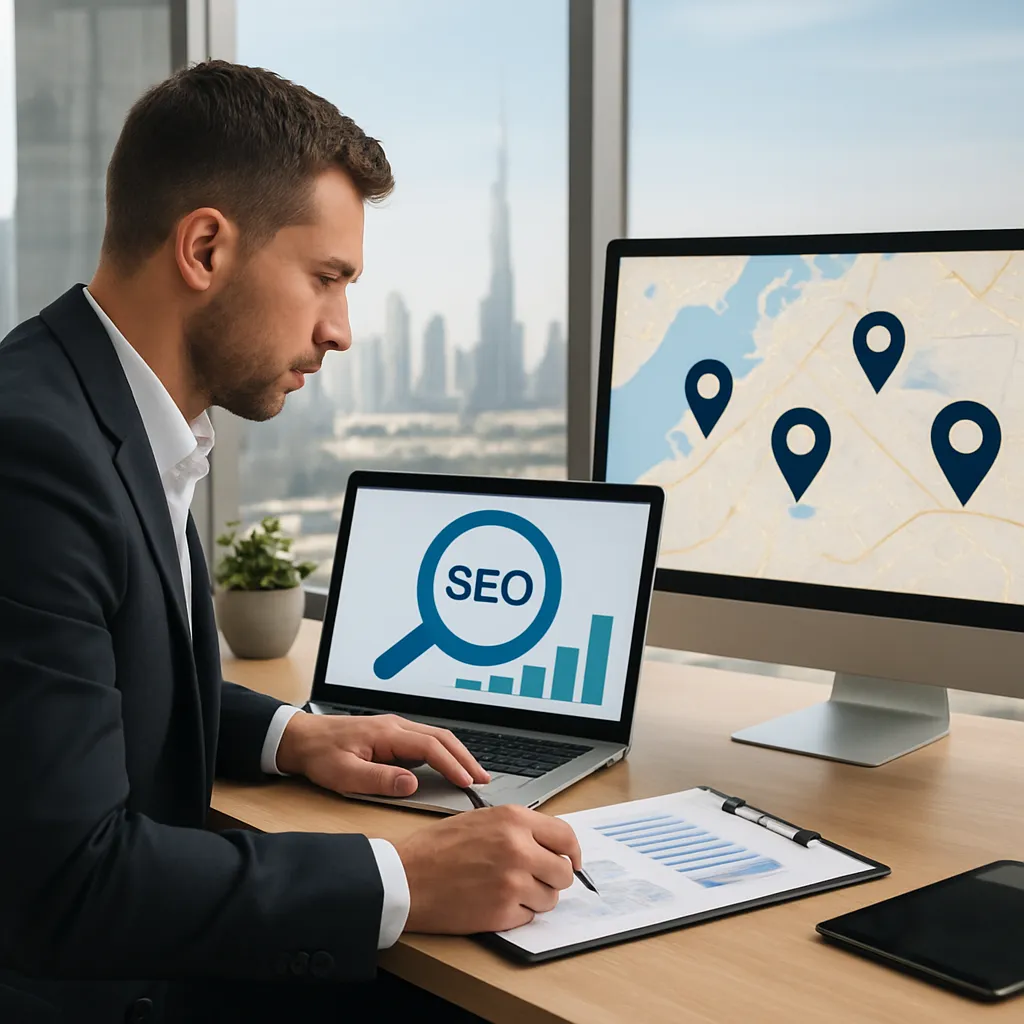
How to Manage SEO for Multiple Dubai Locations
Managing SEO for multiple locations within Dubai is both a technical and strategic challenge. The city’s rapid growth, multicultural population, and highly competitive service sectors mean that businesses need a precise, localized approach if they want to rank for searches like “dentist in JLT” or “gym in Business Bay” instead of competing only on broad, generic terms. Multi‑location SEO in Dubai is about combining classic search engine optimization with deep knowledge of neighbourhoods, user intent, and the regulatory and cultural specifics of the UAE market.
Understanding the specifics of multi‑location SEO in Dubai
Dubai is not just one homogeneous market. For SEO purposes, it functions more like a collection of micro‑markets: Dubai Marina, Jumeirah, Deira, Bur Dubai, Business Bay, Jumeirah Lakes Towers (JLT), Dubai Silicon Oasis, Al Barsha, Downtown, and many others. Each cluster has its own demographic profile, search behaviours, and local competition. Optimizing for these micro‑markets is essential if you want to capture high‑intent searches such as “ladies salon Dubai Marina” or “accounting firm Al Barsha”.
According to various regional digital marketing studies, the UAE has one of the highest internet penetration rates in the world, exceeding 99%. Mobile usage dominates: more than 90% of internet users access search engines primarily via smartphones. For local queries, this is even more pronounced. Users searching for nearby restaurants, clinics, or real‑estate offices frequently rely on Google Maps, voice search on mobile, and location‑aware apps. That means **local SEO** signals, especially for multiple business locations, can make or break your visibility.
Multi‑location SEO is more complex than promoting a single address. It involves managing multiple Google Business Profiles, ensuring accurate NAP (Name, Address, Phone) data across hundreds of local listings, and building location‑specific landing pages that avoid duplicate content. In Dubai you also need to consider language preferences: large segments of residents search in English, but there is a significant share of Arabic searches, alongside South Asian languages. Even if you focus on English only, many queries blend transliterated Arabic and English, such as “shisha cafe Jumeirah” or “muroor fine payment Dubai”, which influences your keyword strategy.
For sectors like hospitality, retail, clinics, beauty, gyms, and professional services, search results in Dubai are packed with ads, aggregator platforms, and large brands with strong domain authority. Smaller and mid‑sized companies with multiple outlets must therefore rely on very careful **keyword research**, technical **on‑page optimization**, and strong **local citations** to compete in organic rankings.
Building an effective multi‑location SEO structure
To manage SEO for multiple Dubai locations effectively, you first need a scalable website structure. A well‑planned architecture allows search engines to understand which locations you serve, which pages correspond to which branches, and how your services differ across neighbourhoods. Without this, your brand may rank for general branded terms, but you will miss many high‑intent, local searches.
Designing a scalable URL and content architecture
The starting point is a clear hierarchy of location pages. Instead of a single “Contact” page listing all branches, create dedicated landing pages for each area. For example:
- example.com/dubai/dubai-marina/
- example.com/dubai/jlt/
- example.com/dubai/business-bay/
- example.com/dubai/al-barsha/
For businesses with many outlets, you can group pages by district or service type. The key is that each location page targets a specific combination of service + area, such as “physiotherapy clinic Dubai Marina” or “car rental Business Bay”. This helps Google clearly match the page to local queries and prevents internal competition between your own URLs.
Each location page should have:
- A unique, descriptive title tag, for example: “Car Rental in Dubai Marina | 24/7 Service & Free Delivery”.
- A meta description that includes the area name, main service, and a clear value proposition.
- H2 and H3 headings mentioning the neighbourhood in a natural way.
- Location‑specific body text explaining services, local benefits, access routes, nearby landmarks, and parking options.
- Embedded Google Map with the precise pin of the branch.
- Structured NAP information in a consistent format, visible on the page.
Search engines penalize thin or duplicate content, so simply copying the same text and swapping “Dubai Marina” for “JLT” is risky. Instead, adjust copy for each page: highlight local landmarks (Dubai Marina Mall vs. JLT Park), dominant customer segments (residents vs. office workers), and nearby transport connections (tram, Metro stations, Sheikh Zayed Road exits). These details not only improve **user experience**, they also send strong local relevance signals.
Managing NAP consistency and local listings at scale
In multi‑location SEO, NAP consistency is non‑negotiable. Name, address, and phone must be identical across your website, Google Business Profiles, Apple Maps, and third‑party directories such as YellowPages UAE, YallaBanana, or industry‑specific portals. Inconsistent NAP data can confuse both users and search engines and may lead to lower local rankings.
Best practices include:
- Create a standardized address format for all branches (building name, street, area, emirate, plus a clear landmark, if appropriate).
- Decide whether you use the company legal name or trading name and stick to it across all listings.
- Avoid mixing different branch names; if you use “Brand X – Dubai Marina Branch”, keep that structure the same across profiles.
- Use a dedicated local phone number for each branch where possible; call tracking systems must be configured carefully so they do not create NAP inconsistencies.
For businesses with many locations, manual management quickly becomes unmanageable. In such cases, consider using listing management platforms or building an internal database of all NAP data that can be exported and updated regularly. Localization has an extra dimension in Dubai: addresses often rely on landmarks rather than street numbers, so be precise and consistent with descriptions like “near Marina Mall” or “opposite Dubai Mall Metro Station” across your profiles.
Leveraging structured data and technical SEO
Structured data (schema markup) helps search engines understand the nature and geography of your business. For multi‑location Dubai SEO, use LocalBusiness or more specific schemas (e.g., MedicalClinic, Restaurant, Store) for each branch. Include:
- Business name, address, and phone.
- Geo‑coordinates (latitude and longitude).
- Opening hours, including Ramadan or seasonal schedule variations if relevant.
- Links to the corresponding Google Business Profile.
Implement schema on a per‑location basis, not only on your homepage. This increases the chance that your location pages will appear as rich results with star ratings, opening hours, or “popular times”. Technical health also matters: fast loading (critical for mobile users on 4G/5G), secure HTTPS, responsive design, and clean internal linking all influence how Google evaluates your multi‑location site.
According to multiple global SEO reports, a delay of just one second in mobile load time can reduce conversion rates by up to 20%. In a competitive environment like Dubai, where alternative providers are only a tap away, performance optimization is not just a technical detail but a core marketing factor.
Optimizing Google Business Profiles and local signals
For Dubai‑based businesses with multiple outlets, Google Business Profile (GBP) is often the main driver of local leads. Map packs and local results take a huge share of screen space, particularly on smartphones. Brands that manage their GBPs strategically for each branch can dominate search visibility within specific districts, even if their main website is relatively new or not yet highly authoritative.
Creating and optimizing profiles for each branch
Every physical location that serves customers on site should have its own GBP. For service‑area businesses (like home cleaning companies or plumbers), the model is slightly different, but the principle remains: clarify the geographic area you serve and avoid having multiple overlapping profiles that violate Google’s guidelines.
Key optimization steps include:
- Selecting the most precise primary category (e.g., “Dental clinic”, “Car rental agency”, “Digital marketing agency”).
- Adding relevant secondary categories that reflect your specific services.
- Writing unique business descriptions that reference the area and main services without keyword stuffing.
- Uploading high‑quality photos: exterior (with visible signage), interior, staff, services, and short videos.
- Using UTM‑tagged links from GBP to each location page to measure traffic and conversions in analytics.
In Dubai, visual presentation matters a lot. Residents expect modern, clean facilities, and tourists often make decisions from abroad before they arrive. High‑quality, up‑to‑date photos on each Google Business Profile can significantly increase clicks and calls. Some case studies in the region show that profiles with 100 or more photos can receive several times more interactions than those with only a few images, particularly in hospitality and beauty sectors.
Managing reviews and reputation across locations
User reviews are one of the most powerful local SEO signals. They influence both rankings and conversion rates. A BrightLocal survey found that over 85% of consumers trust online reviews as much as personal recommendations; in a cosmopolitan city like Dubai, where many residents are new and rely on online research, this effect is likely even stronger.
To manage reputation across multiple branches:
- Encourage satisfied customers to leave reviews on the specific branch’s GBP, not only on the brand as a whole.
- Reply to all reviews, positive and negative, in a professional, timely manner.
- Address branch‑specific issues (parking problems, waiting times, staff behaviour) and mention improvements you have implemented.
- Monitor sentiment by location; a consistently low rating in a particular area can signal operational issues that hurt both SEO and revenue.
Some Dubai industries are highly regulated when it comes to incentives for reviews, so always follow legal and platform guidelines. Instead of offering direct rewards, focus on making it easy and natural for clients to review you: follow‑up emails, SMS reminders, QR codes at the reception, or links in WhatsApp communications (widely used in the UAE) can help increase review volume.
Local link building and citations in a Dubai context
Backlinks remain a core **ranking factor**. For multi‑location SEO, links that emphasize local relevance are especially valuable. Instead of only chasing global domains, look for opportunities such as:
- Dubai‑based news portals and lifestyle magazines writing about your new branch opening in JVC or Dubai Hills.
- Local bloggers and influencers reviewing a specific outlet (restaurant, gym, spa) in their neighbourhood.
- Partnerships with schools, community groups, or events that list your business as a sponsor or partner.
- Community forums and Facebook groups for districts like Arabian Ranches or The Greens, where recommendations and mentions can drive both traffic and awareness.
Citations (mentions of your NAP details on third‑party sites) also support local authority. While the impact of generic directories has decreased globally, industry‑specific and regional platforms still matter. Ensuring that each branch is correctly listed and categorized on major UAE directories, expat portals, and booking engines helps reinforce the signals you send via your own website and Google profiles.
Content strategy, language nuances, and analytics for multi‑location SEO
Beyond technical setup and profiles, content is essential for sustaining and scaling local visibility. Multi‑location businesses in Dubai can use content marketing to answer local questions, build authority, and attract high‑intent traffic that goes beyond basic “service + location” phrases. At the same time, analytics and measurement must be configured so you can distinguish performance by branch and neighbourhood.
Creating hyper‑local content for Dubai neighbourhoods
While core service pages should remain relatively generic, supporting content can be highly localized. Examples include:
- Blog posts about “How to choose a nursery in Jumeirah” or “Top things to consider when renting a car in Dubai Marina”.
- Guides for newcomers to a particular area: “Living in Business Bay – Fitness, Clinics, and Daily Services Nearby”.
- Content around local events: “Special health check packages during Dubai Fitness Challenge in JLT”.
- FAQs that reflect specific traffic and parking realities, such as “Where to park near our Al Barsha branch”.
This kind of content signals to search engines that your brand understands and serves particular micro‑communities, increasing topical relevance. It also builds trust with residents who are evaluating options in their immediate surroundings. Integrating internal links from such articles to corresponding location pages strengthens the overall **site architecture** and distributes authority.
Dealing with language, transliteration, and voice search
Although English dominates many Dubai sectors, Arabic SEO is a growing opportunity. Some residents, especially locals and long‑term Arab expats, prefer searching in Arabic or mixing languages. For example, queries like “افضل دكتور اسنان في دبي مارينا” coexist with standard English phrases. If your target audience includes Arabic speakers, consider:
- Creating at least partial Arabic versions of key location pages.
- Ensuring right‑to‑left layout support and culturally appropriate imagery.
- Researching Arabic keywords that combine transliteration and native script, particularly for district names.
Voice search is another factor. With widespread use of smartphones and smart assistants, many users speak full sentences such as “Where is the nearest veterinary clinic in JLT?” or “Best Pakistani restaurant near me”. This means your content should include natural‑language phrases and long‑tail questions. FAQ sections, conversational headings, and schema markup like FAQPage can all help surface your pages for voice‑driven queries.
Tracking performance per location and channel
Without accurate analytics, it is nearly impossible to manage SEO for multiple Dubai locations effectively. You need to know which branches attract organic visits, calls, and bookings, and which keywords or content pieces drive those results. To achieve this:
- Use UTM parameters on links from each Google Business Profile to its corresponding location page.
- Set up goals or events in analytics for key actions such as call clicks, form submissions, WhatsApp chats, or online bookings.
- Create segments or custom reports that group traffic by location page directories (e.g., /dubai-marina/, /jlt/).
- Monitor rankings by location using SEO tools that support geo‑specific tracking in Dubai.
Many businesses discover that performance differs significantly between branches, even with similar services and branding. For instance, the Marina outlet may generate high search traffic but fewer conversions than the Al Barsha one, perhaps due to parking challenges or higher price sensitivity. Data allows you to adapt: adjusting offers, testing new **landing pages**, or investing more in local content and partnerships in underperforming areas.
Industry analyses suggest that local searches with clear purchase intent (“near me”, “open now”, “booking”) convert at significantly higher rates than generic informational searches. Some reports estimate that over 70% of such local mobile searches result in a visit or contact within 24 hours. In Dubai’s fast‑paced environment, this window can be even shorter, making visibility in local SERPs especially valuable for multi‑location brands.
Coordinating SEO with paid and offline marketing
In practice, multi‑location SEO rarely exists in isolation. Many Dubai brands combine organic search with Google Ads, social media advertising on platforms like Instagram and Snapchat, and offline campaigns such as mall stands, outdoor billboards, or radio. Coordination between these channels can amplify location‑specific results.
Examples of integrated actions include:
- Running Google Ads with location extensions tied to your branches, reinforcing their visibility in Maps and SERPs.
- Using paid campaigns to quickly test which neighbourhood messages resonate best, then integrating successful wording into organic content.
- Promoting the opening of a new outlet with both local SEO (new location page, GBP, citations) and targeted social ads aimed at residents within a radius of that district.
- Encouraging offline customers (mall visitors, event attendees) to search for branded terms that include the location, which sends useful behavioural signals back to search engines.
Over time, this integrated approach builds a strong, multi‑layered presence. Your brand becomes associated with key service categories in each district rather than only at the city level. For a diverse and competitive market like Dubai, that granular dominance is often what separates leaders from followers in digital marketing.