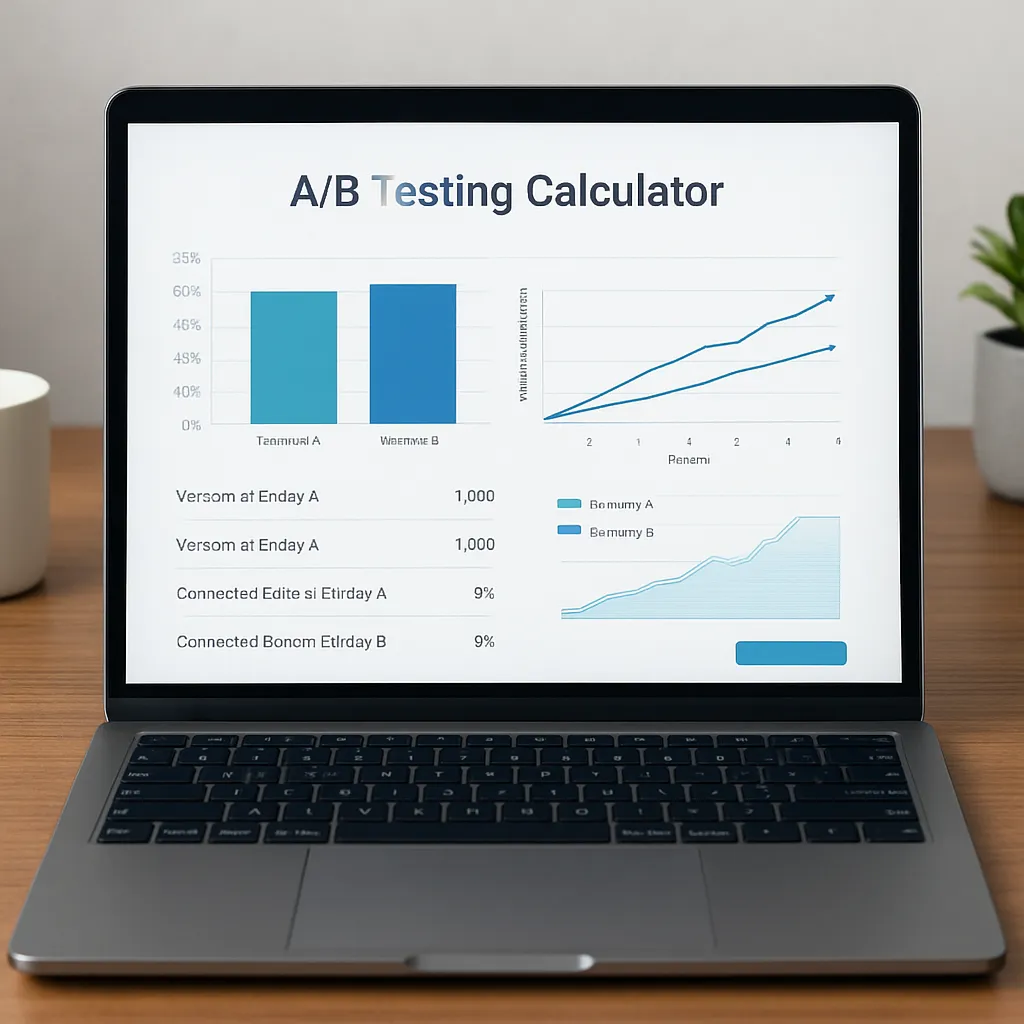
A/B Testing Calculator
A/B testing has become one of the most reliable methods for making data-driven decisions in digital marketing and SEO. Instead of relying on intuition, teams can test two or more variants of a page, element, or copy and see which one delivers better results. An A/B Testing Calculator is a simple but powerful tool that helps interpret the performance of these experiments. It turns raw data from experiments into actionable insights about statistical significance, conversion uplift, and the potential impact on organic visibility and revenue. Understanding how to use such a calculator is extremely valuable for SEO specialists, content marketers and CRO professionals who want to optimize websites with minimal risk.
What is an A/B Testing Calculator and how does it work?
An A/B Testing Calculator is a piece of software that takes basic experiment data and converts it into clear metrics. At its core, it requires just a few inputs from the user: the total number of visitors for each version and the total number of conversions for each version. Based on this, it evaluates whether the difference in performance between variant A and variant B is statistically significant, i.e., unlikely to be the result of chance.
For example, suppose page A has 10,000 visitors and 500 conversions, while page B has 9,800 visitors and 580 conversions. By entering these numbers into the calculator, the tool can estimate the conversion rate for each variant, the absolute and relative uplift, and the probability that the observed improvement is genuine rather than random variation. The strength of the calculator lies in its ability to transform intuitive guesses into measurable outcomes.
From a mathematical perspective, the majority of A/B Testing Calculators rely on classical statistical tests such as the z-test for proportions or a chi-square test on contingency tables. More advanced calculators may also provide Bayesian estimations, visually representing the probability that one variant will outperform the other in the future. This shift from raw experimental data toward well-structured metrics is what makes the calculator so valuable for strategic decision-making in digital marketing and SEO.
An A/B Testing Calculator usually comes with options to set the desired confidence level (for example, 95% or 99%) and may also show confidence intervals around a conversion rate. These intervals indicate the range of values within which the true conversion rate is likely to lie, given the observed data. Thus, a calculator is not just a percentage-comparing tool; it embodies the logic of statistical inference in a user-friendly form.
Key features and types of A/B Testing Calculators
There are many variants of A/B Testing Calculators, each offering specific functionalities. Some are embedded in web analytics platforms, while others function as stand-alone tools. The level of complexity varies from very simple interfaces to sophisticated dashboards dedicated to growth and experimentation teams.
Core functionalities
Most reliable calculators share a set of core functionalities:
- Calculation of conversion rates for each variation, often expressed as a percentage of visitors that completed a desired action (e.g., form submission, purchase, newsletter signup).
- Estimation of relative uplift (percentage improvement) between variations, which helps evaluate how much better one version performs over another.
- Computation of p-values or probability scores that indicate the likelihood that the result is due to chance.
- Overview of statistical power, i.e., how likely the test is to detect a real effect if it exists.
- Support for multiple variations, beyond the classic two-variant setup.
Such features ensure that marketers and SEO specialists do not have to build their own statistical models or deal with complex formulas. By simply entering counts of visitors and conversions, anyone can gain access to robust data analysis.
Advanced options in modern calculators
More advanced A/B Testing Calculators often include sophisticated functionalities that are especially relevant for large-scale SEO and CRO programs:
- Bayesian probability modeling, presenting the chance that a variant is the best among all tested versions.
- Sample size estimators, which help determine how many visitors are needed to run a valid A/B test with a chosen confidence level and effect size.
- Duration estimators, calculating how long an experiment should run to reach sufficient data, based on current traffic levels.
- Segmentation capabilities that allow users to evaluate significance not only at the global level but also for specific user groups (e.g., mobile vs desktop, organic vs paid traffic).
- Integration with analytics platforms and tag managers for automated data feed and reporting.
These options are particularly attractive for organizations that manage many SEO-driven landing pages and need to test multiple aspects of content and design across diverse audience segments. For such teams, automation and reliability in measurement are critical.
Types of calculators for different needs
A/B Testing Calculators can be roughly categorized into several types based on their target user and complexity:
- Basic web calculators designed for quick checks: simple interfaces, no login required, suitable for freelancers and small businesses.
- Built-in calculators within experimentation platforms and SEO suites: integrated with testing tools, allowing one-click calculation from live experiments.
- Custom enterprise calculators used by large companies: often part of internal analytics solutions, tailored to the specific metrics and constraints of an organization.
- Open-source calculators for data-savvy teams: scripts in R, Python or JavaScript that developers and analysts can adapt to specialized scenarios.
Each type has its own strengths. Freelancers may find the basic tools sufficient, while enterprises engaging in continuous experimentation benefit from customized or deeply integrated calculators.
Applications of an A/B Testing Calculator in SEO strategy
Although many people first associate A/B testing with conversion rate optimization or advertising, it has strong and direct implications for SEO. Search engines increasingly reward websites that deliver great user experience, high engagement and clear value to visitors. An A/B Testing Calculator supports this by allowing teams to experiment with elements that influence organic traffic performance and engagement metrics.
Testing on-page elements that impact SEO
One of the most direct applications of an A/B Testing Calculator in SEO is the evaluation of on-page elements that can affect rankings and click-through rates from search results. Among the most important testable components are:
- Title tags and meta descriptions, which can heavily influence CTR from search results.
- Headlines and subheadings that determine how users perceive page relevance.
- Call-to-action copy and button placement, which can affect engagement and conversions from organic traffic.
- Content structure, such as the order of sections, internal links, and visual hierarchy.
By using an A/B Testing Calculator, SEO specialists can precisely measure how much a change in a title tag or headline influences user behavior once they land on the page. For example, a more compelling heading might not only increase conversions but also reduce bounce rates and time to first interaction, indirectly signaling to search engines that the page is relevant and engaging for particular queries.
Impact on behavioral metrics and user experience
Modern search algorithms pay attention to how users interact with a page: whether they immediately go back to search results, how long they stay, how many pages they visit, and whether they return in the future. While these factors are not pure ranking signals in a simplistic sense, they do reflect the quality of user experience and content relevance.
Through systematic experimentation and the use of an A/B Testing Calculator, a website owner can fine-tune page elements that influence these behaviors. For example:
- Testing different layouts to see which version keeps users on site longer.
- Optimizing internal linking structures to guide visitors more effectively through content.
- Adjusting the placement of multimedia elements to balance fast loading with engaging design.
Every test produces data on clicks, time on page and interactions. With a calculator, it becomes easier to interpret whether observed differences are the result of clear improvements or simply random variation. This leads to more confident decisions about permanent changes that influence organic performance.
SEO split-testing at scale
On large websites, especially e-commerce or media portals, SEO teams may run split tests across groups of pages rather than single URLs. For instance, half of a category of product pages may receive one version of structured data markup, while the other half retains the original markup. After a certain period, performance can be compared not only on conversions but also on organic sessions, ranking distributions and crawl frequency.
An A/B Testing Calculator is crucial in these scenarios. Instead of just relying on aggregated metrics, analysts can statistically evaluate whether a new template, internal linking rule or schema implementation has truly improved organic visibility. Even small positive changes measured across thousands of pages can result in substantial improvement in total traffic and revenue. Conversely, the calculator helps detect harmful changes early, preventing a widespread negative impact on rankings.
Does an A/B Testing Calculator directly help with SEO rankings?
An important nuance is that an A/B Testing Calculator itself does not directly alter search rankings. It is not a ranking factor, nor does it automatically send data to search engines. Rather, it is a decision-making engine that helps teams choose changes that are likely to enhance user satisfaction and conversion performance. These improved experiences are aligned with the long-term direction of modern SEO.
In other words, the calculator has an indirect but meaningful influence on SEO. By helping teams select content and design variants that truly resonate with users, it promotes lower bounce rates, higher engagement and stronger conversion funnels. Over time, such improvements can contribute to stronger brand signals, increased return visits and more positive engagement metrics, all of which support sustainable organic growth.
Moreover, regular use of A/B Testing Calculators encourages a culture of experimentation rather than static website maintenance. Sites that constantly test, measure and refine typically adapt faster to changes in user expectations and search algorithms. This agility itself is a competitive advantage in SEO, where outdated assumptions can quickly result in loss of visibility.
Practical workflow: using an A/B Testing Calculator in day-to-day SEO
Using an A/B Testing Calculator effectively requires a clear workflow and discipline. The software is only as valuable as the thought process behind the experiments.
The first step is to define a precise hypothesis tied to a measurable goal. For SEO, this could be improving organic conversion rate on a specific landing page, reducing bounce rate for a set of keywords, or increasing signups from organic sessions. With this goal in mind, the team designs two or more variants that differ in a controlled way, such as headline formulation, content length or visual emphasis on particular sections.
Next, traffic is split between variants in a way that ensures random distribution, usually via client-side testing tools, server-side logic or specialized SEO split-testing solutions. During the test, data on visitors and conversions is collected for each version. After a sufficient amount of data is gathered, these values are entered into the A/B Testing Calculator.
The calculator then provides the conversion rates, uplift, statistical significance and other relevant metrics. Based on this information, SEO specialists decide whether to implement the winning variant, continue the experiment to gather more data, or reject the change as inconclusive. The insight may also inspire new hypotheses, creating a cycle of continuous improvement.
Crucially, the workflow should involve cross-functional cooperation between SEO, UX and analytics teams. While SEO experts specify the targeted queries and landing pages, UX designers adjust layouts and content presentation, and analysts verify that the data is reliable and statistically interpretable. The A/B Testing Calculator becomes a shared tool that ties these disciplines together around objective evidence.
Strengths and limitations of A/B Testing Calculators in an SEO context
Like all analytical tools, A/B Testing Calculators offer significant benefits but also face some inherent limitations. Understanding both aspects is essential to using them responsibly in an SEO strategy.
Strengths of using a calculator
The key advantages include:
- Objective evaluation of changes, eliminating much of the subjective bias that usually drives design and copy decisions.
- Clear numeric outputs that are easily understandable by decision-makers.
- Faster learning cycles, as teams can quickly validate or discard ideas before rolling them out globally.
- Alignment with user-centric SEO, ensuring that improvements in content and layout are grounded in actual behavior.
Especially for organizations investing in large-scale SEO and paid campaigns, these strengths translate into more efficient use of resources. Changes that do not move the needle are identified early, while genuinely effective optimizations can be replicated across broader segments of the site.
Limitations and caveats
Despite their usefulness, A/B Testing Calculators have limitations that users must respect:
- They depend on the quality and volume of input data; low-traffic tests may yield inconclusive or misleading results.
- They typically focus on short-term conversion metrics rather than long-term brand or retention outcomes.
- They cannot capture all external influences, such as seasonality, campaign overlaps or market trends, which might affect experimental results.
- Incorrect interpretation of statistical significance can lead to unjustified conclusions, especially when tests are stopped too early.
In an SEO context, another limitation is that the full impact of certain changes on organic rankings may take weeks or months to emerge. A test that appears neutral or even negative in the short term might still have long-term benefits if it improves content depth, topical relevance or user trust. Thus, A/B testing should complement, not replace, broader SEO strategies based on content quality and authority.
Opinion: Is an A/B Testing Calculator worth using for SEO?
From a strategic perspective, an A/B Testing Calculator is highly worthwhile for most websites that rely on organic traffic. While it does not directly boost rankings, it reinforces an evidence-based approach to optimization. This mindset is closely aligned with what search engines value: relevance, user satisfaction and reliable performance.
For smaller sites, the calculator can help avoid costly mistakes, such as replacing a well-performing page version with a new design that looks better but converts worse. Even a single test on a key landing page can reveal surprising behavior patterns. For larger sites and agencies, the tool becomes an integral part of experimentation frameworks, powering decisions about template changes, navigation, internal links and content positioning.
The most compelling argument in favor of A/B Testing Calculators is their contribution to the synergy between SEO and conversion optimization. Traditionally, these fields were treated separately: SEO teams focused on rankings, while CRO teams optimized landing pages for paid traffic. When they collaborate through shared experiments and a common calculator, the resulting improvements often yield both better search visibility and increased revenue from organic sessions.
At the same time, it is important not to overestimate the role of any single tool. An A/B Testing Calculator does not replace comprehensive keyword research, technical improvements, high-quality content, or link-building strategies. It operates as a complementary instrument that refines the user experience and confirms whether planned changes are beneficial. Used in this realistic, integrated way, it becomes a reliable ally rather than a magic solution.
Interesting aspects and future trends
Several interesting trends are emerging around A/B Testing Calculators and their intersection with SEO and analytics. One of them is the growing adoption of Bayesian methods, which offer more intuitive probability statements about which variation is better. For SEO teams that must deal with noisy, long-term data, Bayesian calculators may provide more flexible insight than classical frequentist approaches.
Another trend is the integration of calculators with machine learning models that predict the likely outcome of changes before a test even begins. By analyzing historical experiments and website behavior, these models can recommend variants that are more likely to perform well. In such a scenario, the A/B Testing Calculator becomes part of a larger intelligent optimization system rather than a stand-alone utility.
From a user experience standpoint, calculators are also becoming more accessible and educational. Many modern tools provide visual explanations of confidence intervals, significance and uplift, which helps non-statisticians understand the meaning of their experiments. This educational component is important for SEO practitioners who may not have formal training in statistics but still need to draw reliable conclusions from their data.
Finally, as privacy regulations evolve and data collection is restricted in some contexts, A/B testing and the calculators that support it must adapt. Tools are increasingly designed to work with aggregated or anonymized data, preserving the ability to optimize websites without compromising user privacy. SEO professionals, who often handle data from organic traffic, will benefit from calculators that ensure compliance while still delivering actionable insights.
Overall, the A/B Testing Calculator occupies an important place at the intersection of analytics, optimization and SEO. It transforms experimentation into a controlled, measurable process and supports decisions that shape how users experience a website. When combined with quality content and technical excellence, it contributes significantly to building a resilient and growth-oriented digital presence.