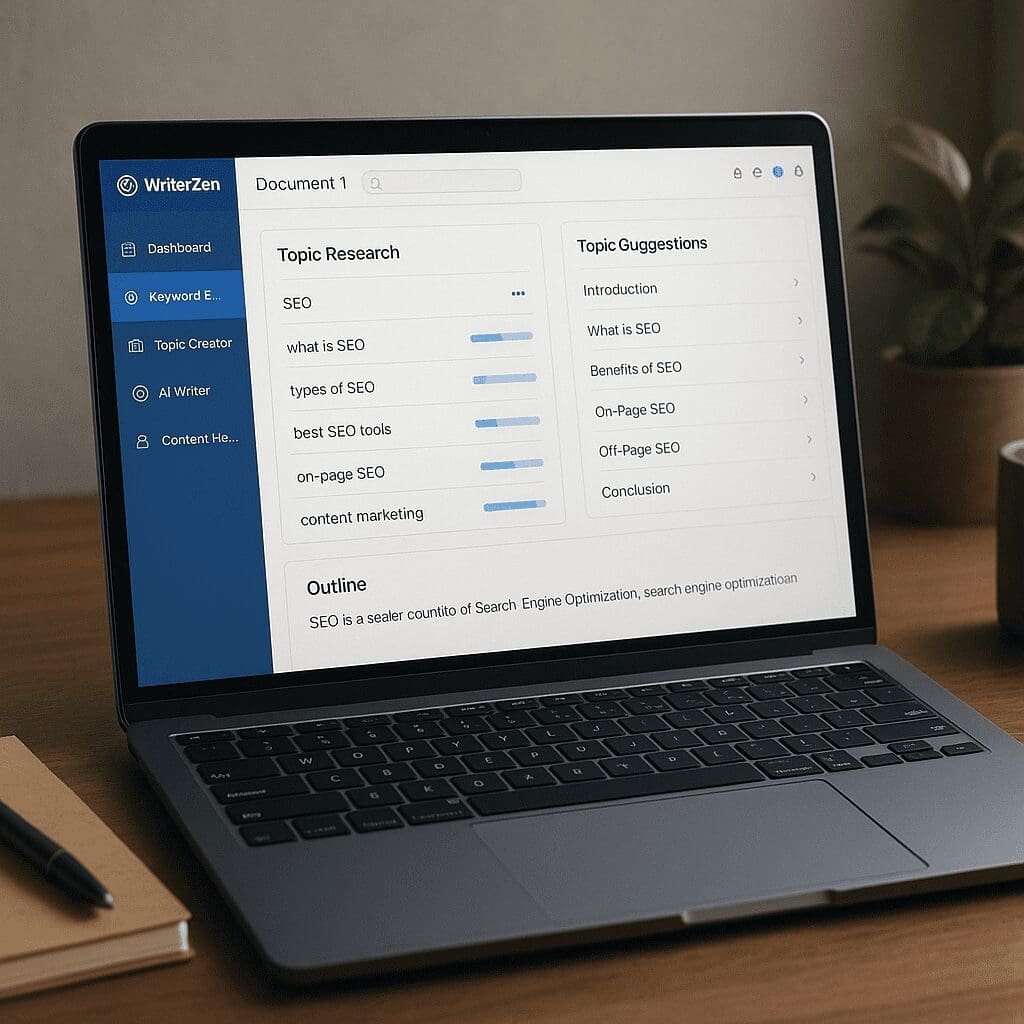
WriterZen
WriterZen is a content intelligence suite built to help marketers research topics, organize keyword data, and produce articles that satisfy human readers and search engines alike. If your team struggles to navigate from an overflowing spreadsheet of ideas to a clear editorial plan, WriterZen provides a structured path: discover opportunities, prioritize, turn them into briefs, and draft with confidence. It does not promise magical rankings; instead, it offers a practical set of tools that de-risk the messy middle of planning and publishing by aligning research, outlines, and on-page execution with measurable outcomes.
What WriterZen Actually Is: Modules, Data, and Core Strengths
At its core, WriterZen combines three pillars: ideation, keyword intelligence, and assisted drafting. The platform is designed so that what you learn in one module flows into the next: topics become keyword lists, lists become clusters, clusters become outlines, and outlines become articles. The result is a research-to-publication assembly line that reduces context switching and captures the logic behind each decision.
Topic Discovery: From Fuzzy Ideas to Structured Themes
Topic Discovery helps you see the landscape beyond a single term. Enter a seed idea and WriterZen surfaces semantically related concepts, questions, and subtopics. Instead of chasing a single head term, you begin to understand the broader semantic space and align your calendar with what readers (and algorithms) associate with the subject. This perspective is essential for building topical authority—the depth and breadth signals that tell search engines you cover a niche comprehensively.
Keyword Explorer: Difficulty, Demand, and Opportunity Signals
The Keyword Explorer integrates volume, seasonality, and competitiveness. One differentiator often praised by users is an “allintitle” type measurement and a composite difficulty or “golden” score that highlights long-tail opportunities where competition appears thin relative to search volume. Whether you subscribe to any single metric or not, the blend of intent cues and competitive density is helpful in prioritizing keywords for early wins while queuing tougher terms for later authority-building.
Keyword Clustering and Mapping: Avoiding Cannibalization
WriterZen’s clustering groups terms that share similar search results so you can target them with a single page rather than scattering them across multiple articles. This clustering-by-SERP-similarity reduces cannibalization (multiple pages competing for the same query) and clarifies how a single page can answer closely related variations. You can adjust thresholds to be more conservative or aggressive depending on your domain’s authority and your content model (hub-and-spoke vs. pillar pages vs. stand-alone posts).
Content Creator and Outline Builder: From Research to Draft
Once clusters are defined, the Content Creator analyzes the live SERP, surfaces headings, questions, common subtopics, and competitor coverage, and helps you build an outline. It can generate structured briefs that include: target terms, on-page guidelines, recommended sections, internal link targets, and draft notes. If you use AI assistance inside WriterZen, it can help translate an outline into a first draft. The real value, however, is keeping research decisions visible to writers so they understand the “why” behind each section.
Originality, Collaboration, and Exports
Teams can manage projects, assign tasks, leave comments on briefs, and export datasets to spreadsheets or CMS workflows. Many users also rely on an originality or plagiarism checker within the platform to safeguard editorial quality. These operational touches—project folders, versioned outlines, and exportable reports—make WriterZen a practical tool for agencies managing multiple clients or in-house teams coordinating across stakeholders.
Does WriterZen Help with SEO? Where It Shines and Where It Doesn’t
Short answer: yes, provided you treat the platform as a decision support system, not a ranking machine. WriterZen helps you connect the dots between searcher intent, competitive context, and on-page coverage. Its biggest contribution is strategic clarity: choosing the right battles, organizing them in sensible clusters, and producing pages that directly answer what people expect to find for a query.
How WriterZen Contributes to Rankings and Traffic
- Improved topic selection: Topic Discovery exposes semantically adjacent opportunities you might miss if you only chase high-volume terms.
- Faster prioritization: Composite difficulty signals and “allintitle”-style metrics identify underserved long tails worthy of early coverage.
- Cluster discipline: Grouping terms by SERP similarity reduces cannibalization and enables you to build interconnected hubs that establish authority.
- Better outlines: SERP-driven outlines ensure your page touches the subtopics and questions most likely to satisfy user expectations.
- Consistent on-page quality: Briefs, content scoring, and editorial checklists standardize output across writers without stifling voice or expertise.
What WriterZen Does Not Replace
- Technical SEO: Site speed, structured data, crawlability, and indexation still require dedicated audit tools and dev collaboration.
- Backlinks and PR: WriterZen is not a link-building platform; authority growth still hinges on relationships, PR, and brand visibility.
- Editorial judgment: AI-assisted drafting can accelerate production, but human expertise, examples, and unique insights separate great pages from generic ones.
In other words, WriterZen makes it easier to execute a coherent strategy, but it cannot overcome a broken site structure, lack of brand signals, or absence of expertise. Used responsibly, however, it reduces waste and increases the percentage of pages that rank because they match intent and provide comprehensive coverage.
A Practical WriterZen Workflow from Idea to Publication
The following blueprint demonstrates how a small team might use the platform to move from a seed idea to a published article and then iterate based on performance data.
1) Define Your Audience and Outcome
Before opening any tool, decide what business outcome you want: leads, free-trial signups, newsletter growth, or product education. Write a one-sentence thesis for the page—what the reader will learn and why it matters. This step makes every later decision easier.
2) Topic Discovery to Expand the Map
Enter a seed concept and collect related topics, questions, and entities. Prioritize those that align with your funnel stage and product. Tag each candidate with a likely intent (informational, navigational, transactional) to guide the type of asset you’ll create.
3) Keyword Explorer to Size the Prize
Move shortlisted ideas to Keyword Explorer to evaluate search volume, seasonality, and competitiveness. Pay attention to variants and question forms. Export or save promising sets into a project list. Flag terms that look like quick wins for near-term production.
4) Build Clusters to Prevent Overlap
Run WriterZen’s cluster feature using the SERP-similarity setting appropriate to your domain. Tight clusters with high overlap typically deserve one page; broader clusters may become a pillar plus spokes. Name clusters clearly, assign a page type, and add internal link targets (e.g., link this article to the buying guide and the comparison page).
5) Create Briefs for Each Page
Generate a SERP-informed outline and enrich it with your unique angle: proprietary data, interviews, product examples, or customer stories. Include target terms only as reminders—avoid stuffing. The aim is to satisfy the user intent comprehensively while bringing something new to the conversation.
6) Draft, Review, and Edit
Use AI sparingly to fill connective tissue, not to invent expertise. Encourage writers to add screenshots, schematics, or step-by-step instructions that demonstrate real practice. Run a readability pass, ensure headings mirror the outline, check internal links, and confirm metadata reflects the page’s promise.
7) Publish and Measure
Once live, monitor impressions, clicks, and ranking movement. If you can, map each cluster to an analytics segment so you can measure performance by topic rather than individual posts. After 4–8 weeks, revisit underperforming pages to expand coverage, refine titles, or tighten structure.
Advanced Tactics: From Clusters to Authority
WriterZen helps execute the following advanced patterns that build durable visibility.
Topical Depth Over Keyword Breadth
Instead of publishing 50 shallow posts across 10 loosely related subjects, go deep on two clusters. Use Topic Discovery to identify every major subtopic, then plan a pillar page plus supporting articles. Close coverage gaps by aligning your outline with common user questions and competitor omissions. This depth-first approach sends stronger authority signals than scattered efforts.
Long-Tail Leverage with Smart Prioritization
When the “golden” or opportunity score indicates low competition, create practical, search-intent-matched pages first. These posts accrue early clicks, improve internal linking structures, and give Google more evidence of your expertise. Over time, link from these pages into tougher head terms to ladder up authority.
Internal Link Architecture from Day One
Use WriterZen’s cluster labels to pre-plan link paths: pillars link down to details; details link to siblings and back up to the pillar; commercial pages receive contextual links from high-traffic informational assets. Internal links pass relevance and help distribute crawls, improving indexation and rankings.
E-E-A-T and Editorial Differentiation
No tool can fabricate experience. Add author bios, cite credible sources, and include hands-on notes (“We tested X across Y scenarios”). Where appropriate, embed video or data visualizations. Tools help you see what the SERP expects; your practice and perspective make the page irreplaceable.
How WriterZen Compares: Strengths and Trade-offs vs. Alternatives
Compared with broader suites like Semrush or Ahrefs, WriterZen is more focused on content planning than on backlink analysis or site audits. Versus on-page optimizers like Surfer or Clearscope, it leans into clustering and ideation while offering a lighter-weight optimization environment. Against outline-centric tools like Frase or Neuron Writer, WriterZen’s value often resides in its cluster-first architecture and the flow from discovery to briefs.
- Where it leads: clustering by SERP similarity, topic-driven planning, and straightforward briefs that keep research tethered to execution.
- Where it lags: backlink intelligence, technical audit depth, and enterprise-grade reporting. You’ll still want a dedicated crawler and link tool.
- Neutral: AI drafting quality is comparable to peers; differentiation comes from your prompts, outlines, and editorial oversight.
Pros, Cons, and Ideal Users
Advantages
- End-to-end research-to-draft workflow that reduces friction and saves time.
- Clear prevention of cannibalization via practical SERP-based clustering.
- Actionable briefs that align outlines with real user expectations.
- Useful prioritization for identifying opportunity keywords early on.
- Team-friendly: projects, comments, and exports support agency use.
Limitations
- Credit/usage systems can be confusing at first; high-volume teams must manage quotas.
- Does not replace technical SEO tools or link-building solutions.
- AI-generated prose can feel generic if you don’t inject expert insights.
- Some keyword difficulty metrics require judgment; treat them as guides, not absolutes.
Who Benefits Most
- Content-led startups building authority in defined niches.
- Agencies needing scalable, repeatable processes for multiple clients.
- Ecommerce and SaaS teams mapping buying guides, comparisons, and use-case hubs.
- Solo creators who prefer structure over scattered notes and tab chaos.
Pricing and Value Considerations
WriterZen generally offers tiered plans with varying limits on keyword lookups, cluster operations, and AI/outline features. If you publish at scale, forecast your monthly throughput first: how many clusters, briefs, and drafts will you generate? Budget for overflow during launch sprints and consider whether teammates need separate seats. Value comes from replacing manual tasks (SERP scraping, spreadsheet clustering, ad-hoc brief templates) with a standardized pipeline that compounds productivity.
Common Pitfalls to Avoid When Using WriterZen
- Chasing metrics without reading the SERPs: Always open results and skim competing pages to understand depth and angle.
- Over-segmentation: Clustering too aggressively can fragment topics into thin pages. If SERPs overlap heavily, one comprehensive page is better.
- Under-segmentation: Forcing everything into one mega page can dilute relevance. Split when search results show distinct intents.
- Neglecting internal links: Clusters need connective tissue. Plan links while building briefs, not after publication.
- Ignoring expertise: Replace boilerplate with real examples, screenshots, data, and first-hand recommendations.
- Publishing and forgetting: Revisit pages after data accumulates; expand sections that underperform and prune redundancies.
Hands-On Example: Turning a Seed Topic into a Content Plan
Imagine a gardening brand exploring “indoor plants.” In Topic Discovery, you’ll see entities like low-light species, watering schedules, soil mixes, pet-safe lists, and troubleshooting for yellow leaves. Keyword Explorer reveals seasonality spikes and question clusters (e.g., “how often to water ZZ plant”). Clustering then groups “best low-light indoor plants,” “pet-safe houseplants,” and “beginner-friendly plants” into separate pages because the SERPs differ—indicating distinct intents and buyer needs.
The Content Creator surfaces headings and common FAQs across competitors. Your outline adds unique assets: a decision tree to choose plants by light level, a printable watering calendar, and a short diagnostic for leaf discoloration. Internal links connect each guide to a shopping category page and to care-specific articles. As traffic grows, the pillar page “Indoor Plant Care Guide” consolidates authority and points readers to transactional pages. Through this flow, WriterZen ensures your content matches searcher expectations while reinforcing commercial goals.
Editorial Best Practices That Pair Well with WriterZen
- Lead with the outcome: Open pages with a clear promise and a fast path to the answer.
- Front-load essentials, then expand: Satisfy scanners first, then deliver depth for engaged readers.
- Use headers as signposts: Each H2 should map to a distinct sub-intent within the query space.
- Integrate product or service naturally: Show, don’t pitch. Use examples, workflows, and case snippets.
- Measure beyond rank: Track conversions, assisted conversions, and time to first value for each cluster.
Performance Iteration: Turning Insights into Updates
Once your pieces are live, treat every page as a hypothesis. If impressions rise but CTR lags, test sharper titles and meta descriptions. If rankings stall on page two, inspect the SERP to see whether competing pages include fresh data, visuals, or a step you skipped. If time on page is low, restructure the first 300 words to surface the core answer sooner. WriterZen helps you identify coverage gaps during the planning phase; the same logic applies when refining pages later.
Opinion: Is WriterZen Worth It?
For teams who believe that sustainable SEO comes from satisfying people first and algorithms as a consequence, WriterZen is an excellent companion. Its biggest strength is operational: it reduces the cognitive load of moving from research to outlines and keeps strategy visible to everyone involved in production. While it won’t replace a backlink index or a technical crawler, it doesn’t try to. Instead, it excels at the connective tissue of content operations—where many teams actually lose time and quality.
Compared with more expensive, all-in-one platforms, the narrower focus can be an advantage: less bloat, clearer defaults, and fewer distractions. The trade-off is that you’ll still run a separate audit and link stack. If that is acceptable, WriterZen provides clarity where it matters most: picking the right battles, matching intent, and delivering pages that deserve to rank.
Final Takeaway
WriterZen won’t do the work for you, but it will make the work easier to do right. Use it to uncover themes, weigh opportunities, group related terms, and turn them into outlines that reflect what users and algorithms expect to see. Then layer in your real-world expertise, examples, and evidence. That combination—disciplined planning plus differentiating insight—is the proven path to durable rankings, compounding traffic, and a content program that ties directly to business outcomes.