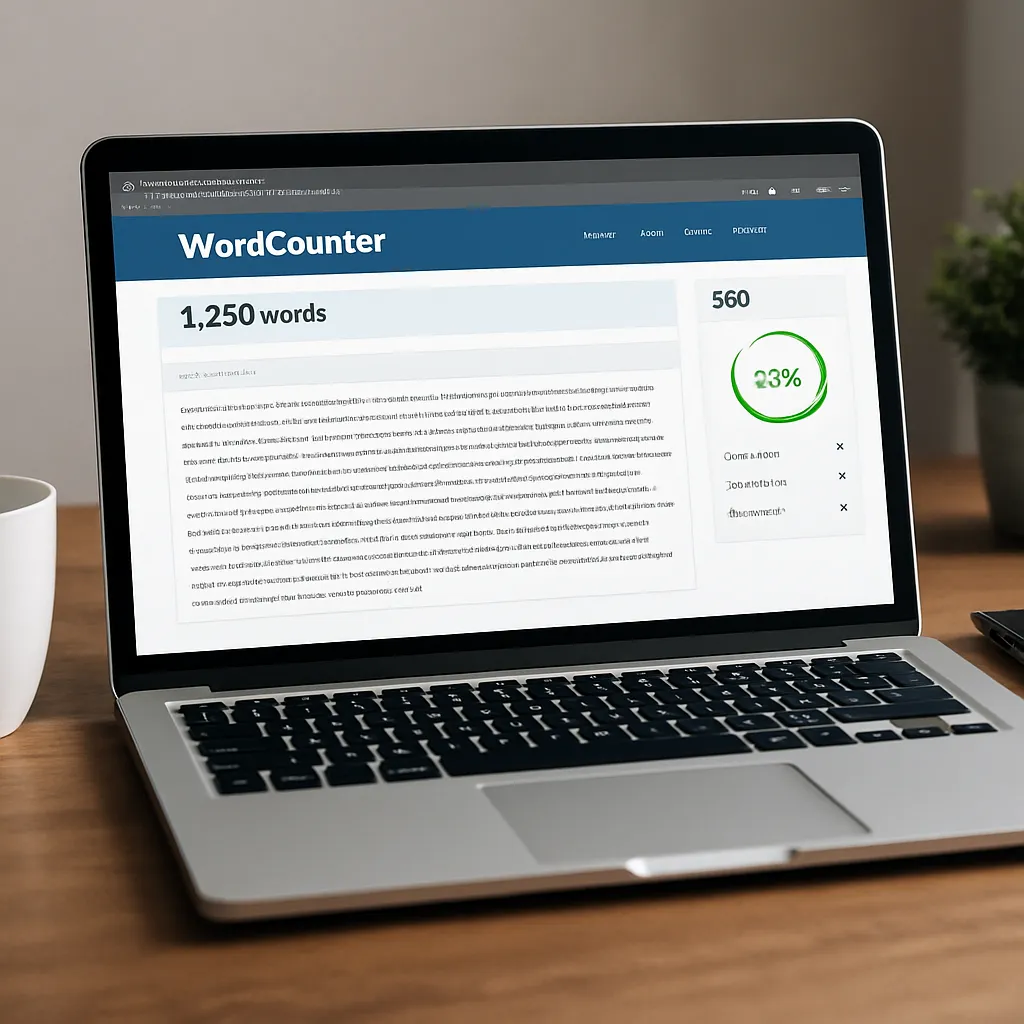
WordCounter
Content creators, copywriters and SEO specialists often underestimate how much a simple text-measuring tool can shape the final quality of their work. WordCounter, an online platform designed to monitor the length and structure of written content, belongs to this group of deceptively simple applications that can have a real impact on **on-page** optimization, readability, and overall **content** performance. By going beyond merely counting characters and words, WordCounter becomes a practical assistant in shaping texts that are not only longer or shorter, but above all better aligned with the expectations of search engines and users.
What WordCounter Is and How It Works
WordCounter is best known as an online tool that tracks the number of words and characters in a block of text. This may sound basic, but for anyone writing with SEO in mind, such metrics are fundamental to controlling the structure of **articles** and landing pages. In most versions, the interface is very minimalistic: a text field in which you can paste your content or write it from scratch, and a panel displaying indicators that update in real time.
Standard functions usually include:
- Word count – tracking the overall volume of content, often essential for meeting client requirements or editorial guidelines.
- Character count – useful for crafting metadata like titles and descriptions that need to fit within specific pixel or character limits in **search** results.
- Sentence and paragraph statistics – allowing authors to check whether the text is too dense or too fragmented.
- Keyword density indicators – in some implementations, WordCounter shows how frequently a given term appears, which can matter for **SEO** planning.
- Basic readability insights – even simple statistics, such as average sentence length, already give an impression of how complex the content appears to the reader.
The simplicity is key: you do not need advanced technical skills or installation. A web browser and an internet connection are enough to start working. This is precisely why WordCounter earns a place in the workflow of both professional **copywriting** agencies and freelancers who handle multiple projects daily.
WordCounter as a Practical SEO Support Tool
Search engines place strong emphasis on user satisfaction, which depends, among other things, on the quality, length and structure of the text. WordCounter is not a complete SEO suite, but it does provide data that is highly valuable from an optimization perspective. Its importance grows especially in tasks that require precise control of text length and distribution of keywords.
Controlling Content Length for Different Purposes
One of the traditional myths in SEO is that longer content always ranks better. In reality, what matters more is whether a text thoroughly answers the user’s **intent**. Still, length acts as a proxy for depth: thin content with only a few sentences will rarely be able to compete with thoughtfully developed pages.
WordCounter helps in several ways here:
- Blog posts and guides – you can quickly verify whether your text falls within a target range, for example 1200–2500 words, depending on the competitiveness of the keyword and expectations of the audience.
- Category and product descriptions – e‑commerce websites often have specific requirements, such as a minimum of 300 or 500 words. With WordCounter, maintaining consistency across many similar pages is much easier.
- Landing pages for advertising campaigns – marketers frequently test different lengths, from short, sales-focused pages to longer storytelling formats. Precise word and character control is crucial, especially if you compare performance of variants in **A/B** tests.
From a strict SEO perspective, the magic is not in hitting a fixed number, but in ensuring that your content is substantial enough. WordCounter makes it simple to confirm that you’re not publishing placeholder texts that search engines may consider low-value.
Managing Meta Titles and Descriptions
Another area where WordCounter is extremely useful concerns **titles** and meta descriptions. Although search engines use pixel width rather than exact character counts, years of practice have yielded approximate ranges that work well. For example, many specialists aim for around 50–60 characters for a title and 140–160 characters for a meta description.
By counting characters in real time, WordCounter helps:
- Prevent truncated titles in search results, which can lower click-through rate.
- Craft meta descriptions that fully fit within the visible snippet, ensuring that the most persuasive elements of the message actually appear to users.
- Align the messaging length with ad platforms that also use character limits, creating consistency between organic and paid search.
This type of micro-optimization may not change rankings alone, but by improving visibility and attractiveness in the results page, it can increase the number of clicks your site receives for existing positions.
Keyword Density and Phrase Distribution
Modern SEO no longer revolves around stuffing keywords into every possible corner of the text. Search engines are better at understanding context and semantics, yet completely ignoring keywords is not wise either. WordCounter can highlight how many times certain terms appear and whether some expressions are used too frequently.
Typical advantages in this area include:
- Checking that main and secondary keywords appear naturally and regularly, without forcing them.
- Avoiding over‑optimization, which can make text sound artificial and might, in extreme cases, be interpreted as spam by search engines.
- Finding opportunities to add related phrases, synonyms or long‑tail variants where the density is currently too low or absent.
Used sensibly, the keyword statistics in WordCounter help maintain an organic feel to the text while still respecting the core principles of classic on‑page optimization.
Readability, User Experience and Indirect SEO Benefits
Beyond numbers and characters, WordCounter contributes to aspects that affect user behavior: time on page, bounce rate, and engagement. These indicators, while not direct ranking signals in every case, often correlate with how search engines evaluate the general usefulness of a page. A text that is easier to read tends to keep users longer, which in turn can positively influence how the page is perceived by algorithms.
Sentence and Paragraph Structure
WordCounter often displays the ratio between words and sentences. High averages, such as 25–30 words per sentence, may indicate that the content is becoming difficult to follow. By monitoring these metrics, authors can consciously shorten or split sentences and break up thick blocks of text into more digestible parts.
Benefits include:
- Improved clarity – shorter sentences are easier to understand for both native speakers and second-language readers.
- Higher accessibility – users who scan content quickly, especially on mobile devices, can more easily catch key information.
- More consistent tone – standardized sentence length often leads to a smoother reading rhythm.
Although WordCounter does not necessarily process complex readability indexes in every version, just watching basic statistics can push authors toward friendlier writing styles, which is crucial for high-performing **websites**.
Detecting Redundancy and Overly Complex Sections
Another indirect advantage is the ability to spot parts of the text that are suspiciously long or short compared to the rest of the article. For example, if one subsection greatly exceeds others in length, the author may ask whether it truly provides proportional value or simply repeats information in different words.
This helps:
- Eliminate redundant passages that dilute the main message of the content.
- Balance sections so that the text feels cohesive, which is appreciated by both human readers and content evaluators working with quality guidelines.
- Focus on depth instead of unnecessary expansion; WordCounter numbers quickly show where the text is bloated.
In practice, especially for long-form guides, running the text through WordCounter before publishing enables a final optimization of structure that would be more difficult to see by eye alone.
Supporting Collaboration Between SEO Specialists and Writers
In agencies or larger companies, briefs for writers usually specify recommended word count, keyword usage and other technical details. WordCounter makes it easy to verify whether these requirements were met before the text is handed off to the client or uploaded to a **CMS**.
Typical uses include:
- Quick self-check by authors before submission, reducing back-and-forth revisions.
- Standardizing content across multiple writers, ensuring that all texts roughly follow the same quantitative guidelines.
- Providing objective metrics for discussing changes: instead of vague comments like “this is too short”, editors can point to clear word counts.
This workflow efficiency directly affects the pace at which new optimized content can be produced and published, which matters greatly for sites that rely on content marketing at scale.
Limitations of WordCounter and How to Use It Wisely
Despite the numerous benefits, WordCounter should not be mistaken for a complete **analytics** or positioning suite. It focuses on the surface layer of text, which means it does not replace complex tools that monitor backlinks, technical health, or search performance. Understanding its limitations is essential to avoiding misuse.
Not a Substitute for Comprehensive SEO Tools
WordCounter does not crawl websites, analyze indexation issues or gather traffic data. It also does not offer keyword research or competition analysis, which are key elements of strategic positioning. It shines primarily in the micro-level of individual texts, providing clean and easy-to-interpret metrics.
Therefore, in professional practice, WordCounter should complement, not replace, platforms such as Google Search Console, premium keyword research tools or sophisticated rank trackers. Its role is to help ensure that the content produced fits well within the broader strategy defined by those other systems.
A Risk of Over-Focusing on Numbers
Any tool that measures something creates a temptation to optimize solely for that metric. In the case of WordCounter, users might obsess over hitting a certain density percentage or exact length, losing sight of what actually matters: usefulness to the reader.
Potential risks include:
- Producing unnecessarily long texts solely to reach a target word count, even when the topic does not require that much explanation.
- Artificially inserting additional instances of a keyword to raise density rather than enhancing real topical depth.
- Neglecting storytelling, style and brand voice in the pursuit of “perfect” statistics.
The best approach is to treat WordCounter data as a guide rather than a rigid rulebook. Numbers can signal where problems might exist, but they do not define quality on their own.
Privacy and Data Handling Considerations
Because WordCounter is typically used as a web application, some organizations may worry about copying and pasting sensitive drafts into third-party tools. The actual privacy policies depend on the specific implementation of the service, so it is wise to verify how data is stored and whether it is logged or processed for additional purposes.
For highly confidential projects or unpublished materials with strong commercial value, some teams may prefer offline versions of word-count tools, integrated directly within text editors. Nevertheless, for standard marketing and web content, the convenience of online WordCounter tools generally outweighs such concerns, provided that you choose reputable platforms.
Opinion: How Useful Is WordCounter for SEO in Real-World Practice?
From a practical standpoint, WordCounter offers a strong value-to-complexity ratio. It is easy to understand, quick to use, and significantly improves the control writers have over the texts they produce. In everyday SEO work, this translates into fewer mistakes such as too-short content, overlong meta descriptions or unbalanced sections.
Its greatest strengths include:
- Universal accessibility – most versions are free or freemium, and run in any modern browser.
- Immediate feedback – changes made in the text instantly affect the displayed metrics, encouraging iterative improvements.
- Low learning curve – no training is required, so new writers and marketers can adopt it almost instantly.
On the critical side, WordCounter does not bring any strategic insight on which topics to cover, which queries to target or how to build authority over time. If used in isolation, it might encourage a mechanistic view of SEO, reduced to character counts and word quotas. For professionals, therefore, it is best seen as a supporting component, not a central pillar of their optimization toolkit.
In conclusion, WordCounter plays a valuable supporting role in SEO and content creation. By providing clear metrics on text length, structure and keyword usage, it helps shape content that is both technically sound and user-friendly. When combined with deeper research and analysis tools, it becomes a reliable, everyday assistant for anyone who treats high-quality written content as a crucial element of their online strategy.