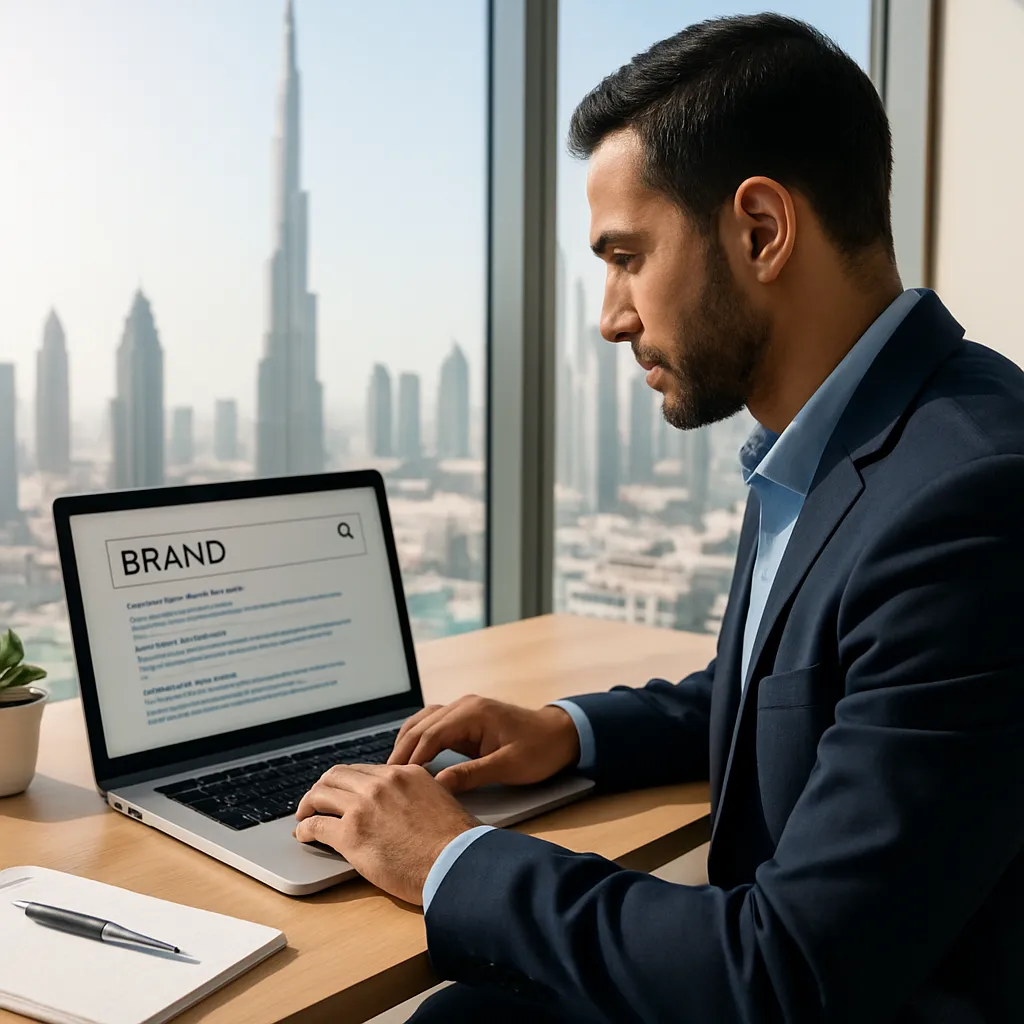
The Importance of Brand Search in Dubai
Brand search has become a strategic battleground for companies operating in Dubai’s highly competitive digital landscape. As the city positions itself as a global hub for tourism, finance, real estate and innovation, businesses are discovering that controlling how users search for and interact with their brand names in Google, YouTube, social platforms and local directories is no longer optional. It is a core pillar of digital marketing performance, revenue growth and long-term customer loyalty.
Understanding Brand Search in the Context of Dubai’s Digital Market
Brand search refers to any search query that includes the name of a company, product, service or a close variation of that name. In Dubai, where consumers are highly connected and often juggle several languages and scripts (English, Arabic and sometimes Russian, Hindi or Chinese), these queries can take multiple forms: from exact brand names to transliterations, abbreviations or combined searches such as “brand + Dubai”, “brand + Marina” or “brand + offer”.
Several characteristics make brand search in Dubai particularly important:
- A young, tech-savvy population with one of the world’s highest smartphone penetration rates, exceeding 96% according to UAE telecom reports.
- Extremely high social media usage, with the UAE consistently ranking among the global leaders in time spent on platforms like Instagram, TikTok and YouTube.
- A cosmopolitan audience made up of residents, tourists, business travellers and investors, all using the web differently but frequently relying on search when evaluating brands.
Global studies by Google have shown that branded search terms tend to have significantly higher click-through rates than non-branded ones, in some verticals exceeding 40% CTR on paid ads. In markets similar to Dubai in terms of income and connectivity, brand queries often account for 30–60% of a company’s total paid search conversions. For many brands operating in the UAE, internal analytics reveal that users who search specifically for the brand name convert at two to three times the rate of generic keyword visitors.
These numbers highlight a crucial point: brand awareness and brand search are deeply interlinked. When offline campaigns, influencer marketing, outdoor ads or PR initiatives introduce potential customers to a brand, the next step for many of those users is to search for it online. If the brand does not control what appears on the results page at that moment — both in Arabic and English — it risks losing attention to competitors, aggregators or price-comparison sites.
Why Brand Search Matters More in Dubai Than in Many Other Cities
Dubai’s infrastructure and culture are tightly woven with mobile internet usage. Residents regularly research restaurants, clinics, schools, real estate projects and luxury goods online before visiting. Tourists landing in the city search for attractions, hotels, malls and experiences as soon as they connect to local networks. This behaviour makes search visibility a decisive factor, particularly for branded queries that signal strong interest or purchase intent.
Several market-specific dynamics amplify the importance of brand search in this city:
High competition in premium and luxury segments
Dubai is a magnet for premium and luxury brands in fashion, hospitality, automotive and real estate. Many of these brands compete for the same affluent, mobile-first audience. When a user types a luxury hotel or designer name into Google, Dubai’s ad auctions are often crowded with:
- Official brand campaigns
- Online travel agencies
- Resellers or distributors
- Local competitors bidding on rival brand names
This environment rewards brands that actively manage their brand positioning in search, protecting their brand terms while using them to cross-sell, upsell or reinforce their unique value proposition. Failing to do so can mean losing high-intent traffic to intermediaries who may control the customer relationship and margins.
Multilingual audience and script variations
In Dubai, the same brand may be searched in multiple languages: for example, a clinic name in English, Arabic or transliterated Arabic using Latin characters. A restaurant could be searched using its English branding, an Arabic nickname, or by area plus partial brand name. Optimizing for brand search here requires more than simply ranking for the exact English name; it demands strategic coverage of:
- Arabic brand versions and common misspellings
- Hybrid searches combining Arabic and English words
- Local area-based brand searches like “brand JLT”, “brand JVC” or “brand Business Bay”
Brands that understand these nuances gain a clear advantage in organic and paid search. They can own more real estate on the search results page and prevent confusion that might divert users to third-party sites or similar-sounding competitors.
Trust, reputation and review culture
Dubai’s consumers, whether residents or visitors, tend to rely heavily on reviews, ratings and social proof before making decisions. When a user searches for a brand, the results page often shows:
- Google Business Profile with ratings and reviews
- Aggregated reviews on booking or delivery platforms
- Articles, blog posts and forum discussions
- YouTube reviews and influencer content
This creates a direct link between online reputation management and brand search. For example, a hotel with a strong offline presence but average Google reviews can see a reduced conversion rate from brand searches, while a smaller but highly rated competitor can capture bookings even when the user initiated a search for a different brand name.
How Brand Search Integrates With Broader Digital Marketing in Dubai
Effective online strategy in Dubai goes far beyond simply buying ads or posting on social media. Brand search connects multiple disciplines — SEO, SEM, social media marketing, performance campaigns and analytics — into a unified system. When structured correctly, it becomes a powerful engine for acquiring and retaining high-quality customers.
Synergy between SEO and paid search on brand terms
Some businesses still question whether they should run paid search campaigns on their own brand name, especially when they already rank first organically. In Dubai’s environment, the answer is usually yes, for several reasons:
- Competitors or aggregators frequently bid on branded terms, appearing above the organic result.
- Ad extensions (sitelinks, callouts, call extensions) allow brands to direct users to highly relevant landing pages such as offers, booking pages, WhatsApp chat or location maps.
- Branded clicks in Google Ads are often inexpensive compared to generic keywords and bring high conversion rates.
Combining strong organic visibility with a strategic paid presence can help a brand dominate the search results page, guide different user segments to tailored content and protect its branding from being diluted by third parties. This is especially valuable in competitive sectors like real estate, automotive and hospitality, where customer lifetime value can be substantial.
Leveraging brand search insights for market research
Brand search data also serves as a rich source of market intelligence. Analyzing how users search for a brand in Dubai can reveal:
- Which locations or districts are most associated with the brand (e.g. “brand Dubai Marina”, “brand Deira”)
- What concerns or interests users have (“brand price”, “brand parking”, “brand brunch”, “brand delivery”)
- How brand perception changes over time, reflected in rising or declining brand query volumes
Marketing teams can use these insights to refine campaign strategy, adjust messaging and improve user experience both online and offline. For instance, a rise in “brand + review” searches may signal that users are uncertain about trustworthiness and that it is time to invest in testimonial campaigns, partnerships with local influencers or improvements to customer service processes.
Connecting brand search with offline campaigns and events
Dubai is known for large-scale events, exhibitions, shopping festivals and seasonal campaigns, particularly around the Dubai Shopping Festival, Expo-related initiatives, Ramadan and New Year’s Eve celebrations. These offline or hybrid events tend to trigger spikes in brand searches. When brands appear in outdoor advertising at key locations like Sheikh Zayed Road or Dubai Mall, or sponsor major events, many viewers later turn to search engines to learn more.
Integrating offline and online requires:
- Tracking branded search volume before, during and after campaigns to measure impact.
- Aligning ad copy and landing pages with the messaging used in offline channels.
- Ensuring that users who search for the brand immediately find relevant information, offers or ways to book.
This alignment can turn awareness generated by large-scale offline spends into measurable digital outcomes: website visits, bookings, sign-ups or in-store visits driven by map interactions and call extensions.
Practical Strategies to Strengthen Brand Search Performance in Dubai
Building a robust brand search presence in Dubai requires a mix of technical, creative and analytical work. It is not just about occupying the first position, but about controlling the narrative and guiding users through the journey from curiosity to conversion and loyalty.
Optimize brand assets in both English and Arabic
One of the first steps is to ensure that all core brand assets — website, landing pages, Google Business Profile, app listings and social media accounts — are properly optimized for both English and Arabic. This includes:
- Using accurate brand names and descriptions in both languages.
- Creating Arabic versions of key landing pages and ensuring they are indexed correctly.
- Structuring meta titles and descriptions to address branded queries and highlight unique benefits.
Brands that invest in high-quality localization instead of basic translation can better connect with Arabic-speaking residents and visitors from across the region. This also signals respect for local culture and regulations, which is particularly important in sectors such as healthcare, finance and education.
Manage and defend branded keywords in paid campaigns
In Google Ads and other platforms, branded keywords should not be treated as an afterthought. Effective campaigns in Dubai typically involve:
- Building separate campaigns for branded terms to monitor performance and allocate budget precisely.
- Testing various ad messages for brand keywords: value propositions, new product lines, seasonal offers.
- Using sitelink extensions to feature popular services, store locations, WhatsApp contact or appointment booking.
Monitoring the auction insights report helps brands see which competitors are bidding on their names and how often they appear above or alongside official ads. This data can inform legal or partnership strategies as well as decisions on how aggressively to bid to protect brand visibility.
Strengthen reputation signals and social proof on the SERP
Since many users in Dubai rely on reviews and ratings when considering a brand, it is essential to cultivate strong social proof that appears directly on the search results page. Tactics include:
- Actively encouraging satisfied customers to leave Google reviews and responding to them in a professional, bilingual manner where relevant.
- Integrating structured data (schema markup) on the website to highlight ratings, FAQs and offers in search results.
- Collaborating with trusted local publishers and influencers whose content will rank for brand-related searches.
Because Dubai is a regional showcase city, positive brand content in search often influences not only local demand but also perceptions across the wider GCC and international markets. This amplifies the value of carefully managed brand search appearance.
Measuring and Maximizing the Business Impact of Brand Search
For brand search to become a real growth driver, companies need to move beyond basic visibility metrics and connect search behaviour with revenue outcomes. This is particularly true in Dubai, where many industries — including real estate, hospitality and luxury retail — involve complex decision-making and high-value transactions.
Tracking key brand search metrics
Some of the most useful indicators include:
- Branded search volume trends over time, segmented by language and geography (Dubai vs other emirates).
- Share of clicks captured by official brand properties vs intermediaries or competitors.
- Conversion rate, average order value and lead quality from branded vs non-branded traffic.
By correlating these metrics with specific marketing activities — such as major campaigns, PR coverage or product launches — brands can identify which investments truly increase brand visibility and customer loyalty rather than just short-term traffic.
Attributing offline results to brand search behaviour
In a city where much business still takes place in physical locations, from malls to clinics and showrooms, it is vital to recognize the role of online research in offline purchases. Users may search for a brand, compare options, read reviews, then visit a store days later. To capture this hidden value, companies can:
- Use unique promo codes or offers that customers see after searching the brand and redeem offline.
- Track calls, WhatsApp messages and directions clicks from Google listings.
- Ask customers during purchase how they discovered the brand and whether they searched online.
These methods are not perfect, but they help quantify how much incremental business is driven by brand search and justify continued investment in building and protecting it in Dubai’s evolving digital marketplace.
Aligning leadership around brand search as a strategic asset
Finally, for many organizations the biggest challenge is not technical or creative, but organizational. Brand search often sits at the intersection of marketing, sales, customer service and IT. To unlock its full potential, leadership teams in Dubai-based companies need to recognize it as a strategic asset rather than a narrow performance channel.
When C-level executives understand that improvements in branded search visibility, reputation and conversion can directly influence revenues, occupancy rates, lead pipelines and customer lifetime value, they are more likely to support initiatives such as:
- Investing in long-term SEO strategy and content in multiple languages.
- Upgrading analytics and CRM integrations to connect search behaviour with real business outcomes.
- Training staff to handle reviews, social interactions and customer queries as part of a unified brand experience.
In the context of Dubai’s rapid digital transformation, brand search is not a passing trend. It is a core mechanism through which people decide which hotels to stay in, which clinics to trust, which developers to buy from and which experiences to book. Companies that learn to treat brand search as a central component of their online marketing ecosystem will be far better positioned to capture growth in one of the world’s most dynamic urban markets.