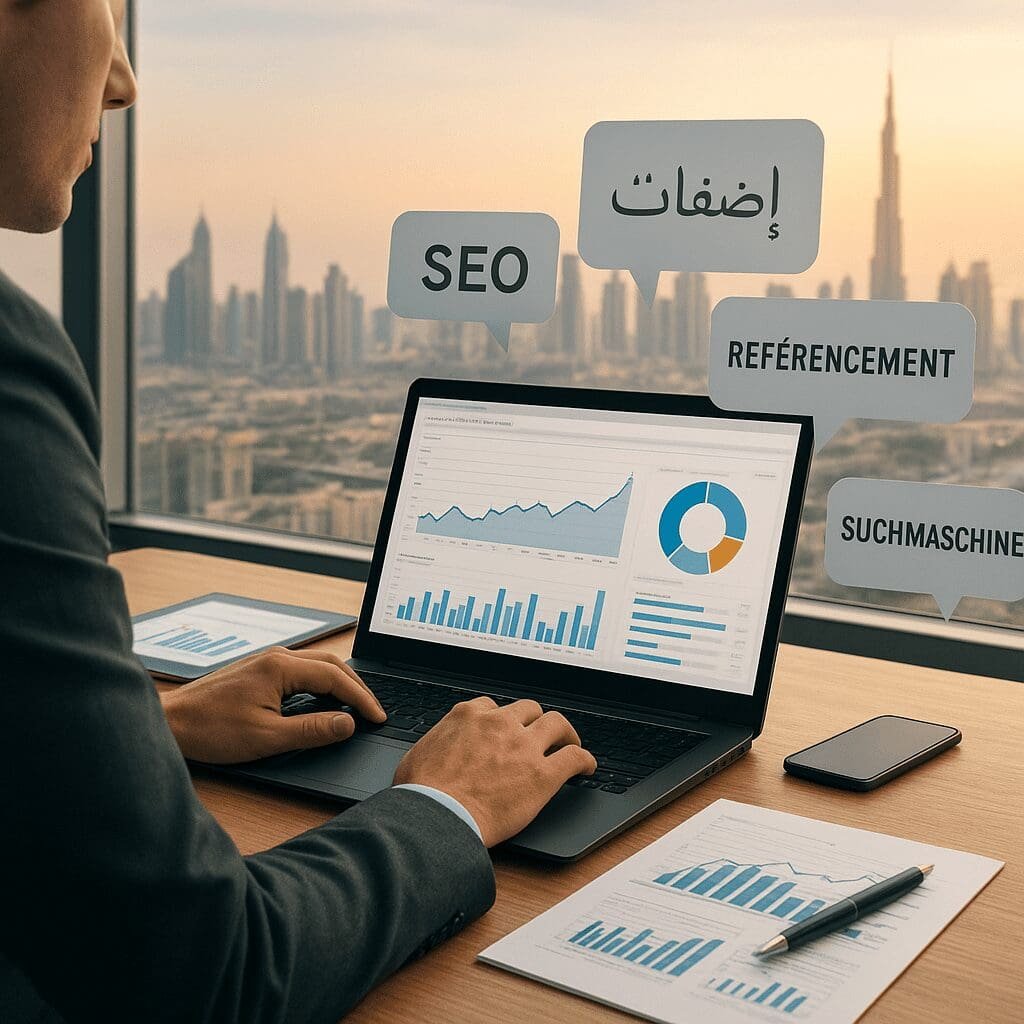
The Impact of Dubai’s Multilingual Environment on SEO
Dubai’s economy thrives on a rare mix of global ambition and local detail. That mix is mirrored in how people search, read, watch, and buy online across languages and scripts. For marketers, the city’s linguistic reality isn’t a footnote—it is the terrain. This article maps how a multilingual audience reshapes search opportunity in Dubai, what technical and strategic moves increase visibility, and how to measure gains with precision. It draws on real usage patterns, known market statistics, and field-tested practices to help teams build search programs that win in both breadth and nuance.
Dubai’s Linguistic Mosaic: Why It Reshapes Search
Dubai is home to residents from more than 200 nationalities, with expatriates comprising a dominant share of the population across the UAE. That composition fuels a digital market where the official language coexists with wide use of business lingua francas and community tongues. The practical result for search is simultaneous demand for content in multiple languages, differences in query syntax and phrasing, and expectations that brands will adapt to cultural context, not just translate words.
Several structural factors make the city distinct for search marketers:
- Population composition: The UAE’s population is majority expatriate, and Dubai is its most international city. This migration-driven diversity is visible in searches that mix languages, transliteration (e.g., Latin characters for non-Latin words), and code-switching within the same task flow.
- Digital adoption: Internet penetration in the UAE is near-universal (widely reported around 99% in 2024), and smartphone adoption is among the world’s highest. This pushes search volume to mobile, where brevity, autocorrect, and voice input alter keyword patterns.
- Search engine dominance: Google holds the overwhelming share of search in the UAE (commonly measured above 95% by StatCounter in 2024). Optimizing for Google’s guidelines, features, and evaluation signals is therefore non-negotiable, while YouTube and app-store search often function as parallel discovery channels.
- Tourism flow: Dubai welcomed over 17 million international overnight visitors in 2023, reinforcing seasonal search behaviors across travel, retail, and dining in multiple languages. Optimizations must anticipate peak periods such as Ramadan/Eid, Dubai Shopping Festival, and year-end holidays.
In short, the city’s audience can be described as both concentrated and fragmented: concentrated on a few dominant platforms, fragmented across languages, scripts, and cultural frames of reference. Successful SEO programs in Dubai turn this complexity into a portfolio of micro-opportunities instead of fighting for a single monolithic ranking.
Search Behavior Across Languages in Dubai
Understanding how people search in Dubai means examining intent expression across languages and the mechanics of input on mobile devices. Differences are most visible in three areas: phrasing, transliteration, and place awareness.
Phrasing and query structure
Arabic queries often lean on descriptive noun phrases or intent-bearing universals (e.g., “best,” “near me,” “price”), but the specific tokens and order may diverge from literal translations. English queries skew terse, frequently branded or category-plus-modifier. South Asian languages (Hindi, Urdu, Malayalam, Tagalog/Filipino) bring their own idioms; however, many speakers still search in English for transactional tasks while using their native language for informational or community needs. This blend creates overlapping yet distinct keyword clusters even for the same product.
Transliteration and Arabizi
Users may type Arabic names in Latin characters (e.g., mall names, areas, foods) or blend numerals to represent Arabic phonemes (“Arabizi”). Meanwhile, brand names can appear in multiple transliterated variants. A search strategy should capture these variants in research and content planning, balancing breadth with quality so as not to dilute topical authority.
Local context and landmarks
Directions, proximity, and landmark-based wayfinding dominate mobile search: “near mall of X,” “in Business Bay,” “close to metro,” “parking City Walk.” Google’s local pack and map interface reward granular coverage of neighborhoods, towers, and mixed-use developments, with name forms and spellings in both the official script and English. Location signals (map pins, structured data, internal linking tied to districts) are pivotal to local visibility.
Device and modality trends
High mobile share and strong video consumption shape discovery flows. YouTube is a go-to channel for how-to, product trials, and reviews, sometimes preceding a brand or category search on Google. Voice queries rise around navigational and hands-free scenarios; assistants in Arabic and English reinforce natural-language phrasing. Short-video search behaviors also influence search language, as users replicate phrases they’ve heard in videos when they move to Google or app stores.
Technical Foundations for Multilingual SEO in Dubai
Technical architecture is where discoverability either scales or stalls. A well-structured site provides clear language and regional signals to crawlers, preserves crawl budget, and ensures the right page ranks for the right user. In Dubai, multilingual setups commonly involve at least Arabic and English; some brands add Hindi/Urdu or Filipino based on audience composition.
URL architecture and language tagging
- Choose a consistent URL strategy: subdirectories (example.com/ar/), subdomains (ar.example.com), or country code domains if relevant (example.ae). Subdirectories often consolidate authority efficiently when markets are closely related.
- Deploy hreflang annotations correctly across every language variant to guide Google toward the right page for each user’s language/region signal. Ensure reciprocal pairs, include x-default for language selectors, and validate at scale.
- Declare language in the HTML tag and use the inLanguage property in structured data for clarity.
Right-to-left (RTL) rendering and accessibility
- Implement dir=”rtl” for Arabic sections and ensure CSS supports mirrored layouts without breaking components (carousels, breadcrumb order, iconography).
- Adopt systematically tested typography: Arabic webfonts can be heavier; subset fonts, use modern compression, and preload critical faces to avoid CLS and FOIT impacts.
- Screen readers: Make sure language attributes switch correctly so assistive technologies read in the correct voice.
Canonicalization and duplication control
- Prevent cross-language cannibalization: English pages should not outrank Arabic ones for Arabic queries, and vice versa. Self-referencing canonicals, precise hreflang, and distinct internal linking graphs per language curb leakage.
- Handle transliteration variants by selecting a single primary URL and redirecting secondary forms or mapping them via internal linking rather than proliferating near-duplicates.
Structured data and SERP features
- Use organization, localBusiness, product, event, and FAQ markup to help Google understand entities and content purpose. Include the schema in every language with translated fields (e.g., name, description) and appropriate inLanguage.
- Events are especially powerful in Dubai’s calendar-driven economy. Mark up date ranges for Ramadan activations, festivals, and seasonal sales.
- For local businesses, provide multi-language opening hours descriptions when relevant and ensure map category alignment matches the localized naming.
Performance and crawl efficiency
- Minimize resource duplication across languages by sharing design systems, sprites, and framework bundles, but avoid bundling language strings in the same payload when they aren’t needed.
- Use CDNs with PoPs in or near the Gulf to cut latency. Arabic pages can suffer from large font payloads; focus on subsetting and caching headers.
- Provide separate language sitemaps and surface them in robots.txt for clarity.
Content and On-Page Strategy: Translation vs Transcreation
The core principle for multilingual content in Dubai is that the best-ranking page is not just a translation—it is the best answer for how the target audience frames the question. That often requires transcreation: rethinking headlines, structures, and visuals so each version is native, not derivative.
Arabic: MSA and Gulf nuances
Modern Standard Arabic (MSA) is safe for broad reach, but subtle Gulf dialect cues boost resonance for local searches. Decisions to inflect copy should be intentional and consistent across touchpoints. Navigation labels, CTAs, and microcopy must be short, directive, and tested on mobile; line length and punctuation norms differ from English.
English for business and transactional searches
English remains the working language for many corporate and transactional tasks. Keep category naming consistent with how users describe products in the region, not necessarily the UK or US. Incorporate local modifiers (Dubai, UAE, neighborhood names) and address region-specific concerns (warranty availability, VAT, delivery times within the emirate).
Beyond two languages: when to expand
Consider Hindi/Urdu or Filipino when data shows sustained query volume and funnel progression. Pilot with a high-intent hub (e.g., payments page, key product category) rather than replicating the entire site. Measure uplift and expand based on achieved return.
Information architecture and cross-language parity
- Maintain content parity for critical journeys (category pages, checkout help, contact and policy documents) so users don’t hit dead ends when switching languages.
- Build topic clusters per language to earn topical authority. Internal links should be native-language anchor text, not machine translations.
- Place a visible language switcher that preserves the user’s context (switching “/en/product-x” maps to “/ar/product-x” where it exists); use x-default for the selector page.
Media and UX considerations
- Visuals should reflect Dubai’s built environment and demographics without stereotyping. Landmarks, skyline views, and district names aid orientation.
- Form UX must support bilingual input: name fields, addresses, and search bars should accept both scripts without validation errors.
- CTAs should be A/B tested by language; an English “Book now” may correspond to a more formal Arabic imperative. Subtle linguistic differences can move conversion rates materially.
Local SEO and SERP Features in a Bilingual City
Local and rich results are disproportionately important in Dubai, where users rely on maps, directions, and snippets to act quickly.
Google Business Profile (GBP) for multiple languages
- Add Arabic and English descriptions within GBP. Categories should match language context; verify that Arabic category labels map to the correct English equivalents.
- Solicit and respond to reviews in both languages. Review snippets feed into snippets and can influence E‑E‑A‑T perceptions.
- Ensure address and place names appear in both scripts where possible; users search by either, and map results can hinge on proximity to well-known towers or roads.
Snippets, FAQs, and zero-click searches
- Structure content to own featured snippets in both languages. Paragraph, list, and table formats should be localized, not translated literally.
- FAQ sections, if genuinely helpful, can capture People Also Ask visibility. Maintain a separate Q&A bank per language to reflect different common questions.
Entity coherence across languages
For brands, venues, and products with names transliterated into Arabic, build entity bridges: mention the native and transliterated names within the page (ideally near first mention), ensure consistent usage in structured data, and align Wikidata/Wikipedia references when applicable to strengthen knowledge graph understanding.
Measurement, Tooling, and Experimentation
Dubai’s multilingual scope increases the need for precise measurement. Treat each language as both a distinct market and an interacting channel.
Analytics instrumentation
- In GA4, track language selection events and persist language preference as a user property. This enables cohort analysis and attribution per language journey across sessions.
- Segment by page path (e.g., “/ar/”) and compare funnel metrics to identify friction unique to RTL pages (e.g., higher bounce on Arabic PDPs because of a carousel bug).
- In Search Console, filter by country and query language signals (inspect query strings with Arabic characters or transliterated patterns). Monitor impressions, clicks, and CTR per language to detect leakage where the wrong variant ranks.
Keyword research templates that respect language reality
- Seed with queries from each language’s Search Console dataset; expand via autosuggest in both scripts and transliteration variants.
- Cluster topics by intent rather than direct translations. Users may ask “how it works” in one language but “price” in another at the same funnel stage.
- Use paid search to validate uncertain keyword groups quickly; pivot spend toward volumes that convert while content is in production.
Testing frameworks
- Run language-paired experiments: the same component change on Arabic and English pages measured separately. Differences can reveal cultural preferences in CTA shape, copy tone, or social proof.
- Track assisted conversions by language to capture cross-language behavior (e.g., research in English, purchase in Arabic).
Link Earning and Authority in Multilingual Media
Dubai’s media and creator ecosystem spans Arabic and English outlets, plus diaspora publications and niche vertical blogs. Authority grows when content travels across that landscape with shared substance but native expression.
- Digital PR: Build angles for both Arabic and English desks. For example, a data report can be pitched with different headlines tailored to each newsroom’s framing.
- Community nodes: Leverage neighborhood groups, expatriate forums, and industry associations for mentions and citations that reinforce local relevance.
- Influencers: Micro-influencers within districts or verticals often outperform mega-creators in driving qualified traffic. Provide assets localized per language, including captions and on-screen text.
E‑commerce and Conversion Architecture
Checkout friction is amplified by language gaps. Streamline every step so users feel at home regardless of their default script.
- Payments: Offer region-standard options (major cards, local wallets, and BNPL partners) and label them in each language. Trust badges should be recognizable to the local audience.
- Addresses: Support bilingual input and provide autocompletion with Dubai’s communities, towers, and landmarks. Avoid rejecting Arabic characters in any form fields.
- Policies: Return, exchange, and warranty pages must be parity-localized. If your English policy page is comprehensive but Arabic is sparse, expect abandonment.
- Microcopy: Delivery date estimates should reflect local realities (weekend schedule, public holidays) for both languages.
Compliance, Culture, and Brand Safety
Dubai’s regulatory environment prioritizes consumer protection, modesty norms, and accurate claims. Ensure all language versions observe the same standards.
- Claims and disclaimers: Health, finance, and real estate content must avoid exaggerated promises. If one language carries a disclaimer, all should.
- Imagery: Align with cultural expectations; avoid visuals that would be acceptable in other regions but inappropriate locally.
- Language priority: Arabic is the official language; customer-facing legal materials often need Arabic versions. Commercial signage typically prioritizes Arabic—this expectation carries over into digital journeys.
Operationalizing Multilingual Workflows
Winning programs in Dubai bake multilingual needs into the operating model, not just content sprints. That means assembling cross-functional teams and processes designed for scale.
- Roles: Pair native-level copywriters with technical SEOs who understand RTL and structured data. Editors should guard tone consistency in each language.
- Glossary and style guides: Maintain a bilingual glossary for product names, category labels, and CTAs. Lock down approved transliterations for brand terms.
- Design systems: Components must be RTL-ready by default. Avoid one-off fixes that will break on the next campaign.
- Governance: Institute pre-release checks for localization quality, performance, and compliance per language.
Data Signals That Matter in Dubai
Not all ranking signals weigh the same in a multilingual environment. The following tend to correlate strongly with durable outcomes in Dubai:
- Language intent alignment: The page that best answers the user’s question in their chosen language wins. Clarity here beats mechanical translation.
- Entity coherence: Consistent naming across scripts, profiles, and citations builds confidence for knowledge graph systems and reduces ambiguity.
- Local proximity and authority: Map accuracy, reviews in multiple languages, and high-quality local citations influence both local pack and organic performance.
- Experience signals: Speed, stable layout, intuitive RTL navigation, and clear microcopy drive engagement metrics that compounds rankings.
Playbook and Checklist for Dubai-Focused Multilingual Search
- Audit: Inventory content by language; identify gaps in critical journeys (payment, support, store locator) and slow pages caused by font payloads.
- Architecture: Pick URL structure, implement comprehensive hreflang, and create language-specific sitemaps.
- Content: Build topic clusters per language. Transcreate high-value pages (category hubs, guides), and localize CTAs.
- Local: Complete GBP in both languages; standardize NAP data; generate bilingual review flows; add structured data with inLanguage.
- Performance: Subset fonts, deploy CDN, and test on mid-range Android devices common in the market.
- Research: Expand keyword sets with transliterations and code-switch forms; validate with PPC pilots before big content investments.
- Measurement: Tag language selection; compare funnel KPIs; monitor Search Console per language. Create custom dashboards for analytics.
- Governance: Lock a bilingual glossary and brand style guide; implement pre-launch QA for RTL, schema, and compliance.
- PR and links: Pitch bilingual press angles; secure citations in local directories and district-focused community pages.
- Iteration: Run A/B tests by language and feed learnings into the design system to prevent regressions.
Benchmarks, Stats, and What They Mean
While each brand will see different baselines, several macro indicators help set expectations and priorities:
- Search engine share: Google typically commands more than 95% of search in the UAE (StatCounter, 2024). Focus technical efforts on Google’s guidelines first, then optimize for YouTube and app-store discovery where relevant.
- Connectivity: Internet usage is near 99% of the population (DataReportal 2024). Mobile-first design is table stakes, not an optimization layer.
- Social influence on search: The UAE consistently ranks among the world’s highest for social media usage. Expect search demand to spike following local influencer campaigns and seasonal cultural moments.
- Tourism: With over 17 million international visitors in 2023, hospitality and retail categories should run language-aware seasonal playbooks aligned to key source markets.
The practical takeaway: resource allocation should mirror language demand patterns and peak periods. Anchor Arabic and English as core pillars, then layer selective investments into additional languages where ROI is demonstrable.
Common Pitfalls—and How to Avoid Them
- Literal translation of keyword lists: This misses underlying search motives. Cluster by task and compare SERPs by language to see how competitors satisfy needs differently.
- Incomplete RTL support: Visual asymmetry or broken components on Arabic pages signal neglect and depress engagement metrics.
- Ignoring transliteration: Failing to capture common variants of place and brand names forfeits meaningful traffic.
- Weak cross-language parity: If customer support is complete in English but thin in Arabic, users will abandon or switch devices to solve problems elsewhere.
- Over-segmentation without authority: Spreading thin across many languages can weaken topical depth. Start where you can earn and defend authority.
Team Skills and Tools That Raise the Ceiling
A durable multilingual program blends editorial rigor with engineering maturity. Invest in:
- Native-speaking editors for each language who can adapt tone and idiom to Dubai’s audience.
- Engineers familiar with RTL, font strategy, and structured data scaling.
- SEO analysts who can bridge qualitative SERP observation with quantitative dashboards, moving from correlation to causation in experiments.
- Automation for quality assurance: Lighthouse CI with RTL test suites, schema validators per language, and automated screenshots for layout drift detection.
Outlook and Opportunities
Dubai’s next phase of growth is tied to continued sector diversification—finance, logistics, tourism, healthcare, and technology—each with increasingly sophisticated online journeys. Brands that treat multilingual search as a system rather than a series of translations will compound gains: they will earn entity trust across scripts, achieve design parity for right-to-left experiences, and capture both exploration and transaction queries at scale. That mindset transforms a seemingly complex environment into a repeatable advantage.
To get there, make ten commitments: be audience-native in two anchor languages; research across scripts and transliterations; engineer for RTL from the component level; deploy structured data with language clarity; prove value quickly with high-intent hubs; localize social proof; match Dubai’s seasonal cadence; measure language cohorts end to end; integrate paid data to accelerate learning; and iterate without sacrificing quality. In a city where every district has a story and every audience has a voice, mastering the multilingual reality is not optional—it is the operating system of growth.
Practical Examples to Spark Execution
Consider three illustrative, anonymized patterns that recur in Dubai:
- Hospitality: A hotel near a landmark observes that English queries center on brand and amenity (“pool,” “family room,” “late checkout”), while Arabic queries lean into proximity and value (“near metro,” “offers Ramadan,” “breakfast included”). Transcreating headers and FAQs for Arabic, adding landmark schema, and aligning GBP to both languages yields outsized gains in local pack and featured snippets.
- E‑commerce electronics: English PDPs outperform Arabic in organic traffic but underperform in checkout completion. Investigation shows Arabic pages suffer layout shift from heavy fonts and unclear installment microcopy. Font subsetting, clearer Arabic CTAs, and parity in warranty copy increase completion while stabilizing rankings through better engagement.
- Healthcare clinic: Users research symptoms in English but look for appointment booking in Arabic. Building a bilingual symptom hub, adding doctor profiles with dual-script names, and embedding appointment schema in both languages bridges research and action, improving assisted conversions across channels.
From Strategy to Daily Practice
Turn this playbook into habits:
- Weekly: Audit Search Console by language; check transliteration variants rising in autosuggest; review GBP Q&A in both languages.
- Monthly: Ship at least one transcreated hub or update; A/B test a component in both languages; expand structured data coverage for priority templates.
- Quarterly: Refresh the bilingual glossary; run a crawl to ensure hreflang health; review local citations and earned links across Arabic and English outlets.
- Seasonal: Build campaigns around Dubai’s event calendar with localized landing pages and PR hooks; align paid and organic to capture surges.
Across all of this, remember the principle that connects tactics to outcomes: relevance is language-shaped. Whether a user starts in Arabic, switches to English, or navigates via transliteration, the winning experience feels native at every turn. When your teams design, ship, and measure with that assumption, Dubai’s complexity turns from obstacle to advantage—and your search visibility compounds accordingly.