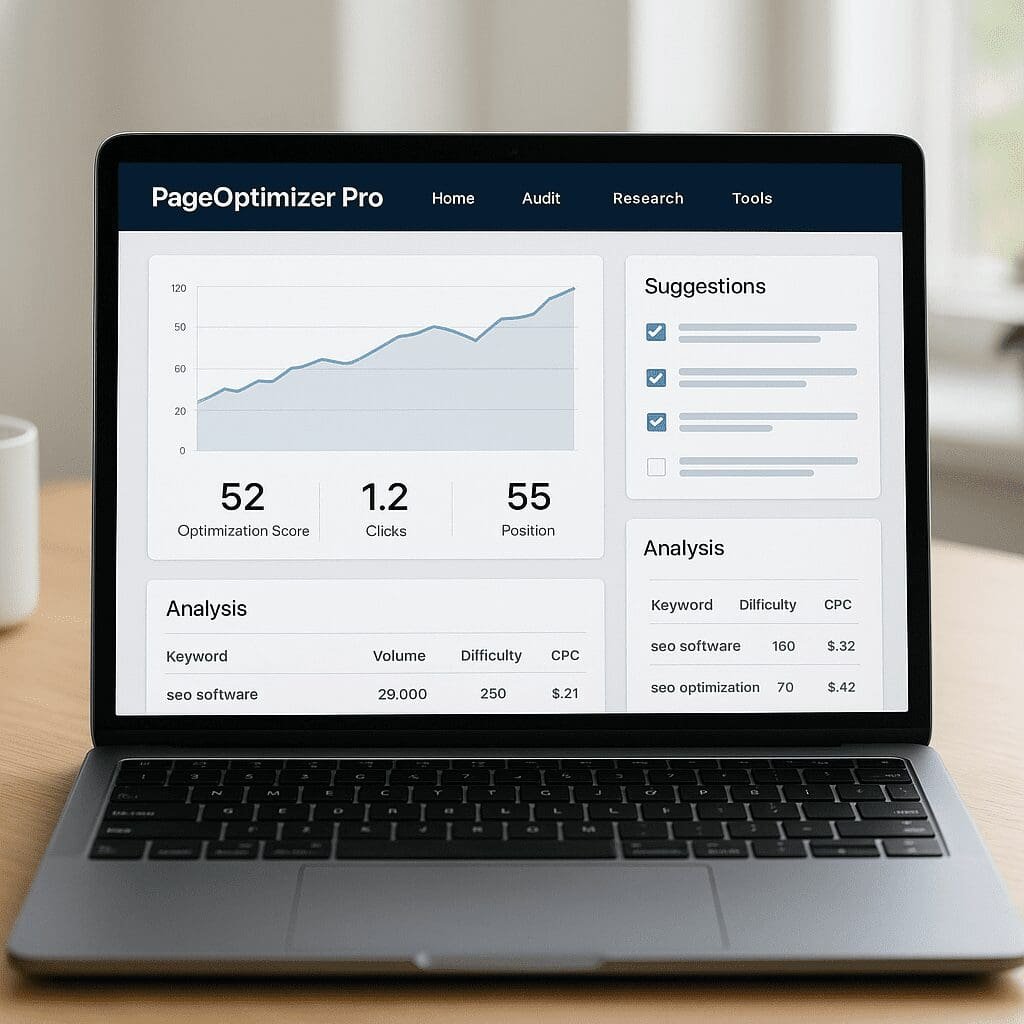
PageOptimizer Pro
PageOptimizer Pro (POP) is a practical, experiment-driven tool for on-page SEO that focuses on what already works in the current SERP. Instead of guessing, it measures how top competitors structure their pages and then translates those patterns into step-by-step optimization recommendations you can implement in minutes. It feels less like a crystal ball and more like a checklist informed by observable ranking signals. For solo marketers, agencies, and in-house teams under publishing pressure, POP’s appeal is its precision: it tells you what to add, where to add it, and how much is likely enough.
What PageOptimizer Pro Is and How It Works
PageOptimizer Pro was built around the idea that search engines reward pages that align with patterns common to winners in a given query space. POP crawls the pages that already rank, catalogs their structural and semantic elements, and then shows you how to bring your own page into alignment. This “match the winners” approach is essentially informed correlation, applied at the level of headings, body copy, image attributes, link usage, and other on-page elements.
POP’s core audit evaluates target keyword placement (title tag, URL slug, H1/H2/H3, introductory paragraph), supporting terms and topics, word count, and various HTML attributes. It then outputs a prioritized set of recommendations with estimated impact. In practice, that means you can open a report and see exactly where to add or adjust content to close the gap with competitors—without rewriting your entire page.
One of POP’s distinguishing features is how granular its guidance can be. It doesn’t just say “add your keyword more often”; it shows how many times to include it in headings, how many images should carry descriptive alt text, whether to introduce a table or list, and how to balance primary and secondary terms. You can accept its default competitor set or hand-pick which URLs to benchmark against—useful when the SERP includes outliers like giant directories or thin category pages that you don’t want to model.
Does PageOptimizer Pro Actually Help Rankings?
In most cases, yes—especially for queries where on-page alignment makes the difference between page two and page one. POP is built by practitioners accustomed to testing hypotheses in real SERPs, and it shines when your page is close but not quite there. Think informational articles missing a few key subsections, local service pages lacking supporting signals, or ecommerce category pages underusing relevant synonyms and entities.
However, POP is not a magic wand. It won’t fix slow hosting, nonexistent backlinks, or a weak brand. It works best as part of a systematic process that includes technical hygiene, link earning, and a credible publishing cadence. Treat POP as a tactical lens: it reveals what the market expects to see on a page for a given query and helps you meet that expectation efficiently.
There’s a secondary benefit: workflow and quality control. By encoding best practices as measurable guidelines, POP reduces room for error across teams. Writers, editors, and SEOs can align on what “done” looks like for a page. That consistency often translates into faster time-to-publish and fewer rounds of revision, which matters when you scale.
Key Capabilities and What They Mean in Practice
Content Editor and Scoring
POP’s editor gives you a live score as you implement recommendations. It breaks guidance into plain tasks: add the keyword in H2s, introduce a specific number of supporting terms, expand a section by N words, add alt text, and so on. The immediate feedback reduces guesswork and shortens iteration cycles.
Competitor Selection
You can rely on POP’s automated SERP selection or curate your own. Hand-picking is worthwhile when the top results include mixed intent (e.g., navigational homepages, “people” profiles, PDFs) or when your business model requires benchmarking against similarly resourced sites.
Term and Topic Suggestions
Beneath the hood, POP looks at term frequencies, coverage of subtopics, and distribution across headings and paragraphs. It does not claim to “know the algorithm,” but it does a good job translating what high-ranking pages cover into a workable outline for yours, making it easier to hit depth without fluff.
Structural Guidance
POP flags gaps that often affect usability and ranking: missing summary boxes, lack of lists or tables, absent FAQ sections, or insufficient image support. For a reader, these structures improve scannability; for a search engine, they signal comprehensive coverage and intent alignment.
People Also Ask and Related Searches
Users can integrate common questions and related queries into the outline. This helps you address adjacent intent and expand topical coverage without drifting off-topic.
Chrome Extension and Editorial Workflow
The Chrome extension brings POP’s recommendations into your writing environment, typically Google Docs or your CMS. This reduces tab-switching and helps writers implement guidance as they draft, rather than retrofitting after the fact.
AI-Assisted Drafting
POP includes optional AI drafting that uses your brief and recommendations to generate initial sections. It’s not a one-click publish button, but it can accelerate the first draft—especially for standard sections, FAQs, and definitions—so writers spend more time on examples, insights, and brand voice.
Localization and Market Targeting
Because POP analyzes your chosen market’s SERP, you can run reports for specific countries or cities, which is useful in local SEO. The closer your report is to the audience you want to reach, the better the guidance.
Monitoring and Re-Optimization
You can revisit reports to re-run audits after changes ship. This is invaluable when a competitor updates their page or when a core update reshuffles the top results. POP won’t replace analytics, but it gives you a tactical map for on-page adjustments to recover or defend positions.
Practical Setup: A Repeatable PageOptimizer Pro Process
1) Frame the query correctly. Define a primary keyword and check whether the current SERP shows informational, commercial, or mixed intent. POP works best when your page’s intent matches the page types winning the query.
2) Choose competitors. Start with POP’s defaults, then exclude obvious outliers (forum threads for YMYL queries, or massive directory pages when you intend to rank a product page). Include direct peers and a couple of aspirational competitors.
3) Generate the brief. Pull suggested headings, subtopics, and questions into a cohesive outline that reflects your brand’s POV. Don’t blindly copy; POP provides the raw ingredients, but you decide the order and narrative.
4) Draft inside the editor. Write to solve the user’s problem first, then use POP’s guidance to fill gaps: add missing subsections, improve internal linking, and ensure alt text and captions carry descriptive signals.
5) Implement structural wins. Add a short summary box, a pros/cons list, a feature table, or a decision tree if competitors use them. These often earn you longer dwell time and better snippet eligibility.
6) Polish and publish. Check title tag clarity, URL slug simplicity, H1 uniqueness, and meta description value proposition. Ensure that the page loads fast and passes basic accessibility checks.
7) Re-run and iterate. After publishing, re-run the POP report to validate improvements and identify next tweaks. Update the page as the SERP evolves.
This is where POP’s biggest payoff emerges: a reliable workflow that lifts quality and predictability across dozens or hundreds of URLs.
How POP Compares to Other Optimizers
The content optimization field is crowded. Tools like Surfer, Clearscope, MarketMuse, Frase, and NeuronWriter cover similar ground with different philosophies. POP is more prescriptive at the HTML-element level, which appeals to SEOs who want tactical control. Some competitors lean more into editorial UX or bulk content planning. Your choice depends on team style:
- Lean teams: POP’s actionable tasks get you live fast with fewer meetings.
- Agencies: Its repeatable reports make client communication and proof-of-work easier.
- Enterprises: You might pair POP with in-house guidelines and analytics dashboards for governance.
If your writers prefer tight guardrails, POP’s scoring model keeps drafts on track. If they prefer looser ideation, POP still works as a checklist at the end of the line. Either way, the tool’s strengths are precision, measurability, and the ability to teach best practices by doing.
Strengths That Stand Out
- Speed to insights: From keyword to prioritized tasks in minutes.
- Granularity: Guidance down to headings, alt text, and term placement.
- Flexibility: Manual competitor selection prevents you from modeling bad exemplars.
- Editor-first workflow: Live feedback reduces rework.
- Scalability: Produces standardized deliverables that non-SEOs can follow.
Limitations You Should Plan Around
- Correlation, not causation: POP identifies patterns rather than proving why each factor ranks. Educated judgment is still required.
- Off-page blind spots: Links, brand signals, and user behavior live outside POP’s scope. Use it alongside your broader strategy.
- Mixed-intent SERPs: When Google blends intents, you may need multiple page types; POP can guide each page, but it won’t decide your portfolio strategy.
- Overfitting risk: Chasing every micro-signal can bloat pages. Favor clarity and user value over chasing the last 5% of points.
- Language nuance: POP can run in various markets, but the quality of recommendations tracks the quality of the local SERP. Writer expertise remains essential.
Best Practices to Maximize Impact
Anchor every optimization to searcher intent. If top results answer a how-to, do not attempt to rank a product page without building a fit-for-intent companion piece. Use POP to ensure your how-to is complete and easy to scan.
Balance term coverage with readability. Satisfy recommendations using natural phrasing, synonyms, and varied sentence structures. If a term is awkward, place it in a subheading, list item, caption, or FAQ where it reads naturally.
Use internal links strategically. Point from thematically adjacent pages using descriptive anchor text. POP can surface opportunities to connect hubs and spokes; your information architecture should reinforce that decision.
Leverage visuals: images with descriptive alt text, comparison tables, and diagrams. Structured elements improve comprehension and can win you rich snippets.
Iterate with restraint. After updates, give the page time to settle before making drastic changes. Track both ranking and user engagement; success is not only position but also click-through and satisfied sessions.
Technical and Editorial Details POP Tends to Influence
Title, Slug, and Headings
Clear titles with a strong value proposition usually outperform cleverness. Keep slugs short and reflective of the primary term. Headings should mirror the logical outline of the topic and anticipate skim readers.
Introductory Paragraphs and Summaries
Lead with the answer, then elaborate. POP’s guidance often nudges you to include the primary term early; doing so also helps users confirm they’re in the right place.
Media and Accessibility
Use alt text to describe images for human readers first; SEO benefits follow. Captions can carry secondary terms without sounding forced, and transcripts for audio/video help with coverage and accessibility.
Schema and Snippets
Where appropriate, implement FAQ, HowTo, Product, or Article schema. POP can prompt you to add sections that translate cleanly into structured data, improving your chances at enhanced results.
When PageOptimizer Pro Is a Particularly Good Fit
- Affiliate and review content: The tool highlights comparison points and subtopics competitors cover.
- Local service pages: It helps balance service descriptions with trust and proof elements.
- Ecommerce categories: Improves scannability with lists, filters, and snippet-friendly sections.
- SaaS blogs and docs: Keeps evergreen guides comprehensive and up to date versus changing competitor playbooks.
- Agency retainers: Converts subjective debates into objective tasks and progress reports.
Addressing Common Misconceptions
“Optimizing means stuffing keywords.” Not with POP. The goal is balanced coverage, not repetition. The tool encourages distribution across headings, body, images, and FAQs in service of clarity.
“If I hit 100%, I will rank.” Scores are directional, not guarantees. Treat them as thresholds where diminishing returns begin. It’s wise to stop when the page reads cleanly and moves the user forward.
“AI can write it all for me.” AI drafting is a speed feature, not a substitute for subject expertise. Add unique examples, data, and brand tone to earn engagement and links.
How POP Interacts with Modern SEO Signals
Google’s systems increasingly pay attention to semantic coverage, intent satisfaction, and helpfulness. POP’s emphasis on structural completeness pairs well with those trends. By basing suggestions on what real winners do, it reduces the chances of missing crucial angles while keeping you grounded in competitive reality.
At the same time, you must supply what tools cannot: credible sourcing, expert judgment, and firsthand experience. Cite authoritative references, include test results or screenshots where relevant, and state clear takeaways. These additions enhance perceived expertise and trust beyond what any optimizer can prescribe.
A Note on Language and Semantic Coverage
Modern ranking systems parse meaning through entities and relationships. POP’s guidance often nudges you to cover adjacent concepts and definitions, which helps algorithms infer topical breadth and depth. Where possible, use precise terminology, define acronyms at first use, and include real-world examples to ground abstract ideas.
This is also where judicious use of synonyms and variants pays off. Treat recommended terms as prompts to expand, not mandates to repeat.
Editorial Ops: From Single Article to Program
Rolling POP out across a larger program requires governance. Establish templates for common page types (how-tos, comparisons, service pages), align on minimum viable components (summary box, FAQ, internal links), and set a cadence for re-optimization. A lightweight playbook keeps work consistent even as teams change.
For multi-market sites, localize with intent. Don’t translate outlines verbatim; rerun reports for each target SERP to account for regional competitors, queries, and examples. Local proof points—prices, regulations, brand names—matter.
Where POP Might Not Be Enough
Hyper-competitive queries dominated by authoritative brands may require substantial link equity and offline signals beyond on-page best practices. Also, niche technical topics demand expertise; a perfectly structured but shallow article will underperform versus a subject-matter-led piece with original insight.
In these cases, POP still provides value as a checklist to avoid leaving easy wins on the table, but your strategy must extend to digital PR, partnerships, and thought leadership.
Opinion: Is PageOptimizer Pro Worth It?
For teams who value measurable, repeatable NLP-aware guidance without getting lost in dashboards, POP is a strong choice. Its editor-first philosophy, competitor-grounded recommendations, and sensible defaults make it easy to adopt. It’s not a substitute for research, UX, or authority building, but it reliably upgrades pages from “good” to “competitive.”
The caveat is discipline. Use POP to decide what to include, not as an excuse to overstuff. Prioritize helpfulness and clarity, then let the tool help you check for gaps. If you do, you’ll avoid the common pitfalls of over-optimization and keep your pages aligned with how people read and decide.
Actionable Tips You Can Apply Today
- Run POP on your top five near-miss URLs (positions 8–20). Close the obvious gaps first.
- Turn recommended questions into an FAQ block; mark it up with appropriate schema.
- Add a skim-friendly summary at the top with links to sections for quick navigation.
- Use descriptive anchors for internal links; map hubs and spokes on a whiteboard and mirror this in your site nav.
- Schedule a quarterly POP audit for evergreen pages to keep pace with SERP changes.
Final Perspective
PageOptimizer Pro earns its place in a modern stack by making the invisible visible: it surfaces the implicit rules that winning pages follow and turns them into a to-do list you can ship. Marry that with editorial taste, brand credibility, and real-world examples, and you get pages that do more than rank—they help users accomplish their goals. That alignment between user success and algorithmic relevance is where sustainable growth lives.