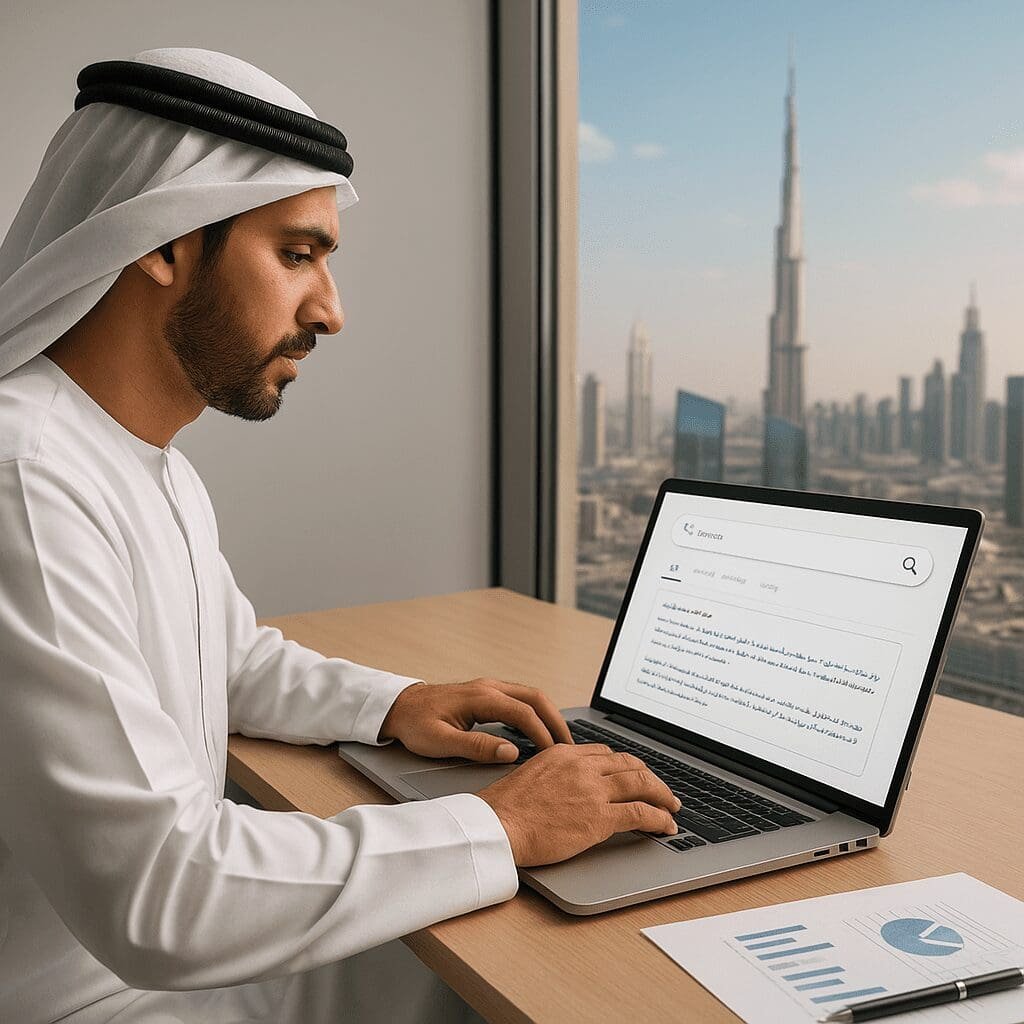
Optimizing for Arabic Search Queries in Dubai
Search behavior in the United Arab Emirates is shaped by an unusual mix of linguistic richness, globalized commerce, and demanding users who expect instantaneous, localized answers in their language of choice. To win discovery and revenue in Dubai, teams must treat Arabic search optimization as a first-class discipline—equal in rigor to English—while respecting dialect, orthography, cultural nuance, and the technical realities of a right-to-left web.
The linguistic landscape behind queries in Dubai
Dubai’s language ecosystem blends Modern Standard Arabic (MSA), Gulf/Emirati dialects, and everyday code-switching with English. That creates distinctive behavior patterns in queries, snippets, and SERP preferences:
- MSA vs. dialect: Many users search in MSA for informational topics (banking, government services, health), but switch to colloquial Emirati for hyper-local and commercial discovery. Queries like “أفضل مطعم مندي في دبي” (best mandi restaurant in Dubai) may coexist with dialect spellings or phonetic shortcuts.
- Transliteration and “Arabizi”: Some segments—especially younger users—type Arabic words with Latin characters or numbers (e.g., “mandi dubai a7san”). You may also see English brand names in Arabic sentences and vice versa.
- Orthographic variation: Hamza forms, taa marbuta (ة vs. ه confusion), yaa/alif maqsura (ى vs. ي), and optional diacritics generate multiple spellings of the same term. Effective coverage requires keyword clustering that tolerates these variants.
- Numerals and punctuation: Users mix Western digits (123) and Eastern Arabic numerals (١٢٣) in the same query. Snippets that render both cleanly reduce friction.
- Plural, gender, and morphology: Arabic’s rich morphology means a core concept can appear in many forms (singular/plural, masculine/feminine, broken plurals, verb patterns). Relying on a single canonical form undercaptures search demand.
Implication: treat Arabic keyword research as a morphological problem, not a one-to-one translation problem. Cluster by root meaning and intent, not just by the exact surface form. Validate with Search Console impressions to confirm which variants actually trigger impressions for your pages.
Market data and platform priorities in the UAE
Multiple signals confirm the opportunity and the level of competition you face in Dubai:
- Near-universal internet access: According to DataReportal (Jan 2024), internet penetration in the UAE is roughly 99%, and active social media usage exceeds the total population count because of multi-account behavior.
- Smartphone-first behavior: Various industry trackers place smartphone adoption in the mid-to-high 90s percentage range. Pages must load instantly and present clear, tappable Arabic UI elements.
- Search engine dominance: StatCounter data for 2024 shows Google’s market share in the UAE typically above 95%. Bing and privacy-focused engines remain niche but non-zero, especially on corporate desktops.
- Video as search: YouTube usage is among the highest globally; DataReportal regularly finds that YouTube reaches the vast majority of UAE internet users. For many, YouTube is the “how-to” and product research engine in Arabic.
- Voice and local queries: With Arabic now supported across major assistants, question-style queries like “كيف” (how), “أقرب” (nearest), and “أفضل” (best) are prominent—especially for food, services, and destinations.
These inputs set priorities: build for SEO on Google first, never neglect YouTube, and take a mobile-first approach to speed, IA, and conversions.
Arabic keyword research for Dubai
Building a corpus and clustering by meaning
Start by assembling a broad corpus of seed terms from customer interviews, Arabic site search logs, ad queries, and competitor SERPs. Expand with tools that handle Arabic scripts and dialects: Google Keyword Planner, Search Console, Trends (with region set to UAE), and Arabic-capable suites like Ahrefs and Semrush. Since volumes in third-party tools can be sparse or noisy in Arabic, weight decisions heavily toward Search Console impressions once you have baseline pages live.
Cluster terms by underlying concept, not literal spelling. For instance, for medical clinics you might cluster “عيادة أسنان دبي”, “طبيب أسنان دبي”, “تقويم الأسنان دبي”, including dialect spellings and transliterations like “asnan dubai”. Use subclusters for modifiers (near me, prices, reviews, 24 hours, women doctor, family-friendly, parking). Establish target pages for high-value clusters, and add FAQ subsections for long-tail intents.
Managing spelling, numerals, and transliteration
- Create synonym lists for common orthographic variants (e.g., dental/teeth words; hamza placements) and incorporate the top variants naturally across headings, paragraph copy, and FAQs.
- Include both digit styles where appropriate in on-page copy or structured markup, but avoid keyword stuffing. Product specs or opening hours may be the safest area to reflect both numeral styles.
- Gather Arabizi examples from social comments and site search logs; answer them in content but prefer standard Arabic in headings and titles to maximize match rate and professionalism.
Intent segmentation and SERP mapping
Label clusters by transactional, commercial, informational, and navigational intents. Explore SERPs in Arabic for each cluster to anticipate features: map packs, Top Stories, carousels, video results, People Also Ask, and aggregator dominance (e.g., booking marketplaces). This mapping prevents publishing the wrong format: if the Arabic SERP is video-heavy, prioritize Arabic video with captions over long-form text.
On-page optimization that respects Arabic reading and culture
Titles, meta descriptions, and headers
Write concise titles in Arabic with the primary keyword early and the city modifier “دبي” near the front when genuinely relevant. Avoid mechanically appending “دبي” to global topics. Craft meta descriptions with an actionable value proposition and a short CTA. For readability, keep line lengths appropriate for RTL displays on phones, and ensure that LTR brand names or codes do not break the flow.
URL slugs and internal anchors
Two viable slug strategies exist: Arabic slugs or transliterated English. Arabic slugs reinforce relevance but require careful handling across analytics, logging, and sharing. If your stack struggles with encoding, use clean English or transliteration and focus Arabic signals in titles, headers, and body copy. Internal anchors should use Arabic anchor text for Arabic pages to reinforce topical connections.
Media and accessibility
- Use Arabic alt attributes for images where the image conveys meaning; keep decorative images empty. This aids image search and accessibility.
- For video, supply Arabic titles, descriptions, and captions; if the audio is in Arabic, include an Arabic transcript on the page to amplify indexable text.
- Choose fonts optimized for Arabic scripts and ensure baseline legibility at small sizes on phones. Avoid mixing incompatible font styles for LTR elements.
Trust and expertise signals
Clearly display author names, credentials, editorial review notes, and update dates in Arabic. Government, health, and finance topics benefit from cited local standards or regulations. Showcase structured reviews and localized awards. Real photos of locations and Arabic UI microcopy increase credibility more than translated boilerplate.
Technical SEO and international targeting
Hreflang and architecture
- Use dedicated URLs per language: /ar-ae/ for Arabic (UAE), /en-ae/ for English (UAE). A sitewide hreflang map should include ar-AE, en-AE, and canonical self-references.
- Ensure mutual hreflang return tags and use XML sitemap hreflang annotations for scale.
- Separate sitemaps by language to spot indexing asymmetries quickly.
Right-to-left rendering and HTML hygiene
- Declare lang=”ar” and dir=”rtl” appropriately on Arabic pages or containers. For mixed content (e.g., English model names), wrap those segments in dir=”ltr” to prevent punctuation drift.
- Test breadcrumbs, pagination, and number formatting in RTL. Pay attention to truncation in Arabic SERPs; avoid overly long tokens that push the unique value off-screen.
Performance and hosting
Speed matters more when users are on cellular networks or roaming. Host close to the UAE or use a CDN with Middle East POPs (e.g., Bahrain, UAE). Optimize critical CSS for Arabic fonts, subset them to reduce file size, and defer non-critical scripts. Tune Core Web Vitals with field data from users in the UAE, not only lab tests. If you ship separate bundles for Arabic, ensure cache keys reflect language to avoid mismatched assets.
Structured data and SERP features
Leverage structured data thoughtfully to qualify for Arabic rich results. For LocalBusiness, Product, HowTo, FAQ, and Article types, set inLanguage to “ar” on Arabic pages and include Arabic names, descriptions, and address fields. Marking up prayer-time pages or calendars is unnecessary, but publishing accurate Ramadan hours with clear copy improves user satisfaction. Choose categories and properties that map naturally to Arabic concepts; the goal is precision, not volume. Proper schema helps Google present your information in Arabic carousels and knowledge panels.
Local SEO for discovery in Arabic
Google Business Profile (GBP) in Arabic
- Maintain an Arabic business name variant on the Arabic site and reflect it consistently in citations. Keep NAP details clear in Arabic, including building names and landmarks common in Dubai addresses.
- Add Arabic categories and services where available, and post Arabic updates around seasonal hours (especially Ramadan and Eid).
- Encourage Arabic reviews and respond in Arabic when appropriate. Surfacing review snippets in Arabic on your site (with proper permissions) can boost trust and engagement.
Local citations and maps
List your business in prominent UAE directories that support Arabic entries. Ensure map pins match the Arabic signage or landmark references locals use. If you serve multiple Dubai neighborhoods, dedicate Arabic landing pages per area with genuine content and internal links from your hub page.
Editorial strategy and seasonal planning
Create an Arabic editorial calendar tuned to the rhythms of Dubai life:
- Ramadan and Eid: Adjust opening hours, delivery expectations, and content tone. Publish Arabic FAQs about promotions, charity initiatives, and late-night service options during Ramadan.
- Retail and events: Dubai Shopping Festival, Gitex Global, Art Dubai, and peak tourism months drive spikes in commercial queries. Prepare Arabic guides, comparison pages, and buyer’s checklists two to three months ahead.
- Public services and expat needs: Arabic how-tos for residency steps, healthcare appointments, and transport cards can attract links and brand goodwill—provided content is accurate and regularly updated.
For every pillar page in Arabic, plan cluster articles, a short explainer video with Arabic captions, and a lightweight infographic. Repurpose English research, but re-report with local Arabic examples, metrics, and quotes to avoid the “translated brochure” feel. High-quality content in Arabic stands out because much of the competition still relies on direct translation.
YouTube and short-form video in Arabic
Given YouTube’s reach, invest in Arabic titles, descriptions, and chapters. Add Arabic subtitles even if the audio is English; many viewers browse on mute in public places. For shorts and reels, place the hook text in Arabic within the first two seconds and use Dubai-specific context (landmarks, neighborhoods). Pair each video with a corresponding Arabic landing page that expands on the topic and captures search demand beyond YouTube.
Paid search as a feedback loop for organic
Arabic PPC in Dubai doubles as a rapid validation layer for organic topics. Test ad copy variants to learn which phrasing resonates in Arabic, then fold winners into title tags and H2s. For Shopping ads, ensure Arabic titles and attributes exist in your feed, including brand transliterations and local size conventions. Apply negatives for common mismatches caused by homonyms in Arabic. The fastest way to refine SEO targets is to let paid search surface intent and messaging data you can reuse organically.
Link acquisition and digital PR in Arabic
- Publish original Arabic research or mini-data stories about Dubai consumer trends. Local news outlets and community portals reward relevance; pitch with Arabic subject lines and concise summaries.
- Partner with Emirati creators for product walk-throughs in Arabic and co-create downloadable checklists or maps hosted on your site to earn editorial links.
- Sponsor local events with Arabic landing pages and press kits. Ensure follow-up coverage includes a direct link to your Arabic resource page.
Pursue quality over volume. A small set of high-authority Arabic citations, brand mentions, and editorial references can outperform a long tail of low-quality directories. Natural backlinks tend to follow when your Arabic pages solve specific Dubai problems better than anyone else.
Compliance, culture, and brand safety
Align Arabic content with UAE regulations and community standards. Avoid sensational claims, especially in health and finance. Use respectful, inclusive language and imagery. When in doubt, have a native Arabic editor review for cultural nuance, not just grammar. Calendar-sensitive scheduling matters: launching aggressive sales posts right at sunset during Ramadan can feel tone-deaf; informative, service-oriented content resonates more.
Analytics and measurement for Arabic pages
Instrument your stack so you can prove impact across languages:
- Segment GA4 reports by page language folder (e.g., /ar-ae/) and add custom dimensions for language to isolate funnels.
- In Search Console, filter Performance by Page and Query to track Arabic impressions, average position, and CTR (note that some queries may appear without vowels—expect variety).
- Tag WhatsApp clicks, phone taps, and map opens distinctly on Arabic pages; many conversions happen off-site.
- Run A/B tests on Arabic headlines and CTAs to measure lift, not just readability. A small lexical change can shift meaning more strongly in Arabic than in English.
Share your wins internally with dashboards that show Arabic KPIs side-by-side with English. Elevating Arabic success stories encourages investment in translation quality, native creative, and research. Robust analytics closes the loop between editorial work and revenue outcomes.
Common pitfalls and a practical QA checklist
- Mixed-language pages: Avoid combining English UI with Arabic body copy. Users and crawlers prefer consistent language experience per URL.
- Broken RTL elements: Test carousels, forms, and breadcrumb arrows in RTL. Fix number and punctuation rendering for mixed LTR segments.
- Hreflang mismatches: Ensure reciprocal tags and correct region codes (ar-AE). Watch for canonical conflicts between Arabic and English twins.
- Unnatural translation: Machine-translated copy without native editing hurts engagement and sometimes changes meaning. Budget for on-the-ground Arabic editors.
- Overstuffed keywords: Arabic morphology tempts repetition. Prioritize clarity and varied phrasing over stuffing every variant.
- Slow fonts: Oversized Arabic font files can sink LCP. Subset to needed glyph ranges and serve modern formats.
- Ignoring reviews: Arabic reviews on your GBP and local platforms are powerful social proof. Respond in Arabic to foster trust and surface local keywords naturally.
Mini examples of winning approaches
Healthcare clinic
A Dubai dental clinic builds a /ar-ae/ hub with service pages for “تقويم الأسنان”, “تبييض الأسنان”, and “ابتسامة هوليود”. Each page includes before/after galleries with Arabic alt text, a financing FAQ, and a local map embed. They publish a Ramadan-specific article on managing appointments while fasting and a video Q&A with Arabic captions. Within three months, Search Console shows impression growth across plural and broken-plural variants; CTR improves after swapping a clinical MSA title for a friendlier phrasing aligned with Emirati colloquial preferences.
Home services brand
A cleaning company targets neighborhood pages in Arabic: “تنظيف منازل في دبي مارينا”, “تنظيف الشقق في جميرا”. They adjust service hours for late-night Ramadan bookings and emphasize female-staff availability in areas where it matters. Arabic GBP posts announce promotions, and customer service replies in Arabic to reviews. The result: improved map pack visibility and higher call-through from Arabic pages versus English equivalents.
E-commerce retailer
An electronics retailer localizes Arabic product titles and specs, adds Arabic Q&A blocks to top SKUs, and creates buyer’s guides comparing models popular in the Gulf. Merchant Center feeds include Arabic titles, brand transliterations, and regional voltage/plug notes. Ad testing reveals that certain Arabic adjectives drive higher CTR; these make their way into organic H1s and meta descriptions, lifting SEO clicks.
Future signals: where Arabic search in Dubai is heading
Three shifts will shape the next wave of Arabic search optimization in the UAE:
- Richer SERP experiences: Expect broader Arabic coverage in advanced snippets and knowledge features. Sites with clean markup, fast pages, and authoritative Arabic copy will gain visibility.
- Voice and multimodal growth: Q&A patterns and concise, conversational answers will win more traffic—especially for local, on-the-go tasks. Embedding FAQ and HowTo patterns in Arabic prepares you for this surface.
- First-party data and personalization: As platforms tighten tracking, businesses that collect consented Arabic first-party data (email, WhatsApp opt-ins) will retarget and measure more effectively across organic and paid channels.
Action plan: a 90-day roadmap for Arabic SEO in Dubai
- Days 1–15: Audit current Arabic vs. English parity, fix hreflang, and correct RTL issues. Identify top five Arabic opportunity clusters from Search Console and competitor SERPs.
- Days 16–45: Produce or rewrite five Arabic pillar pages with video captions, FAQs, and structured data. Launch Arabic GBP enhancements and collect Arabic review prompts.
- Days 46–75: Build neighborhood or category landing pages in Arabic. Implement speed optimizations for Arabic fonts and images; fine-tune Core Web Vitals in the UAE.
- Days 76–90: Pitch two Arabic data stories to local media and creators. Iterate titles and meta descriptions based on CTR tests. Publish a Ramadan/Eid or event-aligned guide if seasonally relevant.
This plan balances technical groundwork, content production, local presence, and authority-building—designed for the way people actually search and buy in Dubai.
Key takeaways
- Treat Arabic as a primary market, not an afterthought. Dialect nuance, orthography, and user expectations require bespoke research and UX.
- Optimize across Google web and YouTube; both drive discovery for Arabic users in the UAE.
- Invest in RTL quality, speed, and structured data to qualify for Arabic rich results and map visibility.
- Let paid Arabic campaigns inform organic titles, CTAs, and page architecture—closed loops accelerate wins.
- Plan around Dubai’s cultural calendar and localize for neighborhoods, not just the city name.
Master these practices and you will outpace competitors who rely on translation alone. The prize is durable visibility across Arabic queries, stronger engagement, and compounding brand equity powered by true localization, native creativity, and technical excellence. When your Arabic pages load instantly, read naturally, and answer questions with authority, you convert searchers into customers—and customers into advocates.
Finally, assemble a cross-functional team with clear roles: native Arabic editors, developers familiar with RTL and performance, a PR lead for Arabic outlets, and a data analyst to validate strategy as signals evolve. Sustainable growth happens when craftsmanship meets measurement, and both are tuned to the needs of Arabic speakers in Dubai’s fast-moving market.