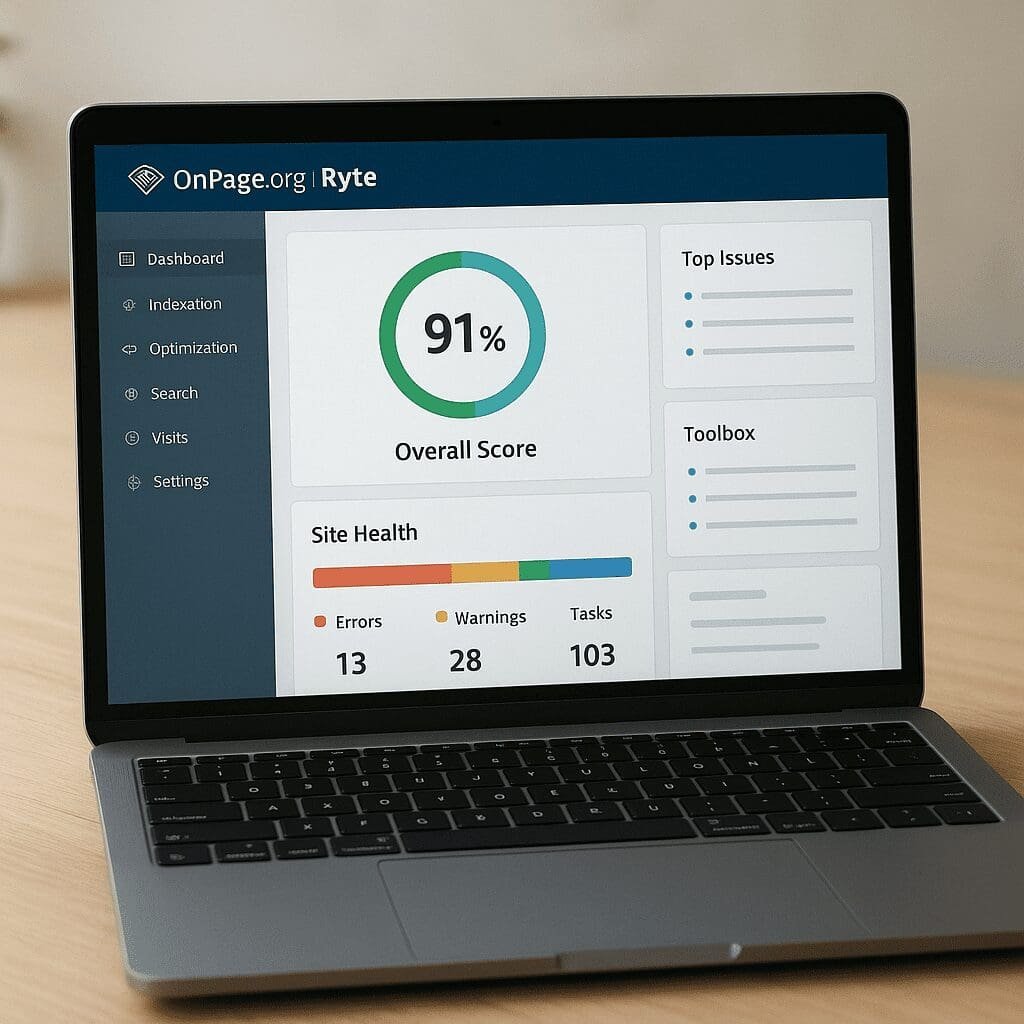
OnPage.org / Ryte
Ryte, known for years as OnPage.org, is a comprehensive platform dedicated to helping websites grow through technical excellence, content quality, and better visibility in search engines. It sits at the intersection of analytics and action: it crawls your pages to find problems, pulls in real user data to prioritize what matters, and guides teams toward fixes that improve both rankings and user experience. If you need a tool that brings technical checks, content analysis, and search performance into one workspace, Ryte belongs on your shortlist.
From OnPage.org to Ryte: what changed and why it matters
OnPage.org emerged from the German SEO community as a specialist in on-site performance and error detection. The rebrand to Ryte signaled a broader mission: move beyond pure on-page checks and build a platform that connects site quality to real-world outcomes. Today, Ryte’s architecture revolves around three pillars—Website Success, Search Success, and Content Success—each designed to answer a different set of questions. Is the site technically sound and crawlable? Which queries and pages are actually driving traffic and impressions? What content improvements will bring the biggest lift?
This evolution reflects a truth most teams discover the hard way: it’s not enough to list issues; you need to filter, prioritize, and ship improvements that move the needle. Ryte introduced dashboards with growth focus, anomaly detection, and user-centric metrics, so developers, SEOs, and content managers can work off the same data. The result is fewer silos and more measurable outcomes across the entire SEO lifecycle.
Core modules and how they fit together
Website Success: the technical foundation
Website Success is Ryte’s crawler-driven auditing engine. It simulates search engine discovery and surfaces patterns that limit visibility. Classic checks include broken links, missing titles or meta descriptions, redirect chains, and soft 404s. Deeper diagnostic layers handle robots directives, canonical tags, HTTP status codes, and rendering behavior, especially for frameworks that rely on client-side JavaScript.
For modern websites, what makes or breaks discoverability often comes down to three areas: crawling, indexability, and internal link flow. Ryte helps on all three. It highlights blocked resources, confusing canonical/robots combinations, and pages that have zero internal links (or orphaned URLs it discovers through sitemaps or logs, depending on your setup). It visualizes inlinks and outlinks so that you can see where authority is stuck, and it shows you which sections of a site waste crawl budget by generating near-duplicate or infinite URL patterns (for example, faceted navigation without guardrails).
Website Success also includes checks for structured data, Core Web Vitals signals, and essential security and reliability baselines: HTTPS coverage, HSTS, mixed-content issues, and 5xx error spikes. Because the crawler integrates with headless browsers, you can test JavaScript rendering configurations, evaluate prerender setups, and ensure that critical content is available on initial load. For teams migrating to SPA frameworks or dynamic rendering, this is essential.
Search Success: turning data into decisions
Search Success focuses on real search performance. It connects with Google Search Console to centralize impressions, clicks, CTR, and average position at the query and URL levels. The benefit of seeing these metrics inside Ryte is the cross-module context: you can overlay technical issues on top of performance trends to pinpoint why a page stagnates.
Common workflows include identifying queries where your page is on the cusp (position 8–15), then mapping those URLs to technical and content checks: does the page have thin content, weak internal linking, or slow Largest Contentful Paint? Are there conflicting canonical tags? Are competing URLs cannibalizing the same query family? By stitching signals across modules, Search Success helps teams prioritize high-impact fixes for pages with clear ranking potential.
Content Success: relevance, coverage, and quality signals
Ryte’s Content Success originated in the DACH market’s appetite for quantitative content analysis (often using WDF*IDF styles of scoring). Today the module is broader: it helps editors research topical coverage, compare target pages with competing documents, and understand where content is too thin, off-topic, or under-optimized. It’s not a replacement for editorial strategy, but it’s a practical scaffold for methodical on-page improvements.
Use cases include building brief templates for writers, evaluating entity coverage (people, places, products), and checking alignment between title, H1, and body content. It also helps prevent duplicate content problems by encouraging differentiation among similar landing pages and by reinforcing proper canonicalization and internal linking patterns.
Automation, alerts, and collaboration
The platform is suited to recurring audits and cross-team visibility. You can schedule crawls, set thresholds for error categories, and receive alerts when anomalies emerge—like sudden upticks in 404s or drops in indexed pages. Permissions and project scoping allow agencies to manage multiple clients, and enterprise teams to segment large sites across locales or brands. Because Ryte is Europe-based, it also puts strong emphasis on privacy controls and compliance configuration, which is important for organizations handling user data at scale.
Technical depth where it counts
Several features distinguish Ryte in technically complex environments:
- JavaScript crawling with customizable settings, enabling tests of hydration, dynamic content insertion, and script-blocking scenarios.
- Deep hreflang validation—comparing reciprocal tags, language-region codes, and canonical alignment—so international sites maintain proper mapping across locales via hreflang and avoid cluster confusion.
- Enhanced sitemap diagnostics: Ryte verifies XML sitemaps, detects stale or 404/410 entries, and compares sitemap coverage against actual discovery to ensure no meaningful content is siloed or missed. A reliable sitemap strategy is vital for large catalogs and news sites.
- Structured data validation for popular schemas (Product, Article, FAQ, Organization), checking syntax and alignment between markup and on-page content.
- Pagination and faceted navigation patterns, with flags for infinite combinations, parameter handling, and canonical rules to keep indexability under control.
How Ryte actually helps improve SEO outcomes
Effective SEO is a chain of small wins that compound. Ryte is most useful when it helps teams discover issues, quantify the impact, and roll out fixes that can be verified. Below are examples of workflows that consistently deliver results:
1) Stabilize crawling and indexation
Start by identifying any blockers: robots.txt disallows, noindex tags used unintentionally, or canonical tags pointing to non-equivalent pages. Audit parameterized URLs and session IDs to prevent crawl traps. Ensure critical templates expose primary content without requiring user interaction or delayed scripts. As crawl health improves, the balance of server responses (2xx/3xx/4xx/5xx) becomes stable, and Search Console will reflect steadier indexing patterns.
2) Diagnose traffic dips with cross-signal analysis
When a category loses visibility, use Search Success to pinpoint which queries and URLs declined, then pivot to Website Success to check for concurrent technical changes: template updates, a shift in meta robots rules, slower LCP, or new render-blocking resources. Many drops stem from accidental changes in meta data, canonicalization mismatches, or the rollout of a personalization feature that hides content from crawlers. Ryte’s ability to pair performance data with technical audits shortens the time to recovery.
3) Strengthen topical coverage page by page
For pages ranking on page two, Content Success can surface related subtopics, entities, and questions that improve depth and helpfulness. Replace keyword stuffing with semantically rich explanations. Add FAQs where appropriate, consolidate overlapping articles, and link to authoritative references. Coordinated updates supported by internal links from hub pages typically move the needle. By pairing content enhancement with performance tracking, you get clear before-and-after visibility.
4) Rationalize internal linking
Most large sites leak authority via inconsistent anchor text, buried keystone pages, or auto-generated lists that drown important links. Ryte reveals where cornerstone content lacks sufficient internal links and where pagination or tag pages hog excessive link equity. Use the data to route more links to critical pages, standardize anchors, and remove redundant pathways. Strong internal linking boosts discoverability and helps the right page rank for the right query family.
5) Prepare for major migrations
Whether switching domains, overhauling URL structures, or moving to a headless stack, Ryte acts as a pre-flight checklist. Crawl the old site and new staging environment, compare URL sets, validate redirect maps (minimizing chains), and verify structured data parity. Test rendering for key templates to ensure above-the-fold content and CTAs are intact. Post-launch, schedule crawls to catch regressions quickly and watch Search Success for early indicators that your redirects and coverage work as expected.
6) Improve UX metrics that matter to search
While Core Web Vitals alone won’t guarantee top rankings, unstable LCP, CLS, and INP can hold back otherwise strong pages. Ryte helps identify templates with poor Core Web Vitals performance, map static assets to caching policies, and find heavy components. Combine these insights with developer profiling tools to optimize images, inline critical CSS, adopt resource hints, and limit layout shifts. The combination of better UX and improved indexability tends to produce compounding gains.
Where Ryte shines compared with other tools
SEOs often juggle a stack: a desktop crawler like Screaming Frog, a cloud crawler like Sitebulb or Deepcrawl, a suite tool like Semrush or Ahrefs, and Google’s own Search Console. Ryte’s unique position is the tight coupling between technical audits, content recommendations, and Search Console data—inside a single project environment with collaboration features.
Compared to desktop crawlers, Ryte’s cloud approach scales better for very large sites and enables scheduled monitoring, shareable dashboards, and centralized history. Compared to all-purpose suites, Ryte usually offers deeper coverage of on-site technical nuance (hreflang integrity, canonical traps, dynamic rendering checks) and more flexible segmentation of issues by template, directory, or page type.
That said, no tool replaces specialists. Many teams keep lightweight desktop crawlers for quick local checks or complex custom extraction. For backlink analysis and competitor research, a link database like Ahrefs or Majestic still has an edge. Ryte is strongest when your priority is technical excellence, sustainable content quality, and aligning improvements with measurable search performance.
Pricing, onboarding, and ecosystem
Ryte positions itself for both SMBs and enterprises, with plans that scale by number of projects, crawl limits, user seats, and module access. Teams should factor in the value of scheduled crawls, additional domains, and historical data retention. The trial setup is usually straightforward: connect Google Search Console, configure your preferred user agent and crawl rate, and kick off a baseline crawl to populate dashboards.
Onboarding materials include product tours, documentation, and a knowledge base that covers common scenarios like internationalization setup, sitemaps for large catalogs, and JavaScript rendering tips. Being a Munich-based company, Ryte also emphasizes GDPR-awareness and regional support. Agencies benefit from multi-project organization and shareable issue boards for client communication.
Strengths and limitations: an honest look
Strengths:
- Technical depth where modern sites need it most: indexation control, dynamic rendering, and hreflang validation.
- Tight connection between Search Console data and technical audits, enabling meaningful prioritization.
- Clear focus on collaboration, with scheduled monitoring and alerting that reduce fire drills.
- Content analysis that pushes pages toward broader, more helpful coverage without resorting to keyword stuffing.
- European hosting and strong privacy posture, appreciated by regulated industries.
Limitations:
- It’s not a backlink or digital PR suite; you’ll need complementary tools for link acquisition and competitive link profiling.
- Content suggestions are scaffolding, not a substitute for expert editorial judgment; the best results come when editors treat it as a compass, not a blueprint.
- As with any enterprise-grade crawler, initial setup and segmentation for very large sites require thoughtful planning—especially for parameter handling and subdomain scoping.
Interesting details power users appreciate
Ryte’s crawler respects robots directives, supports custom HTTP headers and authentication, and can throttle requests to avoid overwhelming servers. The user agent can be customized, and it recognizes common anti-bot configurations so you can coordinate with devops to whitelist test runs. Historically, Ryte (as OnPage.org) became popular in the DACH region by offering precise diagnostics for complex e-commerce and publishing architectures, then expanded globally with the rebrand.
The platform’s evolution shows in its emphasis on data trust: reconciling sitemaps vs. discovered URLs, surfacing discrepancies between canonical and internal links, and highlighting mixed signals that commonly confuse search engines. When you study past traffic anomalies, you’ll often find a handful of subtle misconfigurations—like a template that added a stray noindex, or a canonical that points across language variants. Ryte’s reporting is designed to catch exactly those cases.
Best practices to get the most from Ryte
- Define projects by logical site areas (domains, subdomains, or large directories) and set crawl limits and rules that mirror how you want search engines to explore your site.
- Tag templates and page types early. Segmenting by template unlocks fast trend analysis and sticks issues to the teams who can fix them.
- Set alert thresholds on critical metrics: sudden 4xx or 5xx spikes, drops in indexed pages, or unexpected rel=canonical shifts.
- Pair every technical fix with Search Success validation. For example, after cleaning redirect chains, monitor CTR and position for the affected URLs to confirm a positive shift.
- Use Content Success during content planning, not just after publication. Briefs that include entity coverage, headings guidance, and internal link targets tend to ship faster and rank better.
- Document your parameter handling rules (ignore, canonicalize, or index) and align Ryte’s crawl configuration with those rules so your audits match real-world behavior.
- Integrate with sprint rituals. Many teams add Ryte tickets to their backlog refinement, ensuring that fixes are not just noted but implemented.
Who benefits most from Ryte
Ryte fits teams that rely on organic traffic as a growth driver and run sites with meaningful technical complexity. E-commerce, marketplaces, SaaS, and media publishers see outsized value because their architectures generate edge cases: layered navigation, pagination, localization, and content duplication risks. Agencies managing multiple domains also benefit from unified reporting and the ability to standardize QA across clients.
Smaller sites can still benefit, but keep budgets in mind. If your goal is lean experimentation, you might pair a desktop crawler with Search Console for a while and then adopt Ryte when scaling requires better monitoring and collaboration. If you already operate in multiple countries or maintain a component-based front end relying on client-side rendering, Ryte moves from nice-to-have to essential.
Concrete examples of problems Ryte helps solve
- International expansion gone wrong: a retailer launches six new locales and sees rankings split across languages. Ryte flags missing reciprocals in hreflang, contradictory canonicals, and a sitemap that lists mixed languages. Fixes restore proper clustering and consolidate signals.
- Traffic plateau after redesign: pages load visually fine, but LCP climbed and hero text now loads after hydration. Ryte’s render-based crawl and Core Web Vitals insights highlight delayed content and oversized images; developers implement critical CSS and next-gen formats, boosting both UX and rankings.
- Thin category descriptions: product listings rely solely on grids. Content Success guides editors to add concise, helpful introductions and FAQs, while Search Success confirms improved CTR and gradual rank gains on mid-tail queries.
- Legacy redirect chains: a news site with years of migrations accumulates 2–3 hop chains. Ryte maps them, teams compress to single 301s, and crawl efficiency improves; combined with updated internal links, the site recovers lost positions.
My verdict: does Ryte actually help with SEO?
Yes—when used as an operating system for on-site quality, Ryte delivers consistent improvements. Its strength is not magic scores; it’s the way it connects technical truth to performance data and content execution. Websites don’t fail for one reason—they fail for a hundred small ones. Ryte surfaces those issues, shows where to act first, and offers a framework for sustained fixes. In the hands of an SEO who collaborates with developers and editors, it becomes a powerful force multiplier.
There is no single “best” tool for everyone, but Ryte strikes an effective balance for teams that want depth without drowning in raw data. The integration of technical audits, keyword-level performance, and content scaffolding inside one interface reduces thrash and accelerates delivery. Pair it with complementary capabilities—backlink intelligence, A/B testing, and analytics—and you have a modern SEO stack.
Final guidance for teams evaluating Ryte
Before trialing, inventory your pain points: Is indexation unstable? Are JavaScript frameworks hiding content? Do you suffer from recurring duplication or canonical mistakes? Are your Core Web Vitals lagging? If you answer yes to several, Ryte addresses the exact categories that hold back most sites. During a pilot, pick a bounded project—like a category cluster or a single locale—and measure outcomes: fewer 4xxs, stabilized indexing, improved rankings for near-threshold queries, and better CTR. Iterate based on what the data shows.
No platform replaces the fundamentals of helpful content, clean architecture, and focused internal links. But software can make those fundamentals repeatable and visible. Used thoughtfully, Ryte helps teams avoid blind spots, protect gains during releases, and build an operational rhythm that grows organic traffic quarter after quarter. For organizations serious about technical excellence and sustainable growth, it’s a compelling choice.
Key concepts that Ryte helps you master include SEO, crawling, indexability, structured data, JavaScript rendering, Core Web Vitals, hreflang, duplicate content, internal linking, and sitemap integrity. Internalize these, pair them with a robust content strategy, and your site’s search visibility is far more likely to rise—and stay there.