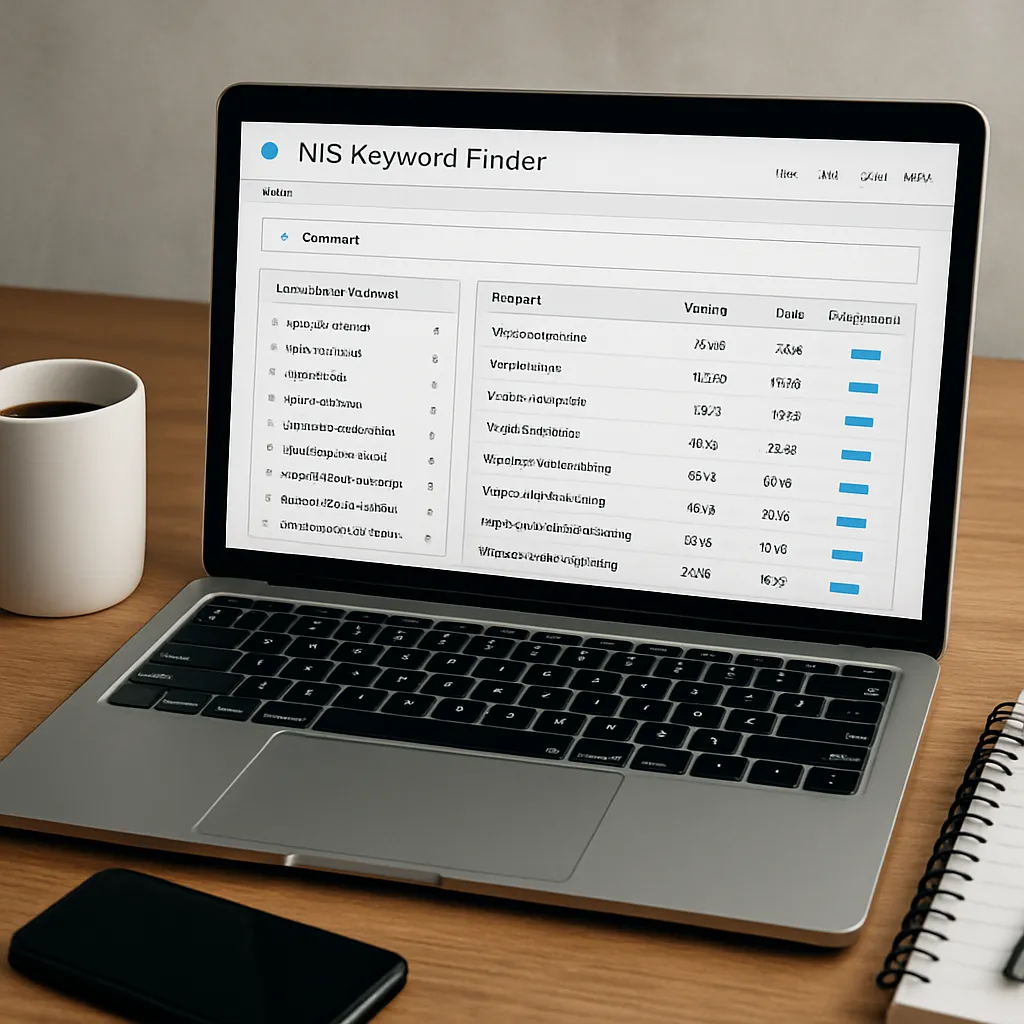
NLS Keyword Finder
NLS Keyword Finder is presented as a specialized tool for uncovering profitable search queries, assessing their competitiveness and helping SEO professionals structure content strategies. Instead of being a generic keyword suggester, it positions itself as a more analytical solution that seeks to identify not only what users search for, but also which phrases have the best relationship between demand and difficulty. For agencies, freelancers and in‑house marketers, this makes it an interesting option among the growing ecosystem of SEO software.
Core functionality and SEO applications of NLS Keyword Finder
The primary promise of NLS Keyword Finder is to simplify the process of discovering and prioritizing keywords that can realistically bring traffic and conversions. While many tools just output long lists of related terms, this software focuses on organizing them in a way that can be turned into structured campaigns and content plans. For SEO work, this is essential: raw data is not enough, it has to be translated into strategy, architecture and measurable actions.
One of the key features is the ability to search for new keyword ideas starting from a seed query, a website or a specific URL. The tool then generates related queries, semantic variants and long‑tail phrases. This allows marketers to quickly understand how users formulate their questions around a target topic and which angles they might have missed. The long‑tail focus is particularly valuable because such phrases are usually less competitive and signal higher intent, leading to better conversion potential and more sustainable rankings in search engines.
NLS Keyword Finder also provides metrics indicating potential traffic and competition for each keyword. These indicators usually include estimated search volume, a difficulty or competitiveness index, and sometimes a measure of cost per click from paid advertising data. When combined, these metrics reveal a keyword’s attractiveness: high demand and low competition are the sweet spot for most SEO campaigns. With this information, users can decide whether to build a dedicated landing page, add a section to an existing article or use a keyword only as a secondary support phrase.
Another practical aspect is grouping keywords into thematic clusters. Instead of treating each query in isolation, NLS Keyword Finder can highlight semantic relationships and suggest how to bundle related phrases into one coherent piece of content. This resonates strongly with current search engine trends, which increasingly evaluate topics and entities rather than just individual keywords. A well‑designed SEO strategy today relies heavily on topical clusters and pillar pages, and a keyword tool that supports this mode of thinking can significantly accelerate planning.
The software can also be used to examine competitors’ visibility. By entering a competing domain, you can obtain a list of queries for which that domain ranks or appears in search results. This competitive intelligence makes it easier to identify gaps in your own content strategy and discover opportunities where rivals are weak or absent. Instead of guessing what works for others, NLS Keyword Finder offers a view of actual performance indicators, at least in terms of ranking presence and potential demand.
An additional use case lies in international and multilingual SEO. If the tool supports different countries and languages, it can show how user behavior varies across markets. Phrases with similar meaning may have very different search volumes from one region to another, and competition levels can also shift dramatically. This empowers global businesses to prioritize their localization and expansion efforts, choosing markets where demand is growing and entry barriers are not insurmountable.
For content creators, NLS Keyword Finder can serve as an editorial planning companion. Once the set of target phrases has been defined, they can be distributed across an editorial calendar, each article built around a primary keyword and several secondary ones. This systematic approach helps avoid cannibalization, that is, multiple pages on the same site competing for identical phrases. Instead, each URL receives a clearly defined role in the overall topical map and can be optimized for a specific group of queries derived from keyword research.
Does NLS Keyword Finder really help with SEO?
To evaluate the real impact of NLS Keyword Finder on SEO performance, it is necessary to distinguish between data, interpretation and implementation. The tool itself provides data and structure; whether rankings and traffic actually improve depends on how intelligently that data is used. Nevertheless, there are several areas where this kind of software can directly and measurably support optimization efforts.
First, NLS Keyword Finder helps move away from purely intuitive decisions. Many projects still select topics based on internal assumptions or product perspectives rather than search behavior. When a marketer sees the exact search volume and difficulty levels for a set of related phrases, prioritization becomes more objective. Over time, this usually leads to a content portfolio that is better aligned with user needs and market demand, which in turn improves both organic visibility and conversion.
Second, the focus on long‑tail and low‑competition queries can be particularly helpful for smaller websites and new projects. Competing directly for the most generic, high‑volume phrases is rarely effective for a new domain with modest authority. By using NLS Keyword Finder to identify highly specific queries with transactional or informational intent, these sites can secure a foothold in search results and gradually build authority. Once traffic and backlinks grow, the site becomes better positioned to target more ambitious head terms.
Third, the clustering capabilities facilitate content depth and topical authority, which are increasingly important for search engine algorithms. Rather than publishing random standalone articles, an SEO team can design topic hubs that systematically cover a subject from different angles. NLS Keyword Finder, by revealing related questions and subtopics, supports this process. Better topical coverage sends stronger relevance signals to search engines and can improve rankings for a broad range of semantically related queries.
Fourth, the competitive analysis component can prevent wasted effort. Before investing time in a challenging keyword, a quick overview of who currently dominates that space can reveal whether the odds are realistic. If only the most established and authoritative domains appear on the first page of results, it might be wiser to shift resources to more attainable opportunities uncovered by the keyword tool. In this sense, NLS Keyword Finder acts as a risk‑management aid for SEO planning.
Fifth, research from tools like NLS Keyword Finder often uncovers user intent that product teams had not fully recognized. Questions such as “how to use,” “best way to compare,” or “alternatives to” show underlying concerns and decision processes. When this intent is translated into content and UX improvements, both organic rankings and on‑site engagement can benefit. Organic SEO then becomes connected with conversion optimization and product development rather than being limited to meta tags and headings.
In practice, agencies and consultants can integrate NLS Keyword Finder into their workflows as the central research engine at the beginning of each project. A typical sequence might start with discovering keywords, grouping them into clusters, mapping them to URLs, and then producing or optimizing content. Over time, performance data from analytics and search consoles can feed back into the tool: underperforming keywords can be replaced or supported by additional topics, and emerging queries identified by the software can inspire new campaigns.
It is important to emphasize that NLS Keyword Finder, like any keyword tool, does not guarantee rankings on its own. The quality of content, technical health of the website, internal linking, external backlinks and user experience remain critical. However, the chance of success without solid keyword research is low. In that sense, the software plays a foundational role: it ensures that all further SEO actions are grounded in real search behavior and not random guesses.
Another aspect that influences its usefulness is update frequency and data freshness. If NLS Keyword Finder maintains up‑to‑date indices of queries and continuously refines its difficulty calculations, the insights stay relevant in rapidly changing niches. Some sectors experience seasonal swings or sudden trend spikes; a responsive keyword tool can detect these early and give users a head start. In contrast, outdated datasets may mislead strategy and cause investment into phrases whose popularity has already declined.
For teams that combine organic and paid search, the overlap between keyword research and PPC planning is a practical advantage. Keywords identified as promising organic targets can also be tested quickly via paid campaigns to validate conversion potential. Conversely, high‑performing PPC phrases can be checked in NLS Keyword Finder to identify related long‑tail opportunities worth targeting with content. This integration of SEO and advertising strengthens overall search visibility and improves return on investment.
Opinion, strengths, limitations and interesting aspects of NLS Keyword Finder
As an SEO‑oriented solution, NLS Keyword Finder occupies a useful space between simple free tools and heavy enterprise platforms. It is more specialized than basic suggestion engines yet usually more accessible than large all‑in‑one suites. From a practical standpoint, this makes it attractive for mid‑sized businesses, agencies and freelancers who need solid data but do not want to manage an overly complex dashboard. A clear interface and focused purpose keep the learning curve under control.
One of its main strengths is the emphasis on discoverability of opportunities that are actually attainable. Many marketers are tempted to chase the highest volume phrases, only to find themselves outranked by large portals and global brands. NLS Keyword Finder, by highlighting lower‑competition queries and exposing detailed long‑tail variants, encourages a more realistic and sustainable approach. This is especially beneficial in niches where authority is hard to build quickly and every piece of content must deliver measurable impact.
Another positive aspect is the ability to structure research outputs in a way that closely matches SEO workflows. Rather than giving users a flat spreadsheet of thousands of entries, the tool helps them create lists, segments and topic clusters aligned with website architecture. This bridges the gap between analysis and implementation: keyword groups can be mapped directly to existing section hierarchies, product categories or blog topic silos. When combined with internal linking strategies, this leads to a more coherent, crawl‑friendly site structure.
NLS Keyword Finder also offers value through its contribution to content ideation. Many writers struggle with coming up with new article topics after covering the obvious ones. By surfacing less visible questions, related issues and adjacently relevant themes, the software fuels continuous content creation without losing alignment with user demand. In that sense, it becomes a research assistant for editorial teams, allowing them to avoid repetition while still building depth on central themes.
From an opinionated perspective, one of the most interesting aspects of such a tool is its role in encouraging a data‑driven culture inside marketing departments. When decisions about which content to produce or which products to highlight are consistently based on keyword research, discussions become less subjective. Stakeholders can look at search volumes, difficulty indexes and competitive landscapes provided by NLS Keyword Finder and make compromises grounded in external reality rather than internal hierarchy.
However, no tool is without limitations. The accuracy of search volume estimates and difficulty metrics will always include some degree of uncertainty, regardless of the provider. Different tools use different methodologies and data sources, so results may not perfectly match other platforms. Users of NLS Keyword Finder should treat its figures as directional rather than absolute. Comparing ranges, trends and relative differences tends to be more useful than obsessing over exact numbers.
Another limitation is that keyword data, by definition, describes past and current behavior rather than future shifts. If a market is on the verge of disruption or a new technology is emerging, search volume may not yet reflect upcoming demand. Forward‑looking SEO teams still need qualitative research, industry insights and creativity to anticipate queries that will become important later. NLS Keyword Finder can support this by identifying early signals and related phrases, but it cannot replace strategic vision.
There is also the risk of becoming overly dependent on the tool and neglecting on‑page elements, content quality and link‑building efforts. Keyword selection is just the first step. Without compelling, well‑structured, user‑oriented content and a robust technical foundation, even the best keyword lists will not achieve strong rankings. An overemphasis on metrics can also push teams towards writing for algorithms rather than people, which can backfire as search engines increasingly reward genuine usefulness and engagement.
In terms of usability, much depends on how intuitive the interface is and how easily reports can be exported or shared with clients. For agencies, the ability to brand or customize keyword lists and present them as part of strategic documentation is highly valuable. If NLS Keyword Finder provides flexible filtering, tagging and export options, it fits nicely into client communication and proposal workflows. Conversely, rigid or cluttered output formats may require additional manual processing.
From a broader standpoint, NLS Keyword Finder illustrates how specialized software is reshaping SEO practice. Instead of relying on a single monolithic platform, many professionals prefer a “stack” of tools, each excelling at a particular task: one for keyword research, another for crawling, another for backlink analysis and so on. In such a stack, NLS Keyword Finder serves as the research engine that powers content planning and opportunity discovery. Its value lies in how well it integrates with the rest of that ecosystem, both technically and conceptually.
Looking ahead, the most compelling development paths for tools like this involve deeper integration of semantic analysis, user intent modeling and AI‑driven suggestions for content outlines. If NLS Keyword Finder continues to evolve along these lines, it could become not only a research database but also a strategic partner that helps shape entire topical maps and information architectures. Combined with human expertise, this could lead to more sophisticated and resilient SEO strategies that keep pace with algorithmic changes and evolving user behavior.
In summary, NLS Keyword Finder is best viewed as a practical, focused solution for keyword discovery, competitive assessment and content planning. It does help with SEO, particularly when used to identify realistic opportunities, structure topical clusters and inform editorial roadmaps. Its strengths lie in clarity, actionable data and the capacity to align content with actual user demand. Its limitations revolve around the intrinsic constraints of keyword metrics and the risk of over‑reliance. Used wisely, as one component of a broader optimization strategy, it has the potential to significantly enhance the effectiveness and efficiency of search‑driven marketing efforts.