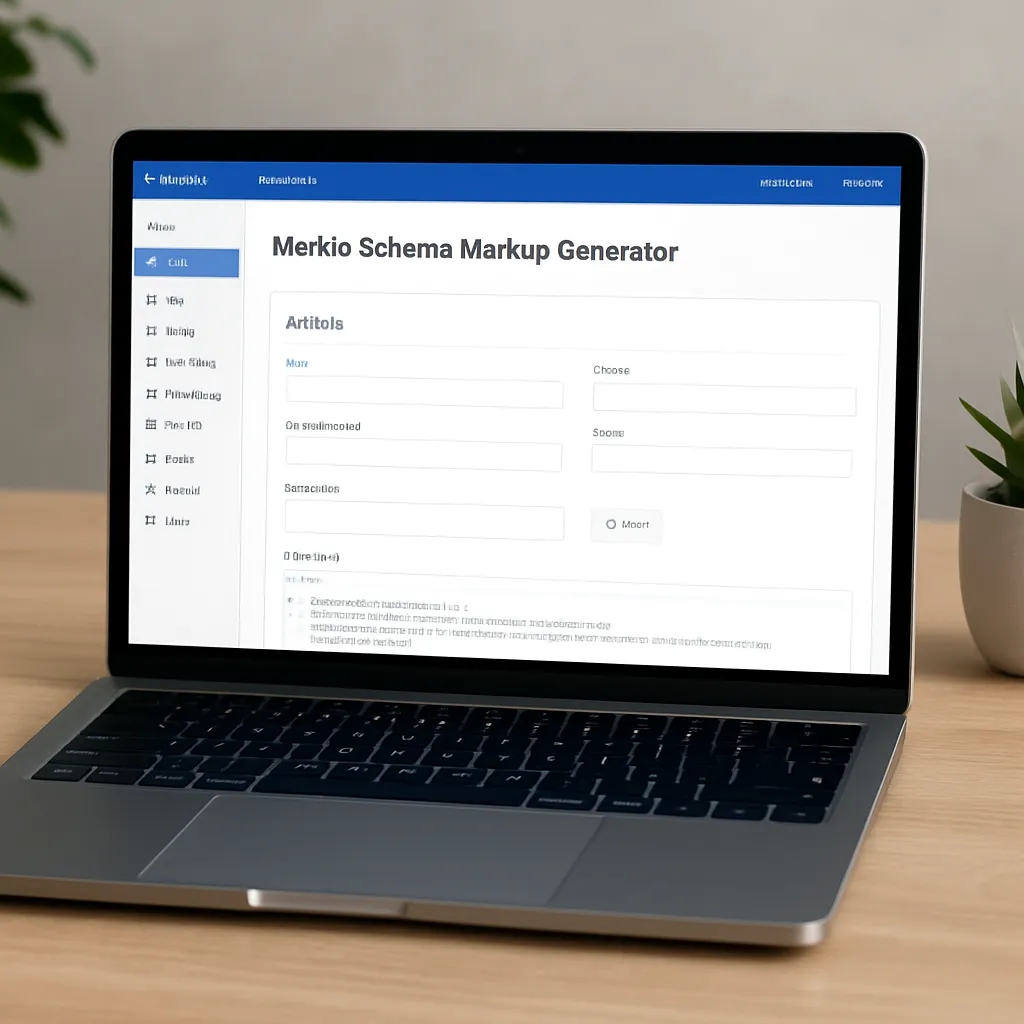
Merkle Schema Markup Generator
Merkle Schema Markup Generator is a practical, widely used utility for creating clean, copy‑and‑paste snippets of structured data that help search engines interpret your pages with greater confidence. Although it is not a full enterprise schema platform, the tool strikes a smart balance between approachability and thoroughness: it guides you through the fields that matter, outputs standards‑compliant code, and shortens the path from planning to implementation. For teams that want to reduce errors, prototype ideas, or train non‑developers to work with schema, it often becomes the first stop and a recurring reference point. Its place in the SEO stack is clear: make compliant markup fast, validate it, deploy through your CMS or tag manager, and monitor the impact.
What the Merkle Schema Markup Generator is and how it works
Developed by the Merkle team behind technicalseo.com, the generator is a free, browser‑based tool that helps you build properly formatted schema markup for many common content types. You select a type—such as Organization, Local Business, Article, Product, FAQPage, HowTo, Event, Recipe, JobPosting, VideoObject, BreadcrumbList, or Person—fill in guided fields, and the tool instantly produces code you can paste into your site. The philosophy is pragmatic: give users just enough structure to avoid mistakes, while leaving room for optional properties that can make the markup robust.
By default, the generator emits JSON-LD, the format most search engines and modern content systems prefer because it is portable, easy to inject, and decoupled from your HTML layout. The interface highlights required versus recommended properties, often adding helpful placeholder text (for example, using ISO date formats or three‑letter currency codes). When you copy the output, you get a compact code block that can live in the head or body of your page without disrupting templates or styling.
Because the tool is web‑based, there is nothing to install and no account to create. That makes it suitable for quick workshops, audits, and cross‑team collaboration. A content editor can populate fields with source material, a developer can embed the output in a template, and an SEO can test and iterate—without anyone arguing about commas, braces, or escaping characters.
Where it fits in modern SEO and why it matters
Search engines assemble meaning from a mix of crawlable content, links, user signals, and structured hints. Schema is one such hint: a transparent way to declare what a page is about in a machine‑friendly vocabulary maintained by schema.org. When used appropriately, schema accomplishes three things that typical HTML often struggles to do alone:
- It formalizes entities and relationships—turning “a review of a book by an author” into a graph of typed nodes and explicit properties.
- It aligns your page with public knowledge—by linking to authoritative identifiers, social profiles, and external references that reduce guesswork.
- It unlocks features—making your content eligible for SERP enhancements where Google, Bing, and others support them.
These mechanics affect findability in two primary ways. First, schema can change how your listing appears, especially when your content is eligible for snippets like products with price and availability, events with dates, recipes with ratings and cook times, or breadcrumbs that clarify site structure. Second, schema can influence how your brand and content are stitched into the wider Knowledge Graph—assisting with entity resolution, attribution, and context. Neither outcome is a magical ranking lever, but both can materially affect click‑through rates, user trust, and the consistency with which crawlers interpret your site.
Merkle’s generator fits this reality by lowering friction. If adding schema takes five minutes instead of an afternoon, you are more likely to apply it consistently across the templates and content types that matter most to your business.
Typical use cases and practical workflows
Teams adopt the Merkle generator for a range of tactical and strategic needs. A few common patterns stand out:
Rapid prototyping and stakeholder education
When you need to show a product manager or editor what schema can do, the fastest way is to build a proof of concept. Paste in the key facts for a product, article, or event, then run the output through your validator. In ten minutes you can go from “What is schema?” to “Here is the exact code that will appear on the page and the issues we must fix.” This clarity accelerates approvals and reduces confusion.
Template design and CMS configuration
For sites that use consistent templates—product detail pages, blog posts, location pages—the generator helps you define a canonical set of properties and nesting that developers can translate into dynamic templates. For example, you can map CMS fields (title, SKU, brand, price, availability, GTIN) to Product properties, decide where to place Offer nodes, and set rules for when aggregateRating or review markup appears. The output becomes living documentation.
Governance, QA, and cross‑team alignment
Because the generator is explicit about required and recommended fields, it doubles as a checklist. Editors can confirm they have the right inputs (e.g., cooking times in ISO 8601 duration format for recipes), and QA can quickly spot gaps during pre‑launch reviews. This prevents a common trap: shipping markup that validates but is ineligible for enhancements because vital properties are missing.
Migration and replatforming
During a redesign or CMS migration, schema often breaks silently. Re‑creating gold‑standard examples with the generator makes it easier to spot regressions. You can compare the intended graph to the new template’s output and verify parity field by field.
Tag‑manager‑based deployments
For teams without immediate developer bandwidth, you can deploy the generated code through a tag manager using Custom HTML tags and triggers. It is not ideal for the long term, but it is an effective stopgap for pilots, seasonal campaigns, or fixes on legacy templates.
Does it actually help SEO? What to expect and how to measure
The honest answer: schema improves interpretation and presentation; the Merkle generator makes correct implementation faster; together they can deliver meaningful, but not guaranteed, gains. When markup leads to rich results, many sites see higher CTR on affected queries because results are more informative and trustworthy. Typical ranges reported in case studies vary widely—anywhere from low single‑digit to 20–30% CTR lifts on eligible queries—depending on intent, competition, and how much the appearance changes.
However, not every schema type produces a special presentation, and search engines retire or limit some experiences over time. For example, certain result types (such as FAQ and HowTo) have been restricted or deprecated in recent years, while others (like Product, Breadcrumb, Video, and Organization) remain consistently useful. The key is to prioritize markup that aligns with both business value and current eligibility guidelines, then monitor performance in Search Console’s reports for Enhancements and rich‑result impressions.
Measurement should be deliberate:
- Establish baselines for impressions, CTR, and average position for the templates you are changing.
- Track the appearance of enhancement reports (e.g., Product, Video) and the share of valid items over time.
- Segment by device and country, as eligibility and presentation can vary by market.
- Annotate deployments and compare cohorts (pages with vs. without markup) when feasible.
This discipline helps you attribute changes to schema rather than to concurrent content or link shifts.
Strengths and limitations of the Merkle generator
Strengths:
- Free, no‑login, and fast—removes friction in day‑to‑day SEO and content workflows.
- Good coverage of the most common schema types used for commercial sites.
- Clear labeling of required versus recommended properties to reduce silent failures.
- Emits clean, compact code that developers can integrate with minimal fuss.
- Excellent for education, prototyping, and internal documentation.
Limitations:
- Not a full lifecycle platform—no crawling, automatic syncing with CMS catalogs, or centralized governance.
- No native API for programmatic generation; bulk operations require custom scripting outside the tool.
- Field sets for some types are necessarily opinionated; power users may want to add niche properties not exposed in the UI.
- It focuses on code generation, not monitoring; you will still rely on validators and Search Console for feedback.
If you need enterprise workflow features—bulk creation from product feeds, centralized auditing, or integrated change management—you will likely pair Merkle’s generator with custom code, a CMS plugin, or a paid schema management platform. For the majority of small to mid‑sized teams, though, its strengths far outweigh its constraints.
Comparison with alternatives
There are several ways to produce schema markup; your choice depends on stack, skills, and scale:
- CMS plugins (e.g., Yoast, Rank Math): Good for WordPress and similar environments where templates are uniform. They automate a baseline set of meta and schema, but you may need custom fields or filters to reach parity with your business needs.
- Full platforms (e.g., Schema App, enterprise SEO suites): Useful when you need governance, feed‑driven automation, and change tracking. They reduce manual work but come with cost and onboarding complexity.
- Hand‑coding with IDEs or component libraries: Maximum flexibility and performance; ideal for engineering‑led teams. The trade‑off is developer time and the risk of drift without strong documentation and tests.
- Tag manager deployments: Fast to pilot; good for prototypes and fixes. Long‑term, it is better to migrate into templates for maintainability and performance.
- Other free generators and JSON editors: Many exist, but Merkle’s stands out for clarity, recency, and SEO‑friendly defaults.
Relative to these options, Merkle’s generator is a safe default starting point, particularly for teams that want to combine speed, accuracy, and low overhead.
Implementation tips, modeling choices, and best practices
Good schema is as much about modeling as it is about syntax. Keep these principles in mind as you use the generator:
- Mirror reality, not marketing. The markup should reflect what users can verify on the page—prices, availability, author names, times, and so on. Avoid promotional fluff in structured fields.
- Use persistent identifiers. Create stable @id URLs for your entities (Organization, Person, Product) so that search engines can recognize the same node across pages and updates.
- Link out with sameAs. Connect your brand, authors, and products to authoritative profiles and catalogs (e.g., Wikipedia, Wikidata, official social profiles, GS1). This supports disambiguation and trust.
- Nest thoughtfully. Products contain Offers; Articles contain authors (Persons or Organizations); LocalBusinesses contain addresses and geo coordinates. Proper nesting clarifies relationships.
- Respect editorial and policy boundaries. For reviews, include only genuine user or editorial reviews, and avoid self‑serving markup that violates search engine guidelines.
- Keep dates, durations, and currencies standardized. Use ISO 8601 formats and three‑letter currency codes to avoid parsing errors.
- Local consistency matters. For LocalBusiness, ensure NAP (name, address, phone) exactly matches your on‑page and business listings; small mismatches can trigger confusion.
- Keep it in sync. If content changes, update markup in the same release. Stale schema can be worse than none at all.
Scaling from one‑off snippets to systematic coverage
The Merkle generator is ideal for crafting exemplars—the gold‑standard snippets that define how each template should behave. From there, scaling is about process and automation:
- Parameterize fields. Map each property in your exemplar to CMS fields, product feeds, or a data layer so that updates flow automatically.
- Create componentized partials. In modern frameworks, wrap your schema output in reusable components that accept props and render JSON‑LD consistently.
- Build unit tests. Validate required properties at build time so templates fail loudly when data is missing.
- Instrument health checks. Periodically sample live pages and run them through validators to catch regressions before they impact search appearance.
When you do this well, you convert a tool built for snippets into the blueprint for a program that delivers sustained coverage, with gains in both quality and scalability.
Validation, testing, and monitoring
No schema rollout is complete without rigorous validation. A reliable workflow looks like this:
- Generate: Use Merkle to draft the initial snippet for a representative page or template.
- Validate: Test the output in Google’s Rich Results Test for enhancement eligibility and in the Schema.org Validator for vocabulary conformance.
- Deploy: Add the code to a staging environment and verify that dynamic values populate correctly.
- Monitor: After launch, watch Google Search Console’s Enhancements and Manual Actions sections, along with coverage of valid/invalid items, impressions, and CTR for impacted content.
Merkle also offers complementary testing utilities on its site that fetch and parse pages, helping you spot extraction issues in live environments. Running multiple validators is worthwhile because each one checks slightly different aspects of your markup.
Common pitfalls and how to avoid them
- Marking up content that is not visible. If users cannot find the information on the page, search engines may ignore or penalize the markup.
- Using placeholder data in production. Ensure example prices, lorem ipsum, or sample authors never ship beyond staging.
- Over‑marking. More is not always better; prioritize types with clear business value and recognized search features.
- Ignoring updates. Eligibility and policies evolve. Revisit your templates quarterly, especially after high‑profile search updates.
- Broken nesting or conflicting nodes. Keep one clear, primary entity per page when appropriate, and nest related entities instead of creating parallel, ambiguous graphs.
Opinion: who benefits most from the Merkle generator
Based on real‑world adoption patterns, the tool shines for small and mid‑sized teams that want results without heavy overhead: agencies that need to prototype for clients, in‑house SEOs who partner with content editors, and developers who prefer concrete examples over open‑ended specifications. It is also a great leveller in cross‑functional settings: product managers quickly grasp what “good” looks like, and QA teams gain a precise acceptance checklist.
Large organizations will still benefit, but are likely to embed the generator within a larger framework: design the canonical snippet in Merkle, instrument a component library to render it, validate automatically in CI, and monitor production pages at scale. In other words, use it as the model generator at the heart of a broader, testable system.
Emerging trends and the future of schema
As search evolves, the role of schema is becoming more nuanced. Search engines increasingly use a blend of unstructured understanding (via large language models) and explicit structure to assemble answers, summarize pages, and render results. Clear, standards‑compliant schema still matters in this environment for three reasons: it reduces ambiguity; it supports features where explicit properties are mandatory; and it anchors your entities to durable identifiers across the web.
Retailers, publishers, and B2B brands should anticipate more programmatic demands on their schema: tighter integrations with product feeds and inventory systems; richer author and organization profiles to support experience and trust signals; and event or job posting lifecycles tied to real‑time status changes. These shifts play to the strengths of exemplar‑first tooling. You define the right model once, then industrialize it across systems.
Practical checklist to get started
- Inventory your high‑value templates (product detail, category, article, video, location) and map them to schema types.
- Create one exemplar per template with the Merkle generator, filling every required and the most impactful recommended properties.
- Decide how you will deploy—template code, CMS fields, or a tag manager for interim coverage.
- Validate pre‑launch with at least two validators, then set up Search Console monitoring for enhancements.
- Measure impact over 4–8 weeks, focusing on affected queries and devices; iterate on gaps.
Final take: does Merkle Schema Markup Generator help SEO?
Yes—by streamlining the creation of accurate markup that clarifies meaning, increases eligibility for visual enhancements, and reduces the chances of silent errors. It does not manufacture rankings or replace authoritative content, but it accelerates the steps that let search engines understand and present your pages the way you intend. For teams that value speed, clarity, and correctness, the Merkle generator is a dependable ally: simple enough for everyday use, robust enough to anchor serious implementations, and flexible enough to fit into any stack you choose.