INK for All
INK for All has quickly gained attention as an AI-powered content platform that promises to make writing, optimization, and publishing easier for marketers, bloggers, and businesses. Designed as a combination of writing assistant, SEO optimizer, and content productivity suite, it offers a set of tools intended to help users create content that ranks higher, converts better, and is easier to manage across multiple channels.
What Is INK for All and How Does It Work?
At its core, INK for All is a content creation environment that blends artificial intelligence, natural language processing, and SEO analysis into one interface. Instead of juggling separate tools for keyword research, optimization, readability, and grammar, INK tries to centralize these features so that writers can focus on producing articles, product pages, social media posts, and ads from a single dashboard.
The platform typically consists of several key components:
- AI writing assistant – A system that uses machine learning to help generate, expand, rephrase, and summarize text. Users can input a topic, a short brief, or a few bullet points, and INK will generate suggestions for headlines, introductions, paragraphs, or entire sections. It can also be used to overcome writer’s block by proposing alternative phrasings or angles.
- SEO optimization engine – A feature set focused on on-page optimization. It usually includes keyword recommendations, content scoring, and an SEO checklist, guiding the user toward better alignment with search intent and technical best practices like meta descriptions, headings, and internal linking opportunities.
- Readability and tone analysis – The editor provides feedback on sentence length, complexity, and tone, helping writers make content more accessible and consistent with brand voice. It may flag overly complex passages and suggest simplifications without stripping away nuance.
- Plagiarism and originality tools – For organizations that care about unique content, INK can be paired with checks that evaluate how similar a text is to existing content on the web, reducing the risk of duplicate content issues and improving trustworthiness.
- Publishing and integration options – INK aims to integrate with popular content management systems, especially WordPress, and other marketing platforms. This allows content to move directly from the optimization interface into production with minimal copy-pasting or reformatting.
The idea behind INK for All is to act as a co-pilot during the entire content lifecycle: from planning and drafting through optimization and finally to publishing. For writers and SEO specialists who are overwhelmed by multiple tools, this unified approach can simplify both the workflow and the learning process.
INK for All as an SEO Tool: Capabilities and Limitations
One of the most attractive promises of INK for All is that it can help content rank better in search engines. To understand whether it truly supports SEO, it is useful to examine how it approaches optimization and where its strengths and weaknesses lie.
On-Page Optimization and Content Scoring
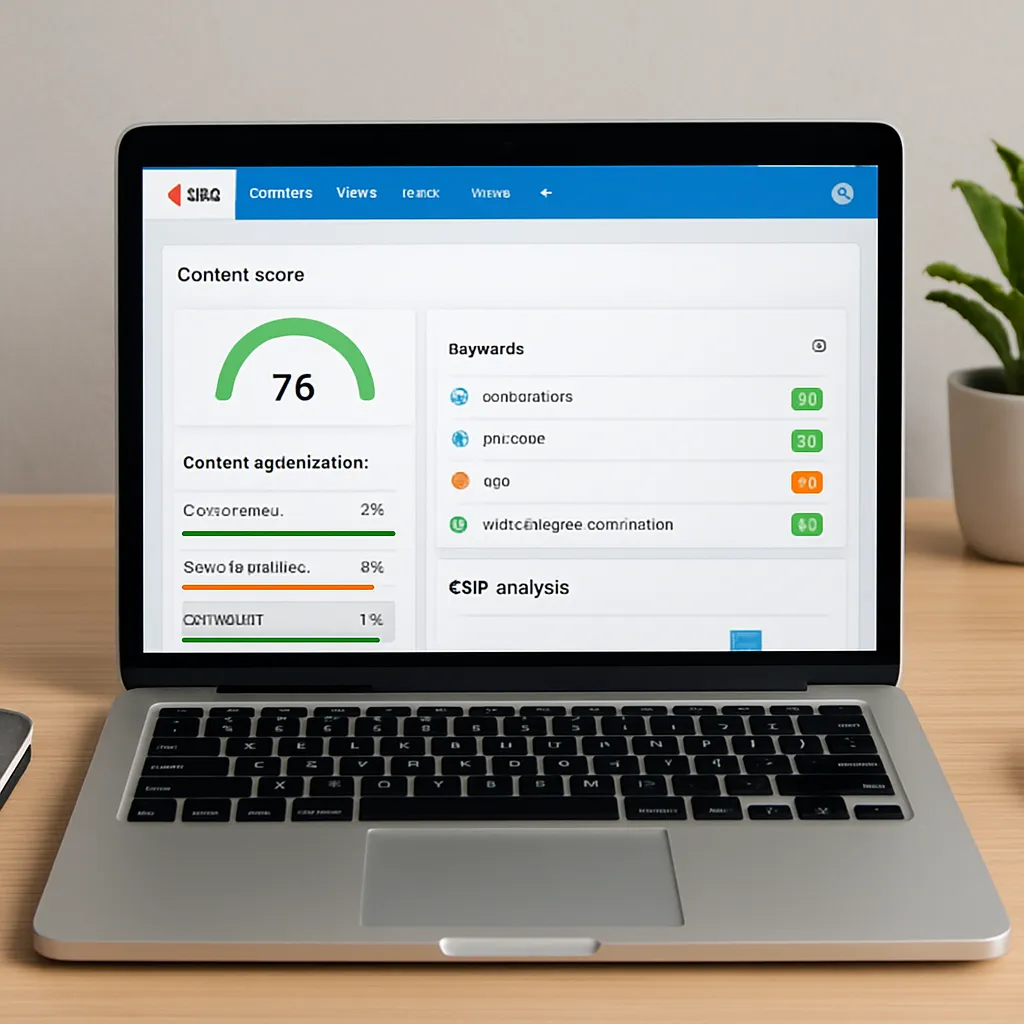
INK’s SEO engine is centered around an optimization score that evaluates how well a piece of content is aligned with a chosen keyword or topic. The tool typically examines elements such as keyword placement, density, semantic relevance, headings, meta tags, and content length. It compares the text against pages that already rank for a given query and then provides a numerical score along with suggestions for improvement.
This approach is similar to what many established SEO content tools do: it uses competitor analysis and semantic modeling to infer which terms, phrases, and structural elements are common on top-ranking pages. The writer then receives guidance on which related topics should be covered, how to structure headings, and where to refine or expand content to match user intent.
In practice, this can be very effective for:
- Ensuring content is not missing crucial subtopics or user questions.
- Avoiding over-optimization and unnatural keyword stuffing.
- Keeping a consistent focus on the primary keyword while covering relevant secondary queries.
- Shortening the feedback loop between writing and SEO review, especially in small teams without a dedicated specialist.
However, it is important to remember that no optimization score perfectly predicts rankings. Search algorithms incorporate dozens of factors beyond the visible text on a page, including backlinks, user engagement, page speed, mobile experience, and domain authority. INK for All can enhance on-page content quality, but it cannot control these external factors.
AI-Assisted Keyword and Topic Suggestions
INK for All includes functionality that suggests keywords and related topics based on the primary phrase the user is targeting. These suggestions often draw from semantic relationships, competitor content, and search engine data. When used thoughtfully, this can help writers:
- Create comprehensive, topical content that addresses a subject in depth.
- Discover long-tail keywords that may be easier to rank for and more aligned with user intent.
- Avoid focusing solely on one highly competitive phrase and instead build a cluster of related terms.
The limitations appear when users treat the suggestions as a rigid checklist rather than guidance. Merely adding every suggested keyword to a text does not make it stronger; it can even dilute clarity. The real benefit lies in understanding which ideas matter most to readers and integrating them in a natural, helpful way. INK can surface ideas, but editorial judgment remains critical.
Does INK for All Really Improve Rankings?
For many users, the key question is whether INK for All directly leads to higher positions in search results. In practice, it is more accurate to say that the tool improves the likelihood of ranking by helping produce better structured, more relevant content. It streamlines processes that used to require manual research and experience, such as analyzing competitors, mapping out subtopics, and fine-tuning keyword usage.
Users who approach INK strategically usually see benefits in several areas:
- Faster content production while maintaining or improving quality.
- More consistent adherence to SEO best practices across entire content libraries.
- Reduction in basic on-page errors, like missing meta tags or poorly structured headings.
- Greater ability for non-SEO specialists to contribute content that still performs well.
However, there are caveats. If the rest of the website is weak – for example, slow load times, poor UX, no backlinks, or thin content – improvements from INK alone may not be enough to secure top positions. Additionally, relying too heavily on AI-generated text without editorial oversight can result in generic content that fails to stand out, even if technically optimized.
Content Creation Experience and Practical Use Cases
Beyond pure SEO, INK for All positions itself as a general-purpose writing environment suitable for many types of digital content. The experience is typically built around an editor which resembles a modern word processor augmented with real-time suggestions, analytics, and productivity helpers.
Writing Workflow and Interface
The editor usually divides the screen into a main writing area and several side panels containing SEO metrics, topic suggestions, and AI commands. Users can toggle between these panels without leaving the document. This design is intended to avoid context switching, letting writers integrate optimization and drafting in one flow instead of treating them as separate stages.
Features commonly reported by users include:
- Commands to expand or shorten paragraphs while maintaining the original meaning.
- Tools to adjust tone, such as making text more formal, casual, or persuasive.
- Options to generate alternative headlines or meta descriptions, which can be A/B tested later.
- Templates for blog posts, product descriptions, landing pages, and social posts, offering structure for those who prefer guidance.
This can significantly speed up drafting, especially for repetitive content types such as category descriptions or standard landing pages. However, for more nuanced, strategic pieces – in-depth guides, thought leadership, or highly branded narratives – the raw AI output usually needs careful editing to align with brand voice and strategic goals.
Use Cases for Different Types of Users
INK for All can serve a wide range of roles within a digital team:
- Marketers – Marketing teams can use INK to maintain a consistent content pipeline without constantly relying on external agencies. Campaign landing pages, email sequences, and promotional blog posts can be drafted, optimized, and published quickly. Internal collaboration is simplified when everyone works in the same interface.
- Copywriters – Professional writers can benefit from AI-assisted ideation and quick rephrasing, allowing them to compare variations and experiment with different angles. The SEO scoring system also reduces back-and-forth with SEO specialists, as many optimizations are visible directly within the editor.
- Small business owners – For entrepreneurs who cannot hire in-house content teams, INK serves as a shortcut: they can draft their own website pages and blog posts with guidance on what to include and how to phrase it. This can be particularly valuable for local businesses trying to establish an online presence with limited resources.
- Agencies – Digital agencies can integrate INK into their content delivery pipelines, ensuring consistent quality and optimization across clients. Templates make it easier to maintain distinct styles for each brand while still leveraging shared processes and checklists.
Across all these use cases, the major advantage is time savings combined with an increase in baseline quality. The main risk is overreliance on automation: if every article begins to sound alike, audiences may lose interest, and search engines may eventually devalue generic content in favor of more unique contributions.
Strengths, Weaknesses, and Overall Opinion on INK for All
Evaluating INK for All as a whole requires balancing its strengths against its constraints and understanding how it fits into the evolving world of AI-augmented content creation.
Key Strengths
- Integrated platform – Having AI writing, on-page analysis, and technical suggestions inside one environment reduces friction. Instead of exporting text across multiple tools, users can stay inside a single editor, which helps productivity and lowers the learning curve.
- Actionable recommendations – The SEO scoring model and suggested improvements are usually presented in clear, concrete terms, such as adding missing subtopics or adjusting heading structure. This is especially helpful for non-experts who need practical advice rather than dense reports.
- Semantic optimization – INK’s attention to topical relevance and related phrases reflects the direction of modern search algorithms. Focusing on semantic coverage instead of purely on exact-match keywords tends to result in content that answers user questions more comprehensively.
- Time efficiency – For teams that produce large volumes of content, automation of repetitive tasks – rewriting intros, simplifying complex sentences, generating variations – can save hours per week, freeing creative capacity for strategy and research.
- Accessibility for small teams – Because it compresses multiple disciplines into one tool, INK lowers the barrier to entry for small companies that do not have separate roles for content, SEO, and optimization.
Main Weaknesses and Risks
- Risk of generic content – Heavy reliance on AI-generated text can lead to articles that feel similar to countless others online. While they may be structurally sound and semantically rich, they can lack the unique insights or personality that build a brand’s reputation.
- Limited influence on off-page SEO – Like any on-page tool, INK cannot directly create backlinks, improve domain authority, or fix technical issues outside the content layer. Users who expect rankings solely from content optimization may be disappointed if other aspects of their sites remain weak.
- Learning curve for best results – Although the interface is designed to be friendly, achieving consistently strong outcomes still requires understanding SEO principles, user intent, and editorial quality. Those who treat recommendations as a checklist without judgment may see diminishing returns.
- Dependence on underlying AI models – The quality of suggestions, tone adjustments, and expansions is limited by the capabilities and training of the underlying language models. Occasionally, outputs can be off-brand, inaccurate, or too verbose, requiring careful review.
Overall Assessment and Strategic Use
From a broader perspective, INK for All is a powerful assistant rather than an autonomous solution. It excels at making good content easier and faster to produce, but it does not replace the need for strategy, research, and human creativity. Organizations that treat it as a co-author – guiding it with clear briefs, editing its output, and combining its suggestions with their own expertise – are likely to see substantial benefits.
As an SEO support tool, it provides strong on-page optimization capabilities, particularly for topics where semantic completeness and structured coverage are crucial. For competitive industries, however, success will still depend on complementary strategies such as link building, brand development, and technical site improvements.
From an editorial standpoint, INK for All encourages a more systematic approach to content, where each piece is evaluated against both user needs and search expectations. Used thoughtfully, it can help writers move beyond intuition toward measurable, repeatable outcomes, while still leaving room for creativity and unique insights.
Overall, INK for All is a valuable addition to the toolkit of any digital marketer or content creator who wants to combine AI assistance with optimization and workflow efficiency. It is not a magic shortcut to top rankings, but in capable hands, it becomes a practical engine for scalable, search-friendly, and user-centered content.