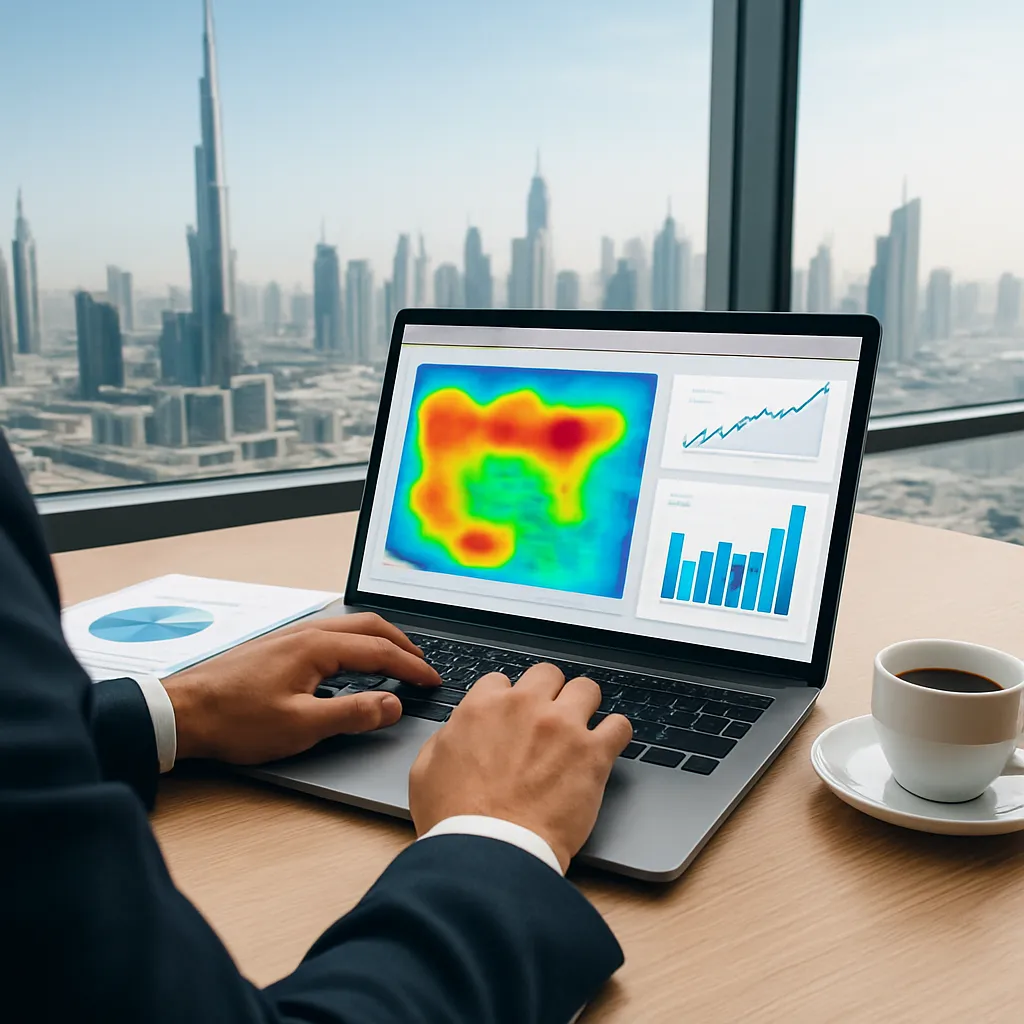
How to Use Heatmaps to Improve SEO in Dubai
Heatmaps have become one of the most practical tools for understanding real user behaviour on a website. For businesses competing in Dubai’s dynamic digital market, they offer a powerful shortcut to improving organic performance, conversion rates and user experience without relying only on guesswork or generic best practices.
Why Heatmaps Matter for SEO in Dubai’s Competitive Market
Dubai is a mature, high-intent digital market where users expect fast, intuitive and visually polished websites. Sectors like real estate, tourism, luxury retail, fintech and professional services invest heavily in online presence, which makes organic visibility and user experience crucial. In such an environment, heatmaps are not only a UX tool; they are a strategic asset for SEO and revenue.
Search engines increasingly evaluate signals that reflect real user satisfaction. While Google does not read your heatmap directly, it measures what heatmaps help you improve: click patterns, scroll depth, time on page, interaction with key elements and reduced bounce rate. These behavioural improvements align closely with what modern algorithms treat as positive engagement signals.
Dubai also has specific user characteristics that make behavioural analytics particularly valuable:
- High mobile penetration and strong mobile-first behaviour, especially for hospitality, food delivery, ride-hailing and local services.
- Large expatriate population with different languages, cultural expectations and browsing habits converging on the same sites.
- Intense competition for high-value keywords in real estate, tourism, legal services and luxury goods, where even small UX improvements can produce meaningful ranking and revenue differences.
Industry studies indicate that improving UX metrics can have a measurable impact on organic performance. For example:
- Research by Backlinko and others has shown that pages with higher dwell time and lower bounce rates tend to rank better on average, even when controlling for backlinks and content length.
- According to various CRO and UX case studies, heatmap-informed redesigns often yield 10–30% improvements in conversion rates; even if these numbers vary by sector, the direction is clear.
- In mobile-focused markets (which includes Dubai), Google’s data suggests that a one-second delay in load time can reduce conversions by up to 20%, making every UX optimization opportunity valuable.
By visualising actual behaviour on your pages, heatmaps reveal where attention gathers and where it leaks. This is particularly important in Dubai, where visually rich design, Arabic/English language switches and complex service offerings can easily create friction that traditional analytics dashboards do not clearly expose.
Types of Heatmaps and What They Reveal for SEO
Heatmaps convert complex interaction data into colour-coded, human-readable visuals. Each type of heatmap offers a different lens on user behaviour and helps answer specific SEO and conversion questions.
Click Heatmaps
Click heatmaps show where users click or tap on a page. Hot colours (red, orange) indicate areas of concentrated interaction; cold colours (blue, green) show where users rarely engage. For SEO and digital marketing in Dubai, click heatmaps are particularly useful to:
- Validate whether users are interacting with your primary calls-to-action (CTAs) such as “Book Now”, “Request a Call”, “Download Brochure” or “Get a Quote”.
- Identify misleading design elements, such as images or headings that look clickable but are not, causing frustration and potential drop-offs.
- Understand how Arabic and English content blocks compete for attention on bilingual pages.
- Compare behaviour between mobile and desktop sessions, which is critical in a mobile-first region.
If users consistently ignore primary CTAs or click on non-interactive elements, it often leads to lower conversion rate, shorter sessions and higher bounce, all of which indirectly hurt SEO. Adjusting the position, colour or wording of CTAs based on heatmap data can therefore improve both revenue and engagement metrics.
Scroll Heatmaps
Scroll heatmaps show how far down the page visitors typically travel. This is essential for long-form content, service landing pages and blog posts that target competitive Dubai-focused queries such as “best SEO agency in Dubai” or “off-plan properties in Dubai Marina”.
Scroll maps allow you to:
- See the exact percentage of visitors who reach key sections such as pricing, testimonials, property listings or contact forms.
- Identify “fold” issues, where crucial information sits below the average scroll depth and remains unseen by most visitors.
- Evaluate whether your content structure matches user attention; for instance, are people dropping off before reaching your main keyword-rich sections?
- Determine if your content is too long or poorly structured for mobile users in Dubai who may be browsing on the move.
SEO relevance is clear: if searchers land on your page but do not reach the part that answers their query, they are more likely to return to the SERP. This behaviour, often called pogo-sticking, suggests that your page did not adequately satisfy intent, which can damage rankings over time.
Move (Mouse-Tracking) Heatmaps
Move heatmaps record mouse movements and indicate where users hover or move their cursor. While not a perfect proxy for eye tracking, they still reveal which areas attract attention and which are ignored.
For Dubai-based businesses, move heatmaps can highlight:
- Confusing layout patterns on pages translated into both Arabic and English, especially when alignment switches from left-to-right to right-to-left.
- Areas where users hesitate, suggesting unclear messaging or information gaps (e.g., property payment plans, visa requirements, booking terms).
- Distractions where visual elements (background videos, large carousels, animations) attract attention away from conversion-focused headings or value propositions.
Refining layout based on move heatmaps can help search visitors find answers faster, reducing friction and improving session quality.
Rage Clicks and Error Heatmaps
Some tools provide specific visualisations for rage clicks (users clicking repeatedly on an element) or error zones. For example, on a Dubai hotel booking site, users might repeatedly click on a date-picker input that does not respond as expected on certain mobile devices. This frustration often leads to abandonment and a negative user experience.
Fixing these UX weaknesses promptly not only protects conversion but also reduces the likelihood of early exits that can negatively affect engagement-related ranking signals.
How Heatmaps Improve On-Page SEO for Dubai-Based Websites
Heatmaps become particularly powerful when integrated into a structured SEO process. Instead of making design or content decisions based solely on intuition, Dubai marketers can connect user behaviour to on-page optimization strategies.
Aligning Content with Real Search Intent
Organic traffic is only valuable if your pages match the intent behind the keywords that bring users in. Heatmaps show whether visitors actually engage with the sections written to satisfy that intent.
Consider a Dubai immigration consultancy targeting phrases around “Golden Visa Dubai eligibility”. A long-form guide may include:
- Eligibility criteria
- Required documents
- Processing timelines
- Fees
- FAQ
If scroll heatmaps reveal that most users abandon the page before reaching the detailed document list, you might need to move that information higher, break it into expandable accordions or highlight it with clearer headings. Reorganising content based on heatmap insights leads to:
- Faster discovery of answers by visitors.
- Longer dwell time and deeper engagement for high-value keywords.
- More natural opportunities to present internal links to related services, improving your overall site architecture.
In an environment like Dubai, where users may be comparing multiple agencies or service providers, the ability to quickly provide clarity can be the difference between keeping and losing a search visitor.
Optimising Internal Linking and Navigation
Effective internal linking supports both SEO and user journeys. Heatmaps help you understand which navigation elements and in-text links actually receive clicks.
Common opportunities on Dubai-focused websites include:
- Highlighting links to high-margin services (such as VIP real estate consultancy or premium tourism packages) in areas that already receive strong user attention.
- Repositioning low-performing navigation items or footer links that drive important organic journeys but are currently ignored.
- Improving cross-linking between English and Arabic content when heatmaps show that users are actively searching for language switchers or alternative versions.
By aligning your internal linking strategy with heatmap evidence, you support better crawling, stronger topical clusters and more intuitive flows for users navigating between related pages.
Reducing UX Friction that Hurts Engagement Metrics
Technical SEO and page speed are only part of the engagement story. Heatmaps surface friction that might not show clearly in standard analytics dashboards:
- Users attempting to click carousel arrows that are too small on mobile.
- High activity near pop-ups or overlays that interrupt the reading flow.
- Disproportionate focus on decorative elements while core informational content is ignored.
These friction points are especially damaging in Dubai’s mobile-heavy context, where users often browse during commutes, breaks or while multitasking. By simplifying interfaces, removing distractions and clarifying actions based on heatmap patterns, you can improve:
- Pages per session
- Conversion rate
- Time on site
- Return visits
All of these signal to search engines that users find your site trustworthy and useful.
Heatmaps and Local SEO: Capturing Dubai’s Intent
Local SEO in Dubai is competitive for restaurants, clinics, gyms, salons, real estate brokerages and professional services. Heatmaps can refine both your service pages and content hubs that target geo-specific keywords such as “near me” searches or neighbourhood-specific phrases.
Understanding Local Landing Page Performance
A local landing page for “digital marketing agency in Business Bay” or “luxury apartment for rent in Downtown Dubai” must simultaneously satisfy search intent and guide users to take action. Heatmaps can reveal:
- Whether visitors interact with location details such as maps, directions and nearest metro stations.
- How prominently your NAP (Name, Address, Phone) information is consumed.
- Which sections—pricing, testimonials, portfolio—receive the most engagement from local visitors.
If scroll or click heatmaps show that very few users engage with directions or contact data, moving that information higher, adding click-to-call buttons or CTA bars fixed to the bottom of mobile screens can significantly improve local conversions and engagement.
Serving a Multilingual, Multicultural Audience
Dubai’s audience is inherently multilingual, with significant use of both English and Arabic, plus visitors from Asia, Europe and beyond. Heatmaps help you evaluate how effectively your site serves these segments by answering questions like:
- Do users quickly find and use the language switcher?
- Is one language version seeing stronger engagement or lower scroll depth?
- Do visitors from specific regions (segmented by country in your analytics tool) behave differently on the same pages?
With this information, SEO and content teams can prioritise localised content, adjust copy tone, adapt imagery and refine information architecture. This not only improves organic performance but also makes paid campaigns more effective because landing pages better match audience expectations.
Practical Workflow: Integrating Heatmaps into SEO Strategy in Dubai
To extract real value from heatmaps, Dubai-based marketers should embed them into a structured workflow rather than treat them as one-off visual reports.
Step 1: Define Clear SEO and Business Goals
Before deploying heatmaps, decide what success looks like. Examples for a Dubai business include:
- Increase organic leads for property viewings in Dubai Marina by 20%.
- Improve conversion rate for Arabic-language contact forms by 15%.
- Boost time on page and scroll depth on pillar pages targeting “Dubai SEO services”.
These objectives guide which URLs to track, which segments to focus on and how to interpret heatmap data.
Step 2: Select the Right Heatmap Tools
Popular options include Hotjar, Microsoft Clarity, Crazy Egg and others. In the UAE context, consider:
- Data storage and compliance requirements, especially for government-related or financial services websites.
- Ability to segment by device, country, language or traffic source (e.g., organic vs paid from Dubai).
- Integration with your analytics stack (Google Analytics, Tag Manager, CRM).
Install tracking via a tag manager and allow time to gather statistically meaningful data—often several thousand sessions at minimum per key page, depending on traffic levels.
Step 3: Prioritise High-Impact Pages
Not every page requires detailed heatmap tracking. In a Dubai SEO strategy, focus on:
- High-traffic landing pages targeting commercially relevant keywords.
- Pages that rank on page one but have underperforming click-through or engagement metrics.
- Key conversion pages (contact, lead forms, booking steps, property enquiry pages).
- Local landing pages for specific districts or neighbourhoods.
This prioritisation ensures you invest time where improvements will produce the greatest SEO and business impact.
Step 4: Segment by Device, Region and Traffic Source
Dubai’s user mix means behaviour can vary dramatically between desktop office users, mobile commuters and international tourists researching from abroad. Segment your heatmaps where possible:
- Mobile vs desktop vs tablet views.
- Dubai and UAE visitors vs international traffic.
- Organic search traffic vs paid campaigns vs direct visits.
For instance, you might discover that mobile users from within Dubai scroll less and interact primarily with sticky CTAs, while international desktop users explore more detailed content. This insight would drive different layout decisions for each device.
Step 5: Translate Heatmap Insights into Concrete Hypotheses
Heatmaps by themselves are descriptive. To improve SEO, turn observations into testable hypotheses, such as:
- “Moving the main CTA above the fold on mobile will increase click-through rate by at least 15% and reduce bounce rate.”
- “Breaking long paragraphs on the English real estate guide into bullet points will increase scroll depth by 20%.”
- “Highlighting trust elements (RERA licence, awards, client logos) near the top will increase contact form completions for Dubai-based leads.”
These hypotheses can be tested with A/B experiments, design iterations or content rewrites, and then measured via both heatmaps and conventional analytics.
Step 6: Monitor Impact on SEO and Business Metrics
After implementing changes, re-run heatmaps on the same pages and track:
- Changes in scroll depth and click distribution.
- Variation in organic bounce rate and time on page.
- Movement in rankings for target keywords over several weeks or months.
- Impact on lead volume, bookings or other key conversions.
This closed-loop approach transforms heatmaps into a continuous improvement engine, rather than a one-time audit.
Case-Style Applications for Dubai Industries
Several Dubai-specific verticals can benefit significantly from heatmap-informed SEO and UX improvements.
Real Estate and Property Portals
Dubai property websites often feature complex pages combining neighbourhood guides, property listings, maps, financing information and contact options. Heatmaps can reveal whether users focus on:
- Specific property cards or filters on listing pages.
- Payment plans, ROI details or floor plans on off-plan project pages.
- Neighbourhood information, schools, metro proximity and amenities.
By surfacing the most important data earlier and clarifying CTAs like “Schedule Viewing” or “Download Brochure”, agencies can strengthen both organic performance and lead quality. This is particularly important for high-intent overseas buyers researching Dubai from abroad, where first impressions of the website strongly influence trust.
Hospitality, Tourism and Experiences
Hotels, tour operators and attraction providers in Dubai rely heavily on international search traffic. Heatmaps help answer questions such as:
- Which images and descriptions attract the most interaction?
- Are users engaging with pricing tables, date pickers and package details?
- Do mobile visitors quickly find the booking button and understand the process?
Optimising page structure based on this behaviour—while ensuring fast performance and clear messaging—can reduce abandonment and strengthen engagement, which search engines interpret positively when evaluating travel-related queries.
Professional Services and B2B
Law firms, consulting agencies, IT providers and financial services in Dubai compete for specialised, high-value keywords. Their pages often include dense information about regulations, compliance or technical services.
Heatmaps help these organisations:
- Identify whether decision-makers actually read case studies and whitepapers linked from service pages.
- See if visitors scroll down to see team profiles and credentials, which can be essential trust signals in B2B.
- Evaluate engagement with FAQ sections about specific Dubai or UAE regulations.
By restructuring content for clarity and engagement, they support both organic rankings and lead-generation efforts.
Ethical and Technical Considerations for Heatmap Use
Using heatmaps responsibly is essential, especially for organisations in regulated sectors like finance, healthcare or government-related services operating in Dubai.
Key considerations include:
- Ensuring that user privacy is protected by anonymising IP addresses where necessary and not recording sensitive form input data.
- Providing clear cookie and tracking notices that align with applicable regulations and user expectations.
- Regularly reviewing tool settings to avoid inadvertently capturing personal details in session recordings.
From a technical perspective, it is important to:
- Test heatmap scripts carefully to avoid performance issues, especially on mobile connections.
- Exclude internal traffic from your office or agency to prevent skewing the data.
- Coordinate implementation with developers and SEO specialists to avoid conflicts with other scripts, such as tag managers, analytics tools or A/B testing platforms.
Future Trends: Heatmaps, AI and the Evolving SEO Landscape in Dubai
As digital maturity grows in Dubai, combining heatmaps with advanced analytics and AI-driven tools will become standard for sophisticated SEO strategies. Some emerging directions include:
- Automated detection of UX anomalies, where systems flag sudden changes in scroll patterns or click behaviour that may indicate technical issues or design regressions.
- Personalised experiences where heatmap insights help define content variations for different segments (for example, tailoring real estate content differently for investors vs end-users).
- Closer integration between SEO, CRO and paid media teams, so that behaviour insights from organic traffic also inform landing pages for Google Ads, social campaigns and remarketing.
For Dubai’s market, where innovation and ambitious digital projects are common, the organisations that model their websites closely on real user behaviour will enjoy a competitive edge in both organic visibility and conversion performance.
Using heatmaps thoughtfully allows marketers, agencies and business owners in Dubai to bridge the gap between technical analytics data and human experience. When this visual understanding is systematically translated into better content, cleaner layouts and more compelling calls-to-action, the result is a healthier, more resilient SEO profile and stronger digital growth across the region.