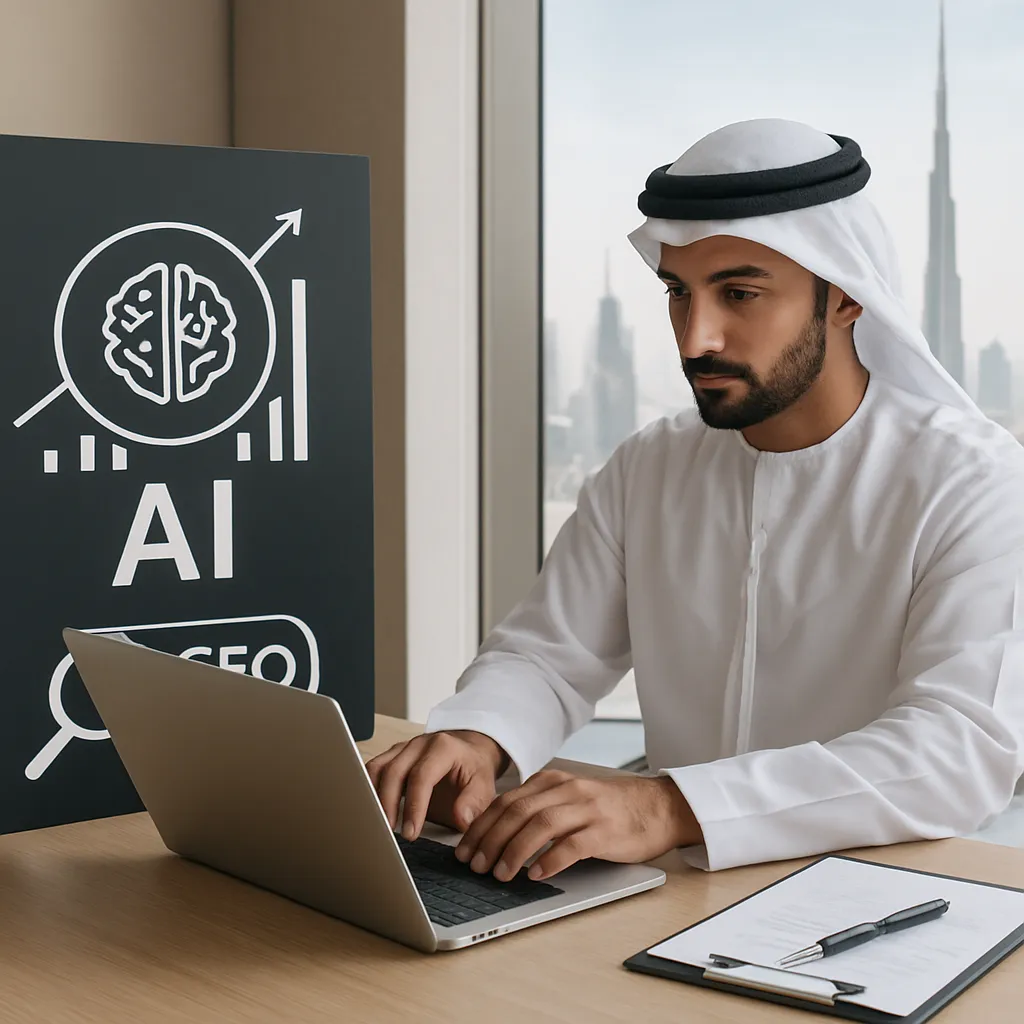
How Dubai Businesses Can Use AI Tools for SEO
Dubai has become one of the most dynamic digital hubs in the Middle East, attracting global brands and ambitious startups that compete aggressively for online visibility. In such a competitive environment, using **AI tools** for **SEO** is no longer a luxury, but a strategic necessity. From data-driven keyword research to personalized content and automated technical audits, artificial intelligence is reshaping how Dubai businesses approach digital growth, both in English and Arabic.
Why AI-Powered SEO Matters So Much in Dubai’s Digital Landscape
Dubai’s economy is heavily driven by sectors like tourism, real estate, finance, logistics, retail and professional services, all of which rely on online discovery. According to Statista, the UAE’s internet penetration is above 99%, and the majority of residents use smartphones as their primary device for browsing and purchasing. This creates a huge opportunity for businesses that can rank high in search results and capture qualified leads before their competitors do.
The challenge is that manual SEO is becoming increasingly complex. Google makes thousands of algorithm updates every year, search intent shifts rapidly, and users expect fast, localized and highly relevant content. AI steps in as a scalable assistant that can analyze massive data sets faster than any human team and uncover patterns that inform smarter SEO decisions.
Some global statistics that explain the relevance of AI for SEO and digital marketing include:
- Over 60% of marketers already use AI in their marketing activities, with SEO and content creation among the top use cases (HubSpot, 2023).
- Organic search still drives around 53% of website traffic on average, making SEO one of the most cost-effective acquisition channels (BrightEdge).
- Search queries are increasingly conversational and long-tail, thanks to voice search and mobile usage, which AI models handle far better than traditional keyword tools.
For Dubai businesses, there is an additional layer: multilingual and multicultural audiences. Tourists, expatriates and local Emiratis often search in both Arabic and English, sometimes mixing languages in a single query. AI-based tools are uniquely suited to process this complexity, enabling brands to optimize for multiple languages, dialects and user intents without multiplying manual work.
Using AI for Smarter Keyword Research and Competitive Analysis
Keyword research remains a foundation of any **SEO strategy**, but AI changes how that research is done and how deep the insights can go. Instead of only looking at search volume and competition, AI-powered tools can interpret user intent, cluster related topics and predict which keywords are most likely to convert.
Finding High-Intent Keywords for Dubai’s Key Industries
Dubai companies operate in industries where user intent can be clearly commercial (for example “luxury villa for sale in Dubai Marina” or “family hotel near Dubai Mall”) or informational (“how to open a business in Dubai free zone”). AI helps distinguish between these intents and prioritize keywords that better match business goals.
Modern AI-based keyword tools can:
- Analyze thousands of potential keywords in seconds and group them by topic, buyer journey stage and intent.
- Generate related keyword ideas for both English and Arabic, including colloquial phrases used by residents and tourists.
- Identify “content gaps” where your competitors are ranking, but your brand has no or weak content.
- Estimate the difficulty of ranking, not just based on backlinks, but also content quality and user engagement metrics.
For example, a real estate agency in Dubai might discover through AI clustering that there is a growing cluster of long-tail searches related to “rent to own Dubai”, “Dubai rent to own villas” or “rent to own Dubai Marina apartments”. While each of these may have moderate search volume, together they create a lucrative niche that can drive qualified leads if targeted with specialized landing pages and localized content.
Competitive Intelligence at Scale
In a market where international and local players compete head-to-head, understanding what competitors are doing in search is critical. AI-based SEO platforms can crawl competitor websites, analyze content structures, backlink profiles and technical performance to provide actionable intelligence.
Some useful AI-powered competitive features include:
- Automatic detection of the pages generating the most organic traffic for competitors.
- Identification of competitor landing pages optimized for specific Dubai neighborhoods, malls or attractions.
- Backlink opportunity analysis, showing which local media, blogs and directories frequently link to top players.
- Content quality scoring, signaling where your pages fall short in relevance, depth or structure compared to the market leaders.
This type of **data-driven** analysis allows Dubai businesses to go beyond intuition and build SEO roadmaps grounded in measurable opportunities. A hotel chain, for example, can discover that competitors get a lot of organic visibility from detailed “things to do near Dubai Marina” guides, and use AI to craft superior, richer guides optimized around both English and Arabic search behavior.
AI-Driven Content Creation and Optimization for Dubai Audiences
Content is where many Dubai businesses either win or lose their SEO battles. AI does not replace human creativity or local market knowledge, but it dramatically accelerates and enhances the process of planning, writing and optimizing content that both users and search engines will value.
From AI-Assisted Ideation to Topic Clusters
Instead of brainstorming topics manually, marketers can feed AI tools with seed keywords such as “Dubai desert safari”, “Dubai business setup” or “Dubai cosmetic clinic”. The AI then generates related topics, questions, subtopics and long-tail queries that people actually search for.
These suggestions can be organized into topic clusters with a main “pillar” page and multiple supporting articles. For example, an agency focused on tourism could create a pillar page on “Dubai desert safari guide” supported by subpages such as:
- Best time of year for a desert safari in Dubai
- What to wear on a Dubai desert safari
- Private vs group desert safaris in Dubai
- Top desert safari options for families in Dubai
- Luxury desert safari experiences in Dubai
AI helps ensure that each piece covers relevant subtopics, includes semantically related terms and answers common user questions. This structure makes it easier for Google to understand your site’s authority around specific themes, improving your visibility across the entire cluster.
Optimizing Content for Multilingual and Multi-Device Users
Dubai’s unique multilingual environment requires content strategies that go beyond simple translation. AI-based language models can assist with:
- Creating original English content and then adapting it into Arabic with attention to cultural nuance and search intent.
- Generating separate meta titles and descriptions for both languages that reflect local phrasing.
- Identifying differences in search behavior across languages; for instance, Arabic speakers might search differently for “family lawyer in Dubai” than English speakers.
- Adapting content structure for mobile users, who form a large majority of search traffic in the UAE.
AI tools also support on-page optimization by suggesting headings, FAQs, internal links and schema markup. For a Dubai clinic, the tool may recommend adding structured data for medical organizations, reviews, FAQs and local business details, increasing the chances of appearing with rich results such as star ratings or FAQ snippets, which can boost click-through rates.
Ensuring Content Quality and E-E-A-T Compliance
Google increasingly values Expertise, Experience, Authoritativeness and Trustworthiness (E-E-A-T), particularly for sectors like finance, health and legal services, which are very active in Dubai. AI assists in several ways:
- Checking factual consistency and flagging statements that might require credible sources or expert review.
- Suggesting additional sections that show real experience, such as case studies, testimonials or author bios.
- Evaluating readability and clarity for non-native English speakers, who make up a large part of Dubai’s population.
While AI can draft paragraphs or outlines, human experts must still validate sensitive content. A Dubai financial advisory firm, for instance, can use AI to prepare initial drafts on company formation in free zones, but licensed consultants should review and refine the final version to ensure compliance with local regulations and provide real authority.
Technical SEO and Automation: Keeping Dubai Websites Fast, Secure and Search-Friendly
With intense competition and a mobile-first audience, Dubai businesses cannot afford slow, buggy or poorly structured websites. Technical SEO is crucial, and **AI tools** can automate many diagnostic and optimization tasks that previously required time-consuming manual audits.
Site Audits and Error Detection with AI
AI-powered crawlers can scan thousands of pages and highlight:
- Broken links, missing alt tags, duplicate content and incorrect redirects.
- Issues with internal linking structure that may prevent important pages from being discovered and indexed.
- Pages with thin content, slow loading times or poor mobile usability.
- Security warnings, such as mixed content or misconfigured HTTPS, that can hurt both user trust and rankings.
The AI not only lists problems but also recommends prioritized fixes based on potential SEO impact. For a Dubai e-commerce store serving customers across the GCC, this can mean the difference between a cluttered technical backlog and a clear, data-driven roadmap that focuses first on revenue-critical pages.
Core Web Vitals and User Experience
Google’s Core Web Vitals metrics (loading speed, interactivity, visual stability) strongly influence search performance, especially on mobile. Many Dubai users access websites on varying network speeds, from high-speed hotel Wi-Fi to congested mobile connections.
AI-based performance analyzers can:
- Simulate user experiences from different locations and devices relevant to Dubai and the wider region.
- Identify heavy scripts, unoptimized images or layout shifts that hurt user experience.
- Offer specific optimization suggestions, such as lazy loading assets or compressing images without hurting quality.
Such improvements not only boost SEO but also directly influence conversion rates. Faster websites lead to lower bounce rates and higher engagement, which search engines interpret as a sign of value.
Local SEO Automation for Dubai Locations
For brick-and-mortar businesses, local SEO is essential. AI tools can assist with:
- Optimizing Google Business Profile listings with relevant categories, attributes and localized descriptions.
- Monitoring and analyzing user reviews at scale, detecting sentiment trends and frequently mentioned topics.
- Ensuring NAP (Name, Address, Phone) consistency across local directories and Arabic/English variations.
- Generating localized landing pages for specific districts and neighborhoods, such as Jumeirah, Business Bay or Deira, with tailored content and FAQs.
As Dubai continues to grow outward with new communities and attractions, AI-driven local SEO allows businesses to quickly establish relevance in newly popular areas, reaching customers before competitors saturate those search terms.
Measuring Results, Personalizing Experiences and Planning for the Future
Implementing AI tools for SEO is only valuable if businesses can measure impact and continue to refine their strategies. AI analytics platforms offer deeper insights into how users from Dubai and abroad interact with your website and content over time.
Advanced Analytics and Predictive Insights
AI-driven analytics go beyond traditional dashboards to uncover relationships between content, user behavior and business outcomes. They can:
- Detect patterns in how visitors from different regions of Dubai or different countries behave on your site.
- Predict which pages or content topics are most likely to generate leads or sales.
- Identify early signs of traffic drops linked to algorithm updates or technical issues.
- Segment visitors based on intent and behavior, informing both SEO and paid campaigns.
For a Dubai B2B company selling to regional clients, AI can reveal that visitors searching for certain long-tail keywords have a higher lead-to-opportunity conversion rate, prompting the team to prioritize related content and outreach.
Personalization and On-Site Experience
AI can also personalize the on-site experience in ways that indirectly improve SEO by boosting engagement metrics. When content recommendations, suggested products or related articles are tailored to the user’s behavior or location, people stay longer, view more pages and are more likely to convert.
In practice, Dubai businesses can:
- Show different homepage sections to users interested in tourism versus residents searching for everyday services.
- Highlight Arabic content automatically to users whose browser language suggests preference for Arabic.
- Recommend region-specific offers, such as Dubai summer promotions or Ramadan packages, based on the calendar and user profile.
These personalization efforts, driven by AI, help create a more relevant and satisfying experience, which in turn sends strong engagement signals to search engines.
Ethical and Strategic Considerations
While AI offers tremendous advantages, Dubai businesses must also be aware of ethical, legal and strategic implications:
- Content generated or assisted by AI should be clearly reviewed and approved by humans, especially in regulated sectors.
- All analytics and data collection must comply with regional privacy requirements and global best practices.
- Over-automation without human oversight can produce generic or culturally insensitive content, damaging brand reputation.
- Long-term SEO success still depends on real value creation: unique insight, excellent service, strong products and trustworthy information.
AI should be treated as a **strategic** partner—an accelerator for skilled marketers and business owners in Dubai, not a replacement for their judgment, creativity or knowledge of local culture and customer expectations.
Practical Steps for Dubai Businesses to Start Using AI for SEO
To translate these ideas into real competitive advantage, organizations in Dubai can follow a structured approach to adopting AI tools.
- Audit your current SEO situation: Understand your existing rankings, technical health, content performance and backlink profile. This creates a baseline.
- Choose AI tools aligned with your goals: For some, the priority will be content ideation and creation; for others, technical SEO or multilingual optimization. Select solutions that integrate well with your CMS and analytics stack.
- Start with one or two key use cases: For example, use AI to identify content gaps in Arabic for your main service pages, or to automate monthly technical audits.
- Create guidelines for AI usage: Define where AI can help (drafting, research, clustering) and where human expertise must take control (final edits, sensitive topics, brand voice).
- Measure and refine: Track organic traffic, keyword rankings, engagement and conversions from AI-optimized content and pages. Adjust your topics, templates and processes based on results.
As Dubai continues its transformation into a global center of innovation, businesses that integrate **AI**, **SEO**, **analytics**, localization and user experience will be better positioned to capture the attention of both residents and international visitors. By treating AI as a core part of their internet marketing infrastructure, companies can move beyond short-term tactics and build sustainable, search-driven growth in one of the world’s most competitive digital markets.