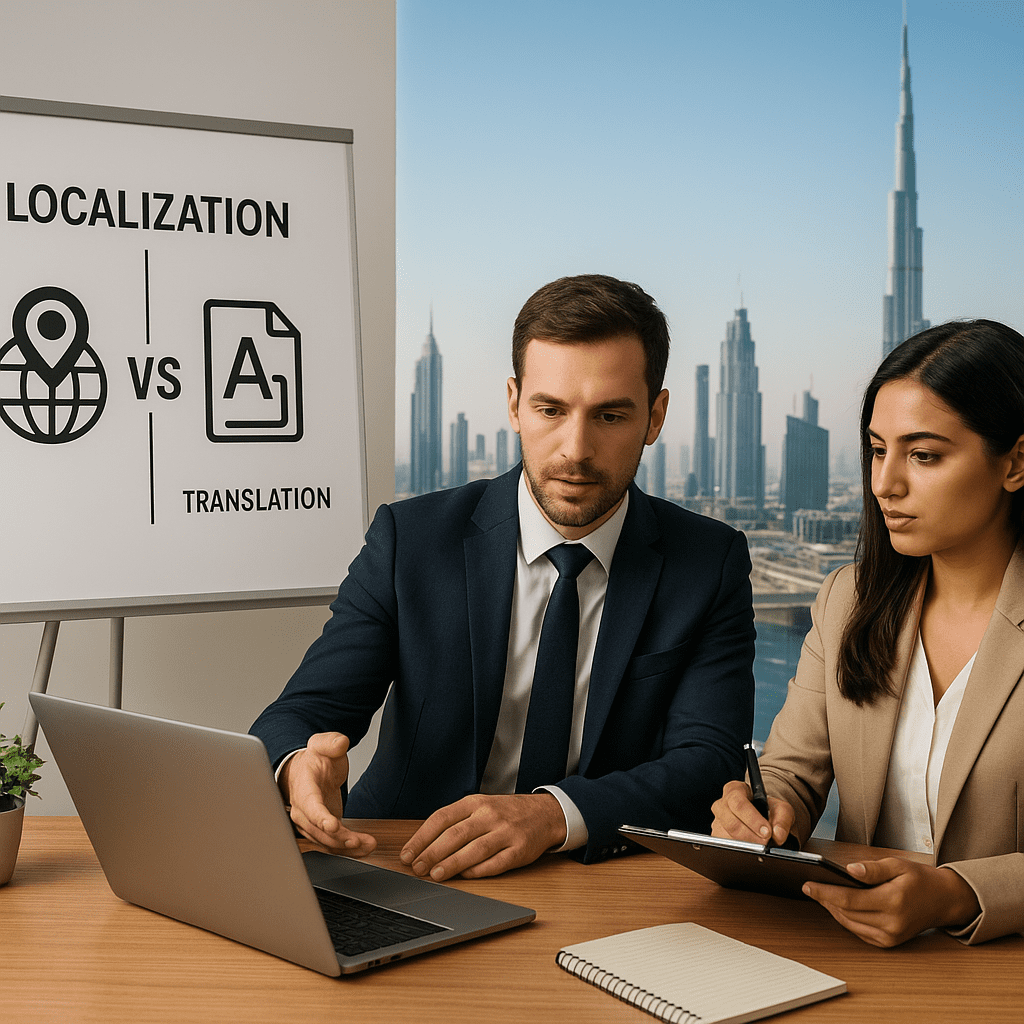
Content Localization vs. Translation for Dubai SEO
Dubai’s digital economy thrives at the intersection of cultures, languages, and high-speed connectivity. For brands vying for organic visibility, the question is no longer whether to publish content in multiple languages, but how to do it in a way that actually moves rankings, traffic, and revenue. The critical distinction is between simple word-for-word translation and full-spectrum content localization that adapts to language, culture, purchasing behavior, and technical SEO realities in the UAE. This article unpacks when translation is sufficient, when localization is essential, and how to architect a scalable multilingual SEO program that converts across Dubai’s uniquely cosmopolitan audience.
Translation vs. Localization: What Matters for Dubai SEO
Translation converts source text into a target language while aiming to preserve meaning. It is efficient for technical documents, legal pages, and standardized product specs where precision and consistency matter more than persuasion. Localization, by contrast, adapts the message to local cultural references, buyer psychology, search intent, and platform conventions—rewriting where necessary to match how people actually search and decide in Dubai.
The difference matters because search engines reward relevance at multiple layers: linguistic match, topical alignment, user engagement, and entity-level authority. A direct translation might match keywords but miss the nuance that drives click-through rates, dwell time, and conversions. In a city where English is a commercial lingua franca and Arabic is the official language, successful brands plan content for both—prioritizing the user’s context first and the words second.
Practically, this means you adapt for:
- Lexical choices: Multilingual audiences may search differently for the same idea (e.g., “serviced apartments Dubai Marina” vs. “شقق فندقية دبي مارينا”).
- Dialects and transliteration: Gulf Arabic vs. Modern Standard Arabic; Arabizi and English brand spellings in Arabic queries.
- Measurement and everyday norms: AED currency, date formats, VAT references, local addresses, WhatsApp calls-to-action, and the UAE’s Monday–Friday workweek.
- Search behavior: Tourists often search in English, residents mix languages, government and public services queries skew more Arabic.
As a rule of thumb, translation is acceptable for reference-heavy pages, while localization is non-negotiable for conversion pages, brand storytelling, and any content competing in commercial SERPs.
The Dubai Market: Languages, Devices, and Platforms
Dubai’s audience is globally connected and device-centric. According to multiple market overviews (e.g., DataReportal 2024), internet penetration in the UAE is approximately 99%, smartphone adoption is among the highest worldwide (well above 95%), and mobile browsing dominates everyday discovery and transactions. Google holds a commanding share of search in the UAE (commonly over 95%), with YouTube functioning as both a social and search platform for product research and local experiences.
Language usage is distinctive. Arabic is the official language and foundational for government, culture, and many B2C verticals. Yet English is the operating language of business, tourism, and much of daily commerce among expatriates. Add to this a large South Asian population that may search in English or in native languages while consuming English landing pages. The overlap creates diversified query patterns:
- English navigational and commercial searches for hotels, real estate, events, and attractions.
- Arabic informational and government-related queries, consumer services, and local community topics.
- Mixed queries: English brand names with Arabic descriptors, or vice versa.
Global research underlines the business case for localized content: CSA Research’s “Can’t Read, Won’t Buy” studies report that a majority of consumers prefer content in their own language, with a substantial share reluctant to purchase when information is not localized. In Dubai, this preference intersects with multicultural expectations: audiences want language comfort, but also local credibility signals like neighborhood mentions (Marina, JLT, Business Bay, Deira), payment methods familiar to the region, and assurances such as COD or WhatsApp support lines.
Keyword Research Across Languages: Mapping Intent, Not Just Words
Effective Dubai SEO starts by mapping queries to user intent across both Arabic and English. Instead of translating a keyword list, build language-native topic clusters reflecting how real users research, compare, and buy.
Sources and methods
- Google Search Console: Extract queries by country (UAE) and page language to identify organic demand patterns.
- Google Keyword Planner, Trends, and Semrush: Separate projects for Arabic and English; check variation by emirate if applicable.
- On-site search logs: Observe real language mixing and brand spellings typed by visitors.
- Competitor SERP analysis: Compare top performers in both languages to discover content gaps, FAQ patterns, and formats Google rewards.
- Interviews and customer service transcripts: A goldmine for colloquial phrases, transliteration forms, and objections to address.
Handling dialects and transliteration
When building Arabic clusters, decide whether to use Modern Standard Arabic (MSA) or Gulf Arabic. MSA offers wider reach and clarity; Gulf Arabic may boost resonance for certain verticals (e.g., food, local services, lifestyle). For mixed-language behavior, capture transliteration variants, such as “marina” vs. “مارينا,” and test which form converts better in titles and H1s. Crucially, align each term to a clear search intent stage—awareness, consideration, or transaction—and craft the page experience accordingly.
On-Page Localization: Copy, UX, and Credibility Signals
Localization extends beyond vocabulary. It shapes the entire page experience: content hierarchy, microcopy, images, trust badges, and calls-to-action.
- Headlines and value props: Rewrite for persuasion in each language instead of mirroring English phrasing into Arabic or vice versa.
- Microcopy: Translate utilities such as “Open now,” “Free parking,” “Pay with card on delivery,” and “WhatsApp us” with locally intuitive phrasing.
- Imagery and examples: Showcase Dubai landmarks, neighborhoods, and local testimonials. Use AED pricing and include VAT context when relevant.
- Local proof: Add Arabic and English customer quotes, press mentions from UAE outlets, and local partner logos.
- RTL correctness: Arabic pages must render right-to-left correctly for menus, forms, and pagination to reduce friction and improve engagement metrics.
Because engagement signals like CTR and dwell time feed ranking models, copy that feels native to the user can outperform literal translations—even when both target the same head terms. Tailor not only the text but the offer structure: for example, hospitality pages that highlight late checkout during Ramadan, or delivery services that emphasize hours during Eid and long weekends.
Technical SEO for Multilingual Sites Serving Dubai
Search engines must clearly understand language, geography, and canonical relationships. Rigorous technical implementation prevents cannibalization and ensures the right audience lands on the right version.
- Language targeting: Use hreflang tags to declare en-AE and ar-AE variants. Avoid generic en/ar if UAE-specific pages exist.
- URL structure: Prefer subdirectories (/en/, /ar/) for central authority while keeping management simple. Consistent slugs improve analytics clarity.
- Canonicalization: Each language version should self-canonicalize; do not canonicalize Arabic pages to English or vice versa.
- Sitemaps: Provide language-specific sitemaps and ensure all indexable pages are present with the correct alternates.
- Structured data: Include inLanguage and availableLanguage in Organization markup. For videos and articles, declare language in schema where applicable.
- Performance: Prioritize Core Web Vitals for both scripts (Latin and Arabic). Ensure fonts render crisply in Arabic without layout shift.
- Hosting/CDN: Serve from a low-latency edge in the Gulf region; compress images and preconnect critical resources.
- RTL support: CSS must handle mirroring for layout, icons, and directional arrows; test all interactive elements.
Information Architecture and Internal Linking
Multilingual IA should make language behavior obvious and frictionless. Use persistent language toggles that preserve context (switch ar/en for the same page path). Internally link within each language cluster first to consolidate relevance and maintain consistent anchor text. Where cross-language linking helps users (e.g., policy pages), make anchors explicit. For location-heavy sites (e.g., clinics, real estate, hotels), build city and neighborhood hubs in both languages to support long-tail discovery.
Content Types That Win in Dubai SERPs
- Service and category pages localized to core neighborhoods and buyer intents.
- Comparison and guide content: “Buy vs. rent in Dubai Marina,” “How to register a business in Dubai,” “Tourist SIM comparison.”
- Seasonal content: Ramadan dining hours, Eid delivery schedules, Dubai Shopping Festival offers.
- Multimedia: Short videos and carousels embedded with transcripts. YouTube descriptions in both languages can attract incremental search traffic.
- Q&A and FAQs: Structured, bite-sized answers that surface in featured snippets, People Also Ask, and voice responses.
Support these with trust drivers—author bios, local credentials, and transparent pricing—to strengthen E‑E‑A‑T signals in competitive verticals like finance, health, and real estate.
Local SEO and Off-Site Authority
For physical or service-area businesses, consistency across Google Business Profile, Apple Business Connect, and UAE directories is essential. Provide dual-language fields where possible and use standardized transliterations for Arabic names. Build relationships with local publishers and community organizations—Arabic and English—to earn coverage and backlinks that carry geographic and topical relevance. Niche citations (e.g., property portals, hospitality guides) often outweigh generic directories for authority in Dubai SERPs.
Measurement: Separating Language Signals and Business Impact
Track performance in a way that isolates language effects from overall growth:
- Analytics views/segments by language and country; separate goals when funnels differ (e.g., WhatsApp clicks on Arabic pages).
- Search Console properties for subdirectories (/en/, /ar/) to audit queries, CTR, and indexed coverage independently.
- Rank tracking in en-AE and ar-AE with device splits; analyze snippet ownership (featured, PAA, video) per language.
- Attribution: Tie revenue to language versions; factor seasonal cycles (Ramadan, summer travel peaks, major events).
Benchmark on engagement as well as rankings. In many Dubai verticals, Arabic pages may attract fewer sessions but higher conversion rates when localized to community needs; English pages might gather broader top-of-funnel traffic. Calibrate investment accordingly.
When Translation Is Enough—and When It Isn’t
Use translation for
- Legal and policy pages, technical specs, installation manuals.
- Back-catalog content where search demand is low but completeness matters.
- Support articles with standardized terminology.
Require localization for
- Money pages: product and service pages, pricing, checkouts.
- Lead gen forms and CTAs: adapt tone, assurance copy, and social proof.
- Top-of-funnel content meant to earn links and shares.
- Seasonal and event content aligned to the Dubai calendar.
The middle ground—transcreation—rewrites sections to fit cultural persuasion patterns while preserving core meaning, ideal for hero sections and ad-like headlines. Blend translation for supporting paragraphs with selective transcreation for hooks and objections.
Workflow, Quality, and Governance
Multilingual SEO requires repeatable processes so quality scales with content volume.
- Guidelines: Create Arabic and English style guides, glossaries, and product naming conventions; define transliteration practices.
- Roles: Pair native-language strategists and editors with subject-matter experts; include legal review for regulated sectors.
- Tooling: Use TMS platforms that support localization memories and QA checks; integrate CMS connectors for version control.
- Review loops: Linguistic QA, SEO QA (metadata, internal links, headings), and UX QA for RTL rendering and microcopy.
- Updates: Plan content refreshes around policy changes (e.g., fees, VAT), new neighborhoods or developments, and algorithm shifts.
AI-assisted drafting accelerates ideation but requires human refinement for idioms, cultural references, and SERP-driven nuances, especially in Arabic. Keep a living glossary of high-value phrases proven to lift conversion in each language.
Compliance and Sensitivities
Localize responsibly. Be mindful of religious holidays, prayer times, and modesty standards in imagery. Ensure claims comply with UAE regulations (e.g., financial promotions, medical advice). In Arabic, avoid overly casual slang for formal industries; in English, avoid idioms that do not translate well culturally.
Sector-Specific Notes
Hospitality and tourism
- English content captures global demand; Arabic pages win local family travel and staycations.
- Emphasize proximity to attractions (Dubai Mall, Burj Khalifa, Museum of the Future) and parking/transport details.
- Seasonal packages for Ramadan and Eid with iftar/suhoor menus in both languages.
Real estate
- Neighborhood landing pages in both languages; unify terms for community names and property types.
- Trust content: RERA compliance, payment plans in AED, service charge explanations.
- Video walkthroughs with bilingual captions; schema for Product/Offer where appropriate.
Finance and fintech
- Strict compliance copy; bilingual FAQs on fees, Shariah-compliant products, KYC steps.
- Localized calculators and rate tables; announce regulatory updates promptly across languages.
Common Pitfalls That Depress Rankings and Conversions
- Literal translation of CTAs and headlines that kills persuasion.
- No language alternates or broken toggles; users bounce rather than switch language.
- Incorrect hreflang mappings leading to wrong pages ranking in UAE.
- Ignoring RTL: misaligned forms and icons degrade trust and usability.
- Mixing dialects haphazardly; inconsistent transliteration of place names and brands.
- Cloned metadata: duplicate titles and meta descriptions across languages waste SERP real estate.
- Lack of schema signals (inLanguage, FAQ, Product) reducing rich result eligibility.
- Thin Arabic pages compared to robust English ones, signaling lower quality.
Voice, Video, and Multimodal Discovery
As voice and multimodal search grow, structured content and conversational phrasing matter more. Arabic voice inputs often use colloquial terms; English voice searches skew toward question formats. Optimize FAQ blocks with concise, direct answers; add timestamps and chapters to videos; and ensure transcripts exist in both languages. Short-form video embedded in pages can improve time on page and SERP visibility, especially when aligned to recurring Dubai events.
Strategic Roadmap: From Audit to Scale
- Audit: Inventory content, technical signals, and backlinks by language; benchmark competitors in en-AE and ar-AE.
- Prioritize: Identify money pages and high-potential clusters where localization will yield the biggest lift.
- Pilot: Localize a small set across both languages; A/B test headlines, CTAs, and trust modules.
- Scale: Roll out winning patterns, formalize style guides, and automate publishing via TMS–CMS integration.
- Maintain: Monitor SERP changes, refresh seasonal assets, and update internal links as clusters expand.
Costs, Returns, and Decision Framework
Localization requires more investment than translation, but returns compound where competition is fiercest. Evaluate by:
- Revenue influence: Which pages drive AED-denominated revenue or qualified leads?
- Competitive density: Verticals with saturated English results may be more winnable in Arabic with high-quality localization.
- SERP features: If snippets, maps, or video dominate, localization plus format-specific optimization is essential.
- Lifetime value: For B2B or real estate, a small increase in qualified Arabic traffic can justify full localization.
Budget pragmatically: translate your long tail, localize your growth engines, transcreate your persuasion levers.
Future Outlook for Dubai SEO
Expect richer SERPs and more entity-driven ranking factors. Brands that codify their bilingual entities—consistent names, addresses, authors, and knowledge panels—will gain durable advantages. AI summaries and answer features will favor sources with clear language signals, expert authorship, and stable internal linking. Multilingual customer experience—from first click to support chat—will increasingly influence organic performance as engagement metrics inform search quality models.
Conclusion: Choose Localization to Win the Market, Use Translation to Cover the Map
In Dubai’s search landscape, translation helps you be present; localization helps you be chosen. Architect content around how multilingual audiences actually search, decide, and buy. Implement airtight technical foundations, tailor persuasion to each language, and measure outcomes by both rankings and revenue. Brands that treat SEO as an experience—supported by robust localization, culturally tuned copy, and precise technical execution—consistently outpace those that rely on direct translation alone. In a city built on ambition and speed, aligning Arabic and English content with real user intent, correct hreflang, rich schema, trustworthy E‑E‑A‑T, and authoritative backlinks is the most reliable path to durable organic growth.