BrightLocal
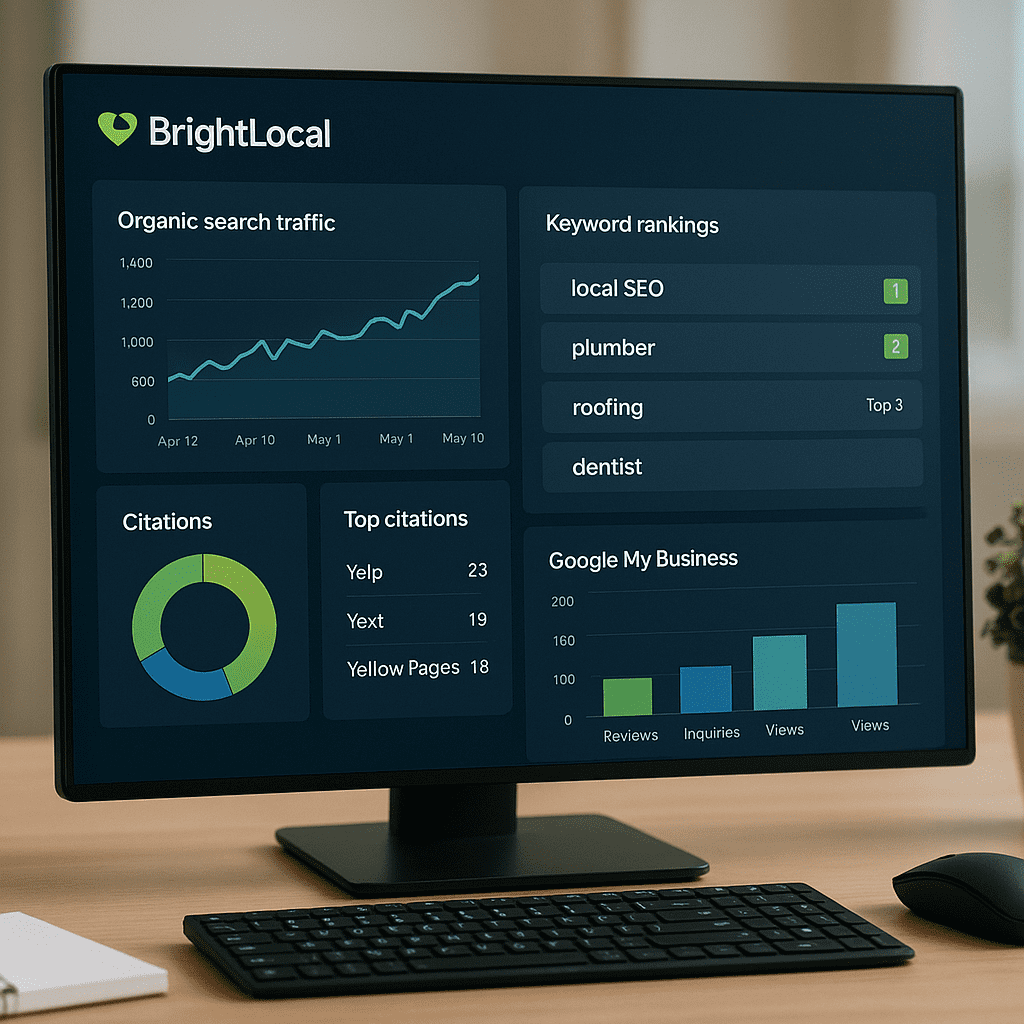
BrightLocal is a specialized platform built to solve the messy, granular, and often opaque parts of local search optimization. Rather than trying to be everything to everyone, it focuses on the signals that influence map pack visibility, store-finder performance, and service-area discovery—areas where small businesses, agencies, and multi-location brands struggle to get reliable data. From rank tracking across neighborhoods to auditing Google Business Profiles and consolidating business listings, BrightLocal offers a toolkit that connects actions to outcomes, helping marketers move beyond guesswork and into measurable improvements in local visibility. It’s practical, outcomes-oriented, and equipped with the right blend of measurement, execution, and workflow tools to support both hands-on practitioners and teams managing hundreds of locations.
What BrightLocal Is and Who It’s For
At its core, BrightLocal is a local SEO platform. It combines auditing, monitoring, and execution features that address the specific ranking factors used by local search engines—especially Google’s local results and map pack. Where enterprise suites emphasize broad keyword and link analysis, BrightLocal zeroes in on business listings (NAP data), Google Business Profile optimization, review signals, proximity and prominence factors, and the competitive topology within a given geography.
The platform is particularly well-suited for:
- Single-location businesses that need clear, actionable diagnostics and quick wins without enterprise complexity.
- Agencies that require scalable monitoring, white-labeled reporting, and repeatable workflows for dozens or hundreds of clients.
- Multi-location and franchise brands that need roll-up visibility and local details at the same time—what’s working systemwide and what needs fixing at the store level.
Founded by Myles Anderson, BrightLocal has grown into a widely recognized authority in local search, not only through its software but also via industry research such as Local RankFlux (local volatility tracking), consumer review surveys, and benchmark studies. This emphasis on research keeps the product aligned with real-world ranking dynamics and makes it a useful barometer of the local search landscape.
Key Features and How They Influence Local Visibility
Local Rank Tracking and Search Grid Visualization
Standard rank tracking shows where a keyword stands in a city; BrightLocal goes deeper by simulating searches from specific points on a map. This matters because local results vary significantly within the same city or zip code. The Local Search Grid visualizes a keyword’s map pack position for a series of grid points, revealing how proximity, density, and competition shape discoverability. You can see where visibility drops off, identify pockets of opportunity, and plan content or link-building efforts to shore up weak zones.
Practical wins include aligning keywords with neighborhoods, tailoring landing pages to local intent, and prioritizing service areas where a small ranking lift would translate into meaningful traffic. The results help teams avoid over-optimizing for a single centroid and instead build diversified coverage across the areas that matter to customers.
Google Business Profile Audit and Insights
BrightLocal’s audit for Google Business Profiles (GBP) evaluates core ranking and conversion levers: completeness of categories, presence and quality of photos, business attributes, opening hours, description, products/services, and local justifications found on the SERP. It also cross-references competitors to spot gaps. When connected, GBP Insights are pulled in to track views, calls, direction requests, and interactions, translating visibility into engagement metrics that matter to real-world outcomes.
Because Google updates its local systems frequently, ongoing auditing ensures profile health doesn’t quietly degrade—especially after category reclassifications, owner changes, or user-suggested edits. In parallel, monitoring protects against profile tampering or accidental regressions in listing completeness.
Citation Tracker and Manual Citation Building
Local citations—consistent mentions of your NAP (Name, Address, Phone) across directories—are still foundational for local credibility and data accuracy. BrightLocal’s Citation Tracker identifies existing listings, inconsistencies, and missing opportunities. The platform also offers a paid, managed service to build or clean up listings. This human-driven approach can reduce duplication and mismatches that sometimes slip through automated pipelines.
Corrected NAP data helps search engines trust the entity, which supports map pack stability and reduces customer friction. While modern local algorithms lean heavily on proximity and prominence, citation cleanliness is still a necessary hygiene factor, particularly for multi-location brands with legacy data drift.
Reputation Management and Review Generation
Review velocity, diversity, and response behavior are strong behavioral signals for local results and powerful conversion drivers. BrightLocal’s reputation tools monitor reviews across major platforms and niche vertical sites, centralizing response workflows. Campaigns for email or SMS can be used to request feedback in a compliant manner, factoring in platform policies that prohibit gating. Templates, reminders, and tracking make it easier to maintain a steady cadence and respond quickly to negative sentiment.
Beyond rankings, review improvement directly influences click-through rates, phone calls, and foot traffic. Surfacing themes in feedback can also guide operational changes—hours, staffing, pricing clarity, and service quality—which in turn generate better reputation signals over time.
Competitor Benchmarking and Market Mapping
Local search is relative. BrightLocal profiles the businesses that appear around you, tracking categories, keyword coverage, proximity advantages, and SERP features. By making competitors visible on the map, the tool reveals why a particular brand dominates a neighborhood and where your brand has leverage. This enables realistic goal-setting and tactical prioritization: defense where you’re strong, and targeted offense where a few optimizations will move needles.
Local Search Volatility and Industry Research
With Local RankFlux and regular industry studies, BrightLocal provides a weather report for local algorithm turbulence. While it doesn’t predict exact outcomes, it helps practitioners separate genuine updates from measurement noise and decide when to hold steady versus when to investigate sudden shifts. This research-first posture improves strategic resilience and keeps teams aligned with local trends—such as the growing role of proximity, service availability, and on-SERP conversion elements.
White-Label and Client Collaboration
For agencies and in-house teams, the platform’s white-labeled dashboards and scheduled reports reduce the overhead of communication. Stakeholders see the metrics that matter—visibility, engagement, and reputation—without digging through multiple logins or spreadsheets. Cleaner collaboration reduces delay between insight and action and creates accountability for ongoing maintenance tasks like listing fixes and review responses.
Does BrightLocal Actually Help with Local SEO?
No software guarantees rankings, but BrightLocal is designed to influence the local factors you can control. The platform aligns with known levers of discovery and conversion:
- Improved proximity coverage by optimizing for micro-areas instead of a single city centroid.
- Increased listing accuracy and authority through citation cleanup and expansion.
- Higher trust signals via consistent review generation and responsive engagement.
- Better GBP performance by closing completeness gaps and maintaining category relevance.
- Sharper tactical decision-making through precise rank mapping and competitor context.
These actions contribute to stronger rankings and better on-SERP conversions, especially for service-area businesses and high-intent local queries. The platform’s value compounds when used consistently: weekly monitoring, monthly optimization cycles, and quarterly strategic reviews produce steady improvements that are hard to replicate with ad-hoc efforts.
Workflow Blueprint: From Audit to Growth
BrightLocal becomes most effective when used within a repeatable, time-boxed workflow. A pragmatic cadence looks like this:
- Initial setup: Verify NAP data, connect GBP, import locations, add target keywords per location (with intent and neighborhood focus).
- Baselines: Run a GBP audit, Citation Tracker, and initial Local Search Grid for core queries. Document gaps, category issues, and top three competitors per location.
- Execution sprint: Fix primary citations, update GBP categories and attributes, add geo-relevant photos, and publish localized content on site. If needed, start a review request campaign.
- Measurement loop: Re-run the search grid and rank tracker biweekly, monitor calls and direction requests via GBP Insights, and compare to competitor movement.
- Refinement: Expand target keywords to include long-tail local intent (service + neighborhood), build a few quality local links (sponsorships, chambers, niche directories), and improve internal linking to location pages.
- Scale: For multi-location, create standardized playbooks: consistent naming conventions, shared review response policies, and templated location pages with unique local elements.
This approach replaces scattered tasks with a system that continuously detects issues, executes fixes, and validates outcomes. It anchors local strategy in measurement while leaving room for creative tactics, such as partnerships and community-driven content.
Strengths and Limitations
What BrightLocal Does Especially Well
- Local precision: Geographic rank visualization makes proximity effects tangible and actionable.
- GBP-centric workflow: Audits, insights, and profile health checks reduce costly blind spots.
- Citation hygiene: Clear identification of inconsistencies and a practical path to clean-up.
- Review operations: Centralized monitoring and campaign tools for sustainable reputation growth.
- Scalability for agencies: White-label dashboards, templated processes, and scheduled exports.
- Research cadence: Industry studies and volatility tracking to contextualize changes.
Where You May Hit Friction
- International coverage variations: Not all directories or review sites carry equal weight across countries; local knowledge still matters.
- Manual work for complex cleanups: Deep citation fixes for legacy data can be time-consuming, even with managed services.
- SERP variability: Local results fluctuate by device, user context, and time; measurements remain samples, not absolutes.
- Learning curve: Non-specialists may need onboarding to interpret search grids, category nuances, and intent mapping.
- Data freshness dependencies: Some third-party metrics rely on sync intervals; configure schedules thoughtfully.
None of these drawbacks are unique to BrightLocal; they reflect the inherent complexity of local search. The platform mitigates many of them with clear UX, documentation, and a steady stream of feature refinements.
Pricing, Onboarding, and Support
BrightLocal offers plan tiers aligned to the number of locations, reports, and features required, with add-on services such as citation building available on demand. A free trial allows hands-on evaluation without risk. Onboarding typically involves connecting GBPs, adding target keywords, importing locations, and configuring scheduled reports. Support resources include documentation, webinars, and responsive ticket-based help, with a knowledge base that clarifies do’s and don’ts around review generation and directory compliance.
For agencies, white-label setup and client-access controls reduce adoption friction. Team members can be assigned roles per location group, making it straightforward to divide responsibilities for audits, review response, and content updates.
Comparisons and Alternatives
In a crowded market of local and generalist search tools, BrightLocal stands out for its local-first approach. Generalist suites emphasize national keyword analysis, backlink indices, and site-wide technical audits; they are invaluable for broader organic strategy but can miss the hyperlocal nuances surfaced by a grid-based rank view and GBP-specific auditing. On the other end, directory submission networks offer speed and reach but may not resolve historical data tangles or provide enough SERP context to drive competitive strategy.
For practitioners already committed to a generalist SEO stack, BrightLocal often functions as the local specialization layer—filling the gaps in localized measurement, citation hygiene, and reputation operations. For agencies, the platform’s white-labeling and workflows can reduce dependence on custom spreadsheets and manual report assembly while improving the credibility of recommendations.
Best Practices and Pro Tips
- Prioritize category accuracy: In GBP, primary category choice is a major relevance signal. Use competitor mapping to validate your selection and uncover secondary categories.
- Target intent, not just keywords: Pair service terms with neighborhoods, districts, and landmarks. Use search grids to identify where intent coverage is thin.
- Focus on on-SERP conversion: Add photos, products/services, attributes, and FAQs that reduce friction. Track calls and direction requests as key outcomes.
- Review cadence over bursts: Seek steady, policy-compliant review flow. Respond promptly with empathy; resolution tone matters as much as the fix.
- Tackle citation debt early: Clean legacy inconsistencies before scaling campaigns. It stabilizes entity identity and prevents contradictory signals.
- Create local landing page templates: Keep a consistent structure—unique H1, local copy, embedded map, location-specific FAQs, and internal links to nearby areas.
- Leverage photos and UGC: Fresh, real images build trust and can influence conversions. Encourage customers to share experiences that reflect actual service quality.
- Measure what you can influence: Don’t over-index on vanity rankings; emphasize engagement metrics and lead proxies tied to business outcomes.
- Schedule recurring audits: Fortnightly or monthly checks catch regressions early—category changes, duplicate listings, or competitor incursions.
- Share wins with stakeholders: White-labeled reports that tie changes to calls, messages, and direction requests make the value of local optimization visible.
Security, Compliance, and Ethical Considerations
Local optimization intersects with customer data, communication policies, and platform rules. When using BrightLocal’s reputation tools, adhere strictly to platform guidelines, avoiding any form of review gating or incentivized manipulation. Keep consent and opt-out mechanisms clear for SMS and email requests, and be mindful of data protection regulations in your operating regions. Ethical review practices not only protect brand integrity but also lead to more resilient, trustworthy signals—something algorithms increasingly reward.
What Sets BrightLocal Apart
Several design choices differentiate BrightLocal from generic toolkits. The map-based rank visualization makes locality concrete rather than abstract, giving teams a shared language to discuss proximity and prominence. The GBP audit doesn’t just grade a profile; it correlates missing elements with real competitive outcomes. The combination of measurement (search grids, benchmarking), maintenance (citations, GBP monitoring), and persuasion (review generation, profile enrichment) reflects a practical understanding of how local discovery actually works.
Equally important is the platform’s steady focus. Rather than chasing every emerging SEO feature, BrightLocal invests in core local workflows and publishes research that explains changes to practitioners and stakeholders alike. That focus is why the tool often ends up as the local cornerstone in mixed tech stacks.
Tips for Multi-Location Brands and Franchises
- Standardize NAP at the source: Lock canonical data in your internal systems to avoid downstream divergence. Use BrightLocal to detect and fix mismatches.
- Govern categories and attributes: Provide category playbooks to franchisees and audit for drift; small deviations can fragment visibility.
- Empower local content within guardrails: Give teams templated pages and messaging guidelines, while encouraging unique local proofs—photos, community partnerships, localized FAQs.
- Centralize reputation policy: Define SLAs for responses, escalation paths for critical issues, and tone guidelines. Monitor at scale, respond locally.
- Roll-up reporting with drill-down: Combine top-level KPIs (calls, direction requests, aggregate ratings) with location-level action lists for weekly ops meetings.
Advanced Use Cases
For experienced practitioners, BrightLocal becomes a command center for orchestrating local improvements:
- Geographic portfolio management: Group locations by market type—urban core, suburban ring, rural—and tailor keyword strategies accordingly.
- Service-area fine-tuning: For SABs, run grids around high-value neighborhoods to confirm coverage; adjust content and links to lift fringe visibility.
- Event or seasonal campaigns: Track shifts in discovery around peak periods (e.g., HVAC in summer) and align review prompts after service spikes.
- Competitive incursion detection: Use scheduled grids to spot new entrants encroaching on key zones and preempt with rapid GBP and review pushes.
- Evidence-backed budget allocation: Tie local visibility gains to calls and visits to advocate for investment in citations, content, and photography.
Common Mistakes to Avoid
- Over-relying on citywide averages: Neighborhood-level differences can hide weaknesses; always validate with map-based checks.
- Ignoring category mismatches: A misaligned primary category can hold back an otherwise strong profile.
- Letting legacy data linger: Old phone numbers and addresses continue to surface if not actively cleaned, confusing both users and algorithms.
- Chasing volume over relevance: Targeting generic terms without local intent mapping wastes effort; prioritize terms tied to proximity and service availability.
- Neglecting on-SERP conversion elements: Photos, attributes, and Q&A drive actions; a complete profile converts more of the visibility you earn.
Performance, Data Quality, and Practical Accuracy
Local measurement will always carry some variability due to personalization, device context, and time-of-day factors. BrightLocal addresses this by offering schedule control, location-specific sampling, and consistent conditions for re-measurement. While no tool can replicate every nuance, the platform’s emphasis on micro-geography, combined with steady auditing, makes trend lines reliable enough for operational decisions. Teams that complement rank data with GBP interactions—calls, site clicks, and direction requests—gain a robust picture of actual outcomes rather than a narrow focus on position alone.
Final Verdict: A Focused Engine for Local Growth
BrightLocal is not a generalist suite—and that’s its strength. It focuses on the levers that matter most for local discovery and conversion: map-based visibility, profile completeness, listing accuracy, and reputation momentum. It helps practitioners move from assumptions to evidence, translate diagnostics into action, and measure lift across the geographies where business actually happens. When paired with sensible site architecture, localized content, and a service experience that earns positive feedback, BrightLocal becomes a durable competitive advantage.
If your mandate includes improving map pack presence, stabilizing entity data, and turning local visibility into calls and visits, BrightLocal is a worthy addition to your stack. Its blend of measurement, execution, and collaboration tools—supported by credible research—makes it a practical companion for the long game of local search. The outcome is not only better surface-level visibility on Google, but also a healthier funnel built on trust signals: accurate listings, steady analytics, respectful review management, and process-aware automation. Use it to understand the market you actually compete in, refine your localization strategy, and outmaneuver competitors one neighborhood at a time.