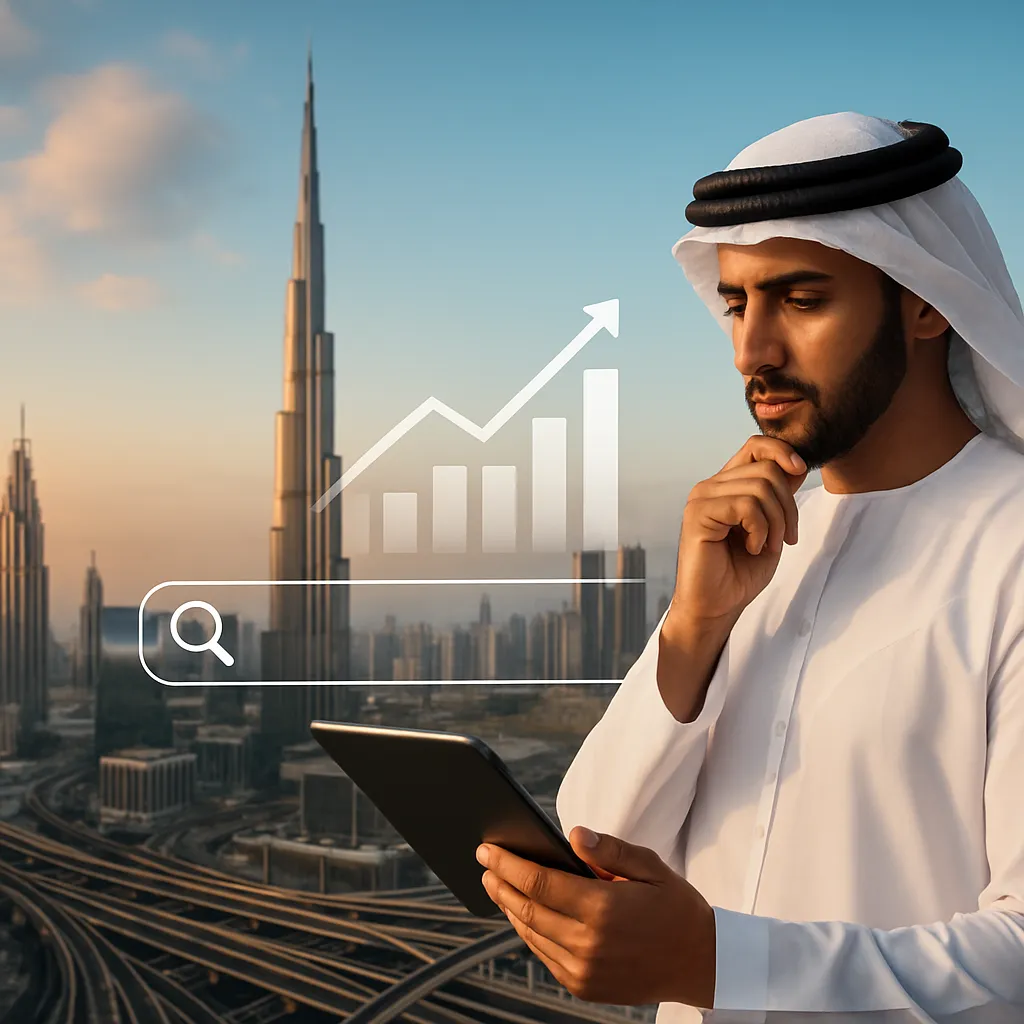
How Dubai’s Economy Shapes Search Demand
Dubai’s spectacular economic ascent has not only redrawn global trade routes, it has also reshaped how people search online, what they search for, and how brands must think about digital visibility. The city’s role as a logistics hub, luxury destination, financial center and innovation lab turns search engines into a real-time mirror of economic shifts. Understanding this connection between macroeconomic forces and micro-level search behavior is now essential for any marketer targeting the Middle East and North Africa (MENA) region.
From Desert Port to Digital Magnet: How Dubai’s Economy Fuels Search Volume
Dubai’s economy is built on diversification. Oil accounts for less than 1% of its GDP, while trade, tourism, aviation, logistics, real estate and financial services drive the rest. This diversification creates a constant stream of new search queries from residents, tourists, investors and workers across more than 200 nationalities.
As the city’s economic engines speed up, they generate distinct clusters of online demand:
- Tourism and hospitality push global users to search for flights, hotels, attractions and experiences.
- Real estate development fuels queries about off-plan projects, mortgages and short-term rentals.
- Free zones and business incentives trigger demand for company setup, visas and professional services.
- Logistics and trade drive searches around warehousing, fulfillment and cross-border shipping.
- Financial services and fintech growth lead to interest in banking, payments, crypto and investment products.
Each of these sectors has a measurable footprint in search data. Dubai’s Department of Economy and Tourism reported that the emirate welcomed roughly 17 million international overnight visitors in 2023, surpassing pre-pandemic levels. That surge translates directly into rising search intent for “Dubai hotels”, “things to do in Dubai”, “Dubai attractions tickets”, and long-tail queries like “best family friendly resorts in Dubai Marina”.
Google data over recent years consistently shows the UAE as one of the global leaders in smartphone penetration, with estimates often above 90% among the adult population. High connectivity, combined with a transient, international population, makes search engines the default interface between people and Dubai’s economy. For marketers, this means that SEO and paid search are not peripheral channels but central tools for capturing economic value created by the city’s growth.
Sector-by-Sector: How Economic Drivers Translate into Search Behavior
Tourism and Hospitality: From Inspiration to Transaction
Dubai invests heavily in tourism infrastructure, from record-breaking landmarks to theme parks, malls and cultural districts. Every new attraction triggers a wave of curiosity online. When the Museum of the Future, Ain Dubai or the latest luxury resort opens, global search data shows sharp spikes in brand- and location-specific keywords.
For travel marketers, this demand is layered:
- Discovery phase: Broad, inspiration-driven queries such as “Dubai vacation”, “Dubai itinerary 5 days”, “Dubai in December weather”.
- Comparison phase: Product-focused searches like “Dubai vs Abu Dhabi holiday”, “best hotels near Burj Khalifa”, “Dubai all inclusive resort reviews”.
- Transaction phase: Highly commercial intent queries such as “cheap flights to Dubai from London”, “Dubai hotel deals”, “Burj Khalifa tickets online”.
The more Dubai’s tourism GDP grows, the more competition intensifies around these search journeys. According to various travel industry reports, online travel bookings in the Middle East are projected to represent well over 40% of total bookings in the coming years. As a result, Dubai-based hotels, tour operators and attractions must invest in:
- Localized landing pages targeting specific source markets (e.g. “Dubai holidays from UK”, “Dubai honeymoon from India”).
- Multilingual SEO in English, Arabic, Russian, German, French and increasingly Chinese.
- Structured data markup to surface rich snippets (reviews, prices, FAQs) in SERPs.
- Optimized pages for meta-search platforms and Google Travel integrations.
Search demand also reflects seasonal and event-driven economic cycles: Ramadan, New Year’s Eve, Dubai Shopping Festival and Expo-related events all create predictable peaks in queries. Savvy marketers build editorial calendars and paid search campaigns around these spikes, aligning offers and content with expected search trends.
Real Estate and Property Investment: High-Value Keywords in a Booming Market
Dubai’s property sector is one of the clearest examples of how macroeconomic dynamics shape search behavior. When prices rise, new master communities launch, or regulations change, search volumes react almost immediately.
Key patterns include:
- High-intent queries: “buy apartment in Dubai Marina”, “off plan projects in Dubai 2025”, “freehold villas in Dubai”.
- Information-focused queries: “Dubai property visa rules”, “Dubai Golden Visa property investment”, “service charges in Dubai”.
- Location-specific long-tail keywords: “3 bedroom townhouse in Arabian Ranches 3 price”, “studio for rent in JVC monthly”.
As of 2023 and 2024, property transaction volumes in Dubai have repeatedly hit record highs, with tens of thousands of sales each quarter and rapidly growing interest from European, Asian and CIS investors. That surge shows up in rising search volumes in multiple languages, often combining Dubai-related terms with home-country financing or legal questions.
For real estate developers, agencies and portals, this environment creates a fiercely competitive performance marketing landscape. Top strategies include:
- Long-form content hubs on investment, tax, visas and neighborhood guides to capture early research intent.
- Hyper-local SEO for specific communities (e.g. “townhouses in Mudon”, “apartments near Dubai Hills Mall”).
- Lead-gen landing pages optimized for speed and mobile conversions, considering that a large share of buyers browse from phones.
- Retargeting flows that connect initial informational searches to later transactional behavior, via search and display.
The value per lead in real estate is high, so keyword CPCs for the most commercial phrases can be expensive in Google Ads. This raises the importance of combining paid search with carefully executed organic content strategies, technical SEO and conversion rate optimization to keep acquisition costs sustainable.
Business, Free Zones and Entrepreneurial Search Demand
Dubai’s economic policy actively encourages company formation. More than 30 free zones cater to different industries, from media and technology to logistics, healthcare and finance. Whenever Dubai introduces new incentives, visas or corporate regulations, search interest spikes around those topics.
Common search themes include:
- “start business in Dubai free zone”, “Dubai mainland vs free zone company”, “lowest cost business setup in Dubai”.
- “freelance visa Dubai requirements”, “Dubai digital nomad visa”, “UAE corporate tax 9% explained”.
- “open bank account in Dubai for company”, “Dubai holding company structure”.
Global entrepreneurs use search engines as their primary research tool before even contacting an agent or consultant. This pushes business setup firms, legal practices, accountants and banks to adopt sophisticated inbound marketing tactics:
- Detailed guides and comparison articles about different free zones and license types.
- Downloadable checklists and calculators (e.g. cost-of-setup estimators) gated behind lead forms.
- Webinars and Q&A pages optimized for high-intent keywords about visas, tax and compliance.
- Remarketing campaigns to nurture leads who made an initial informational query but are not ready to incorporate yet.
The introduction of UAE corporate tax, expansion of long-term residence options like the Golden Visa, and ongoing adjustments to labor and visa rules ensure that search demand in this area is dynamic rather than static. For marketers, the challenge is to monitor regulatory changes and update content quickly, so that articles remain accurate and authoritative in organic rankings.
Digital Infrastructure, Demographics and the Shape of Search Demand
Mobile-First, Instant-Gratification Search Culture
Dubai’s population is young, urban and highly connected. Reports frequently cite UAE internet penetration above 99%, and mobile broadband speeds among the fastest worldwide. This environment shapes how people search:
- Most queries are made on mobile devices, often on the go, with location intent (e.g. “coffee shop near me”, “24h pharmacy Dubai”).
- Voice search adoption increases on Arabic-enabled and English-speaking devices, leading to more conversational queries.
- Users expect extremely fast loading times; slow sites suffer high bounce rates and weaker engagement metrics.
For businesses, mobile-first optimization is not optional. Core Web Vitals, responsive design, click-to-call features and map integration are crucial, especially in local commerce. Restaurants, clinics, salons, gyms and other service businesses must invest in:
- Accurate and optimized Google Business Profiles with reviews, photos, menus and booking links.
- Schema markup for local business, events and products.
- Localized ads and landing pages that highlight proximity, opening hours and instant reservation options.
Dubai’s density of shopping malls and retail complexes also shapes search. Omnichannel behavior is common: users stand inside a mall and search for promotions, store locations or product availability before walking to a shop. That fusion of offline and online demand makes analytics integration between digital campaigns and in-store performance increasingly important.
Multilingual Search: Arabic, English and Beyond
With expatriates making up roughly 85–90% of the population, Dubai’s search landscape is inherently multilingual. English and Arabic dominate, but Russian, Hindi, Urdu, French, Chinese and other languages also appear in query data.
This creates several marketing implications:
- Brands cannot rely on a single language strategy if they target both residents and tourists.
- Search engines handle transliteration and mixed-language queries (e.g. “شقة for rent Dubai” combining Arabic and English) which complicates keyword research.
- User intent may vary by language: for example, Arabic queries might skew more towards public services, religion or local culture, while English queries might lean towards business, tourism and expat services.
Effective multilingual SEO in Dubai requires:
- Proper hreflang tags and language-specific URLs.
- Native-level copywriting to match cultural context and search patterns, not just direct translation.
- Separate keyword sets for each language, based on real query data from tools and search console.
Platforms like YouTube, which has high usage in the UAE, add another layer of search demand. Video search optimization for both Arabic and English content is critical in travel, real estate, education and entertainment sectors. Titles, descriptions, transcripts and thumbnails all influence how Dubai-related content surfaces in video results.
Emerging Trends: Data, AI and the Future of Search in Dubai’s Economy
From Keyword Lists to Intent Modeling
As Dubai’s economy matures, simple keyword lists are insufficient to capture the complexity of search behavior. Users often start searches with vague intent («moving to Dubai», «is Dubai expensive», «business in UAE») that gradually crystallizes into specific needs.
Leading marketers are shifting towards analytics-driven intent modeling:
- Mapping user journeys across multiple sessions and channels: search, social, email, WhatsApp and offline touchpoints.
- Segmenting audiences by stage (awareness, consideration, decision, retention) and customizing content for each.
- Using CRM data and call tracking to link specific search terms with real revenue outcomes.
In real estate, for example, a user may begin with “moving to Dubai cost of living”, then search “schools in Dubai”, then “3 bedroom apartment for rent in Dubai Marina”. Each query signals an evolving intent, and marketing automation tools can react with appropriate messages and retargeting ads.
AI-Enhanced Search and Local Personalization
AI is increasingly woven into search algorithms and ad platforms. In a city like Dubai, where economic sectors and demographics are diverse, AI-powered tools help uncover patterns that manual analysis would miss.
Key opportunities include:
- Predictive bidding in paid search that adjusts budgets based on seasonality, events and device behavior.
- Dynamic ad creatives that swap headlines and descriptions according to user profiles and prior interactions.
- AI content generation as a drafting aid for location pages, FAQs and product descriptions, followed by human editing for quality and compliance.
However, the regulatory and reputational environment requires caution. Financial, medical and legal sectors in Dubai must adhere to strict compliance rules, making human oversight indispensable. Search engines themselves emphasize credibility and expertise signals, especially for “Your Money or Your Life” topics such as investments, tax, healthcare or immigration. Brands that rely solely on generic or low-quality AI content risk losing trust and visibility.
Search Beyond Google: Marketplaces, Social and Super Apps
While Google has dominant market share in the UAE, Dubai’s economic structure pushes many searches into vertical platforms and apps:
- E-commerce and retail queries shift to marketplaces and grocery apps used widely in the city.
- Property searches move to leading portals and brokerage platforms.
- Food discovery and local services rely heavily on delivery and booking apps.
- Job and recruitment searches often start on LinkedIn and specialized job portals.
These platforms have their own internal search algorithms, ad formats, and optimization techniques. For Dubai-focused marketers, “search demand” now means more than just Google keywords; it includes:
- Optimizing product titles, descriptions and metadata for marketplace search.
- Managing reputation and ratings that influence ranking in app-based search results.
- Running sponsored listings and in-app promotions timed to local pay cycles and events.
Social search is also rising. Users increasingly type “Dubai brunch”, “Dubai co-working space” or “Dubai beach club” directly into Instagram, TikTok or YouTube. That shift forces brands to treat visual content and short-form video as integral parts of their search strategy, not merely awareness tools.
Strategic Takeaways for Marketers Targeting Dubai
Dubai’s economy and its search demand are tightly intertwined. As the city pushes into new industries—clean energy, advanced technology, global finance—the online questions people ask will continue to evolve. Brands that succeed in this market typically:
- Align keyword research with sector-specific economic trends and government initiatives.
- Invest in multilingual, mobile-first and video-first content to meet users where they are.
- Blend SEO, paid search, marketplace optimization and social search into a single strategy.
- Use data and analytics to link search behavior with real business outcomes, refining campaigns continuously.
Above all, Dubai rewards agility. Economic policies are updated quickly, new attractions and districts appear frequently, and global sentiment around travel, investment and migration can change in weeks. Search engines reflect these shifts almost in real time. Marketers who track and respond to those signals gain a significant competitive edge in turning Dubai’s economic momentum into measurable digital results.