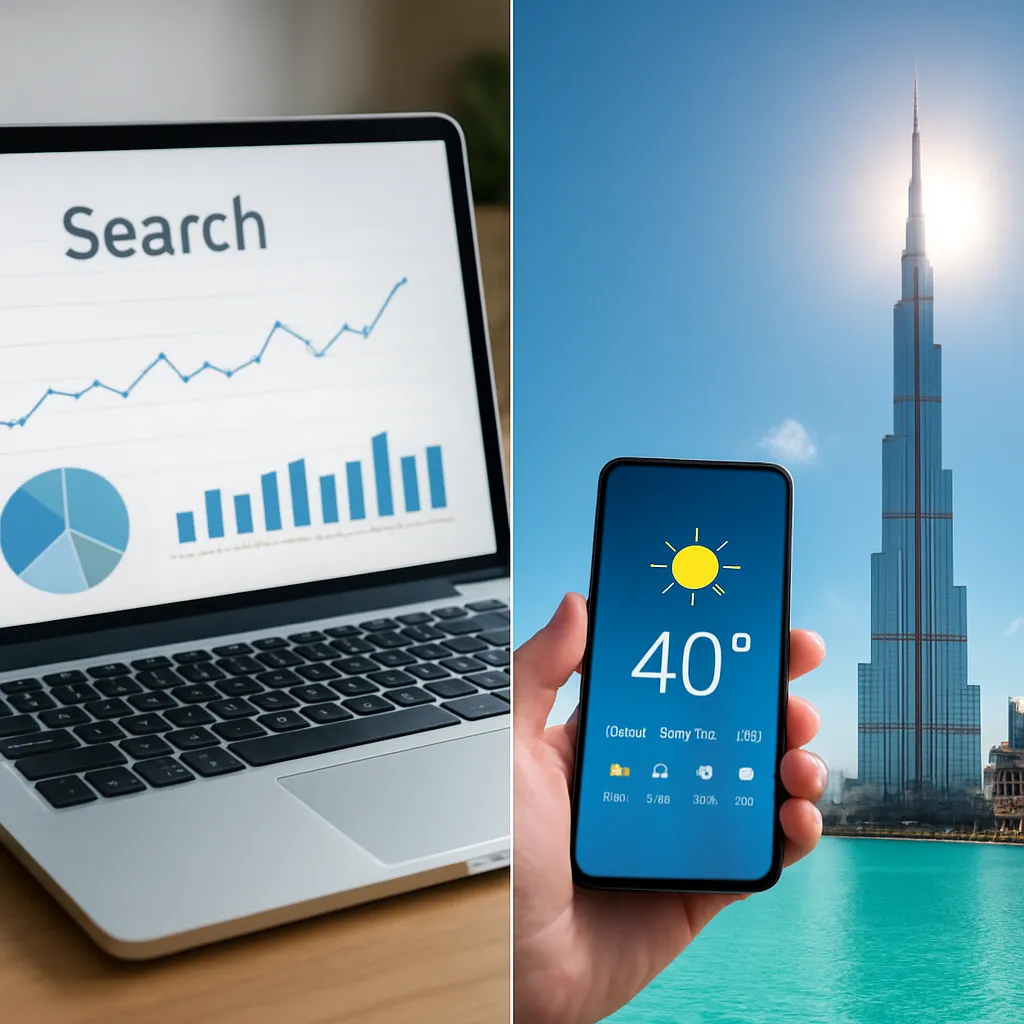
How Dubai Weather and Seasons Influence Search Trends
Understanding how Dubai’s extreme weather and distinct seasons shape online behaviour is crucial for any brand that wants to win in this market. The Emirate’s calendar is not only defined by public holidays, but also by phases of intense heat, more pleasant winter months, sandstorms and humidity spikes that all leave a visible footprint in search data. For digital marketers, these patterns are a roadmap: they reveal when residents are most likely to search for travel deals, air conditioning maintenance, indoor activities, fashion, fitness or real estate, and how advertising messages should be adapted throughout the year.
Climate, Lifestyle and Search Intent in Dubai
Dubai has a subtropical desert climate with two dominant seasons: a long, very hot summer (roughly May to September) and a mild, pleasant winter (October to April). Average daytime temperatures can soar above 40°C in August, while evenings in January may dip below 15°C. This contrast deeply influences people’s routines, and in turn, their search behaviour.
During the hottest months, residents and tourists shift from outdoor to indoor activities. Searches for indoor entertainment, shopping malls, streaming services and e‑commerce retailers climb as people stay inside air‑conditioned environments. In the cooler season, the pattern reverses: users look for outdoor brunches, desert safaris, beach clubs and sports events. These cyclical shifts are reflected in Google Trends data, where queries like “Dubai outdoor activities” or “rooftop restaurant Dubai” peak between November and March, while “indoor activities Dubai” or “Dubai mall” rise sharply in July and August.
Beyond comfort or leisure, heat and humidity also affect key verticals such as health, home services and automotive. Searches for “heat rash treatment,” “dehydration symptoms,” “AC repair Dubai” and “car window tinting” are typically higher in summer, reflecting the population’s attempts to cope with the climate. A study published by Think with Google on Gulf Cooperation Council (GCC) markets reported that weather-sensitive categories in the region can see search volumes fluctuate by more than 30–40% between peak and off‑peak seasons, a trend clearly visible in Dubai.
The city’s economic profile amplifies these patterns. Dubai is a hub for tourism, real estate, luxury retail and events — industries that naturally respond to shifts in temperature and visitor flows. When the high tourist season arrives in winter, global searches for “Dubai holidays,” “Dubai New Year’s Eve” and “Dubai Expo” (during Expo 2020) soar. At the same time, local searches for job opportunities, relocation guidance and property rentals ramp up as new residents arrive in the cooler months, when moving and settling is more comfortable.
Seasonal Search Trends Across Key Industries
For marketers, the real value lies in breaking down how Dubai’s weather and seasons impact specific industries. By understanding the nuances of each sector, brands can adjust their search engine optimization, paid search campaigns and content calendars to capture demand exactly when it spikes.
Travel and Tourism: High Season in the Cooler Months
Dubai’s tourism high season runs from roughly November to March. The milder weather, paired with major events such as the Dubai Shopping Festival (usually January–February), Art Dubai, Dubai World Cup and various New Year celebrations, drives a global surge in travel‑related searches. Queries like “flights to Dubai,” “Dubai packages,” “Dubai hotels,” “Dubai yacht rental” and “desert safari Dubai” tend to achieve their annual peaks in December and January, according to historic Google Trends charts.
Several travel analytics firms have reported that inbound search interest for Dubai can rise by 50–70% between low‑season (peak summer) and high‑season months. Even without exact figures for every year, the pattern is consistent: European and Russian users, for instance, are more likely to search for winter sun destinations, including Dubai, when temperatures drop at home. This seasonality impacts not only organic search but also paid search strategy, as competition for keywords like “Dubai hotel deals” intensifies around public holidays such as Christmas, New Year’s and Chinese New Year.
Local weather anomalies reinforce these cycles. Occasional rainstorms or cooler weeks in December often trigger spikes in branded hotel and attraction searches, as residents seize the opportunity to book staycations and outdoor experiences. On the flip side, during the intense summer, there is a notable shift in search terms: “Dubai summer offer,” “Dubai staycation deals,” “indoor waterpark Dubai” and “kids activities indoor” reflect demand for discounted escapes and air‑conditioned entertainment.
For travel and hospitality brands, this means content and bidding strategies must be tightly aligned with the seasonal calendar. Landing pages focused on beach clubs, rooftop bars and open‑air attractions should be prioritized and heavily promoted in winter, while summer campaigns can highlight spa packages, mall‑based experiences and indoor theme parks. Dynamic search ads and weather‑triggered campaigns — for example, increasing bids when temperatures cross a certain threshold — allow real‑time responses to sudden heatwaves or rare cool spells.
Retail and E‑commerce: Heat‑Driven Demand for Comfort and Convenience
Dubai is one of the most developed retail markets in the Middle East, with enormous malls and a rapidly growing e‑commerce sector. Weather plays a significant role in shaping how and when people shop. In the summer, the combination of extreme temperatures and attractive in‑mall promotions encouraged by campaigns like Dubai Summer Surprises pushes footfall toward indoor shopping centres, but at the same time, online retail sees a spike as people prefer to order from home rather than move between stores in the heat.
E‑commerce platforms frequently report double‑digit percentage growth in traffic and sales during late summer campaigns. While hard statistics vary by retailer, global research from Google and Bain & Company has suggested that in the Middle East and North Africa, more than 70% of online purchases are influenced by search. In a city like Dubai, where smartphone penetration exceeds 90%, seasonal search trends around “same day delivery Dubai,” “grocery delivery,” “AC units price Dubai” and “air cooler online” are particularly pronounced from May through September.
Fashion and beauty categories show their own weather‑linked patterns. Searches for “summer dresses Dubai,” “linen shirts UAE,” “sunscreen SPF 50” or “humidity proof hair products” cluster around late spring as residents prepare for the hotter months. Later in the year, in October and November, there is a sharp pivot to “winter jackets Dubai,” “cardigan,” “boots UAE” and “winter perfume,” even though winters remain relatively mild. Retailers often align their local content calendars to these shifts — publishing blog posts, product guides and lookbooks that emphasize heat‑resistant fabrics and UV protection in spring, then layering and festive wear in autumn.
Promotional peaks such as Ramadan, Eid, Singles’ Day (11.11) and Black Friday overlap with weather phases, compounding their effects. During Ramadan, which shifts across the Gregorian calendar, late‑night browsing and mobile searches increase. If Ramadan falls in the warmer months, there is typically higher search interest in air conditioning, hydrating skin care and comfortable modest clothing. Savvy marketers map these overlapping cycles — religious, retail and weather — to determine content themes, ad copy variations and remarketing schedules that resonate with user intent at each moment.
Real Estate and Home Services: Moving, Cooling and Comfort
Dubai’s property market is intensely dynamic, with residents frequently moving between communities and new projects launching year‑round. Weather exerts a subtle but important influence on real estate search behaviour. Many people prefer to plan relocations or home renovations during cooler months, when site visits, house viewings and physical moves are more manageable.
As a result, search queries such as “apartments for rent in Dubai,” “villa for rent Dubai,” “Dubai real estate agents” and “mortgage calculator UAE” often see uplift in Q4 and Q1. Portal data from leading UAE property websites has repeatedly shown higher user engagement in winter, with more inquiries sent to agents and longer browsing sessions. From an SEO perspective, this is when localized landing pages, neighborhood guides and investment reports have the greatest chance of attracting and converting organic traffic.
Meanwhile, weather‑sensitive home services follow a very different rhythm. In late spring and through summer, there is a clear spike in searches for “AC repair Dubai,” “AC cleaning,” “AC installation,” “water tank cleaning,” “pest control Dubai” and “insulation services.” Many service providers report that more than half of their annual leads are generated between May and September, driven almost entirely by climate pressure.
Marketers in this vertical use predictive models based on historical search data and temperature records to anticipate demand peaks. For instance, when the first heatwaves approach 40°C, they scale up pay‑per‑click budgets, push promotional messaging (free inspection, same‑day service or emergency support) and ensure their Google Business Profile listings are fully optimized. Content pieces like “How to prepare your AC for Dubai summer” or “Energy‑saving tips for UAE homes” are scheduled for publication in March or April to capture early searchers before competitors ramp up their campaigns.
Furniture and interior décor also exhibit weather‑linked behaviour. During hot months, interest often grows for blackout curtains, smart thermostats, energy‑efficient lighting and indoor plants, all of which help improve comfort indoors. Content marketing that connects lifestyle aspirations (a stylish, cool home retreat) with practical benefits (lower DEWA bills, better sleep) tends to perform well, especially if combined with search‑optimized guides and video tutorials.
Health, Fitness and Wellness: Navigating Heat and Outdoor Seasons
Physical activity patterns in Dubai are highly seasonal. In winter, many residents embrace running events, outdoor bootcamps, cycling tracks and beach workouts. This is reflected in search trends: queries for “fitness classes Dubai,” “outdoor gym Dubai,” “Dubai marathon,” “yoga on the beach” and “hiking UAE” typically rise from October and peak between January and March.
By contrast, in summer, there is a shift towards indoor and low‑intensity options such as “indoor gym,” “swimming pool membership,” “Pilates studio,” “online fitness program” and “healthy meal plan delivery.” At the same time, health‑related searches linked to heat stress grow more common: “heat stroke symptoms,” “sunburn treatment,” “hydration tips,” “best sunscreen Dubai” and “electrolyte drink” often trend upwards between June and August.
Digital marketers in the health and wellness sector use these patterns to tailor their offers. Clinics and hospitals schedule campaigns on heat‑related health risks in early summer, using content hubs rich in search‑optimized articles and FAQs. Fitness brands adjust their visuals and messaging to feature sunrise or night workouts during hot months, while in winter they emphasize midday outdoor classes and community events. Influencer collaborations also follow the weather: in cooler months, local influencers share desert camping trips and trail runs, increasing demand for sports gear and wellness retreats through search and social discovery.
Strategic Implications for Digital Marketing in Dubai
Understanding how Dubai’s weather and seasons influence search trends is not only a matter of observation; it can be translated into concrete, measurable marketing actions. From keyword planning and bidding strategies to content calendars and landing page design, every element of digital strategy can benefit from climate‑aware insights.
Seasonal Keyword Research and Forecasting
Effective SEO and PPC campaigns begin with detailed, time‑sliced keyword research. Instead of looking only at average monthly volumes, marketers in Dubai should analyze at least two to three years of search data, comparing performance across summer and winter periods. Tools like Google Trends, Keyword Planner and third‑party platforms make it possible to identify which queries are most sensitive to weather changes and when they typically peak.
For example, a travel agency can distinguish between evergreen searches (“Dubai attractions”) and highly seasonal ones (“Dubai New Year events,” “Dubai winter activities”). Similarly, a marketing team promoting home services can identify that “emergency AC repair” spikes earlier in the year than “AC cleaning package,” prompting them to run awareness campaigns for preventive maintenance before the hottest weeks.
Advanced teams go further by integrating meteorological data into their forecasting models. By correlating historical temperatures, humidity levels and sandstorm alerts with search volumes, they can build predictive dashboards. These dashboards help allocate budget in advance, so that when forecasts predict an unusually harsh summer, additional spend can be reserved for weather‑dependent categories such as air conditioning, indoor entertainment and grocery delivery.
Weather‑Responsive Paid Media Strategies
PPC and display advertising platforms increasingly support automation and conditional rules, which allows brands to adjust bids, creatives and targeting based on real‑time conditions. In Dubai, marketers can implement weather‑based bid adjustments: increasing bids on certain keywords when temperatures surpass a threshold, or decreasing them during cooler periods when demand historically drops.
For instance, a company selling portable AC units can configure its campaigns to boost visibility when official forecasts show upcoming heatwaves, capturing users who are more likely to search for urgent cooling solutions. A food delivery app might push promotions on particularly hot or dusty days, anticipating that more people will stay indoors. Similarly, entertainment brands can rotate ad creatives to feature indoor attractions on extreme heat days and beach or rooftop events when conditions are pleasant.
Programmatic advertising extends this capability across display and video inventory. By layering geo‑location, weather data and audience segments, marketers can serve contextually relevant messages: promoting hydrating skin care products to female users in Dubai when humidity is high, or advertising desert safaris to European tourists browsing from colder climates in winter.
Content and UX Tailored to Seasonal Behaviour
On‑site experience and content strategy must mirror the seasonal shifts revealed by search behaviour. Rather than maintaining static homepages throughout the year, brands operating in Dubai can introduce modular layouts that change emphasis according to the season. In summer, hero banners might focus on indoor offers, cooling appliances or staycations, while winter layouts highlight outdoor events, al fresco dining and adventure sports.
This seasonality should map onto the content hub as well. Articles, guides, landing pages and videos should be planned at least one or two quarters ahead of key weather changes. For example, a comprehensive “Ultimate Guide to Surviving Dubai Summer” published in April can capture inbound links and rankings in time for June and July. A property portal might schedule a “Best Communities for Outdoor Living in Dubai” feature for October, just as residents start exploring neighborhoods with parks, promenades and outdoor pools.
User experience can also be weather‑aware on a more granular level. Smartphone users often search on the go; however, in extreme heat they may be outdoors for only short periods. Streamlined mobile journeys, click‑to‑call buttons and fast‑loading pages are especially important when people search for urgent services from the street, like “car recovery Dubai” in the middle of a heat‑related breakdown. Testing different CTA placements and messaging for summer versus winter can uncover subtle but meaningful increases in conversion rates.
Localisation and Language Nuances
Dubai’s population is highly diverse, with residents from South Asia, the Middle East, Europe, North America and beyond. Weather‑related search terms often cross languages and dialects. A user might type “AC repair near me” in English, “tashteeb mukayyef Dubai” in Arabic transliteration, or a phrase mixing English with Hindi or Urdu. Recognizing these patterns is vital for capturing the full breadth of seasonal demand.
Digital marketers should regularly review search query reports to identify colloquial phrases and misspellings that spike in certain seasons. These queries can inspire dedicated landing pages, FAQ entries or ad groups tailored to specific linguistic communities. For example, during sandstorm season, some users may search for less formal terms or brand‑driven expressions when looking for car wash and detailing services; incorporating these organically into content helps improve relevance and click‑through.
Moreover, visitors from cooler countries may show different intent when searching weather‑related terms. A European tourist searching “Dubai weather in February” might be evaluating whether it is warm enough for beach holidays. Ensuring that top‑ranking content not only provides meteorological data but also connects it to recommended activities, clothing and attractions can steer these users towards conversion paths such as booking forms or newsletter signups.
Cross‑Channel Integration and Measurement
Search behaviour does not exist in isolation; it interacts with social media trends, offline campaigns and word‑of‑mouth. In Dubai, major seasonal triggers — like the first cool breeze of October, the opening of beach clubs, or city‑wide sales events — often spread rapidly on Instagram, TikTok and outdoor billboards before users turn to search engines for more information.
Integrated marketing teams track these stimuli and correlate them with search data. When a popular influencer posts about a new open‑air restaurant in winter, marketers monitor brand and generic search terms for related spikes, then adjust budgets and landing pages to capture that interest. During sandstorm alerts, health authorities may issue warnings on television and social channels; pharmacies that have prepared SEO‑optimized content around masks, allergy relief and eye drops can benefit from the ensuing organic searches.
From a measurement standpoint, weather‑adjusted benchmarks are crucial. Comparing summer conversion rates to winter ones without context can lead to misleading conclusions. Instead, teams should build seasonally segmented dashboards, assessing performance against historical data for the same climatic period. This allows them to understand whether they are outperforming or underperforming relative to expected weather‑driven demand, not just against arbitrary monthly goals.
Leveraging Data and Innovation for Competitive Advantage
Dubai’s weather extremes are sometimes perceived as a challenge, but for data‑driven marketers they represent a powerful source of predictable variation. Because temperature changes, humidity levels and seasonal patterns are consistent year after year, brands can develop sophisticated playbooks and automations that respond almost automatically to shifts in climate and the resulting search behaviour.
Building Predictive Models and Dashboards
One advanced approach is to build predictive models that merge historical search data, sales data and detailed weather records. Machine learning algorithms can detect complex relationships between heat indexes and consumer actions, allowing marketers to forecast demand with greater precision than simple year‑over‑year comparisons.
For example, a retailer could identify that when daytime temperatures exceed 42°C for more than three consecutive days, online conversion rates for cooling appliances increase by a specific percentage. Similarly, a tourism board might learn that a drop below 20°C in certain European cities leads to a measurable rise in international searches for “Dubai holidays.” Once these patterns are quantified, dashboards can alert marketing teams to upcoming windows of opportunity, enabling rapid adjustments to campaign bids, budgets and creatives.
Such predictive analytics also support inventory planning and operational decisions. If a food delivery platform can reliably anticipate surges in orders during thunderstorms or sandstorms (when people avoid going outside), they can ensure adequate driver capacity and promotional messaging that highlights reliability and speed of service. In this way, the intersection of weather, search trends and real‑world operations becomes a strategic asset.
Experimentation, Personalisation and Hyper‑Local Targeting
Weather‑aware strategies open up new opportunities for experimentation and personalization. Brands can run A/B tests where the only changing variable is the weather context of the message. For instance, one version of an ad might say “Beat the Dubai heat with our new cooling technology,” while another simply highlights product features. By comparing performance on hot versus mild days, marketers can quantify how much incremental value weather‑specific messaging provides.
Personalisation engines can take this further by delivering different content to users in Dubai compared to visitors searching from abroad. A user in the city experiencing 45°C heat could see homepage banners emphasizing indoor leisure and delivery options, while a user in a colder country sees imagery of sunny beaches and outdoor terraces. Search‑driven retargeting can also incorporate seasonality: remarketing lists built from winter outdoor activity searches can be activated the following year when similar weather conditions and events return.
Hyper‑local targeting becomes particularly interesting in a city like Dubai where micro‑climates exist between coastal and inland areas, and where new neighborhoods emerge rapidly. Weather APIs can provide data specific to small zones, allowing campaigns to adapt to fog near the coastline, high winds in desert suburbs or slight temperature variations. While these differences may seem minor, during marginal weather days they can influence whether residents opt for indoor or outdoor plans, and therefore which keywords they search and which ads they are likely to click.
Ultimately, the interplay between Dubai’s climate, its residents’ lifestyles and their online search behaviour creates a rich field of opportunity for innovative SEO and PPC strategies. By respecting the city’s unique rhythm — from sweltering summers that drive people indoors to vibrant winters filled with outdoor events — marketers can design campaigns that feel timely, relevant and helpful. The brands that succeed will be those that move beyond generic seasonal clichés and instead build precise, data‑backed frameworks that harness weather‑driven insights to inform every aspect of their digital presence.